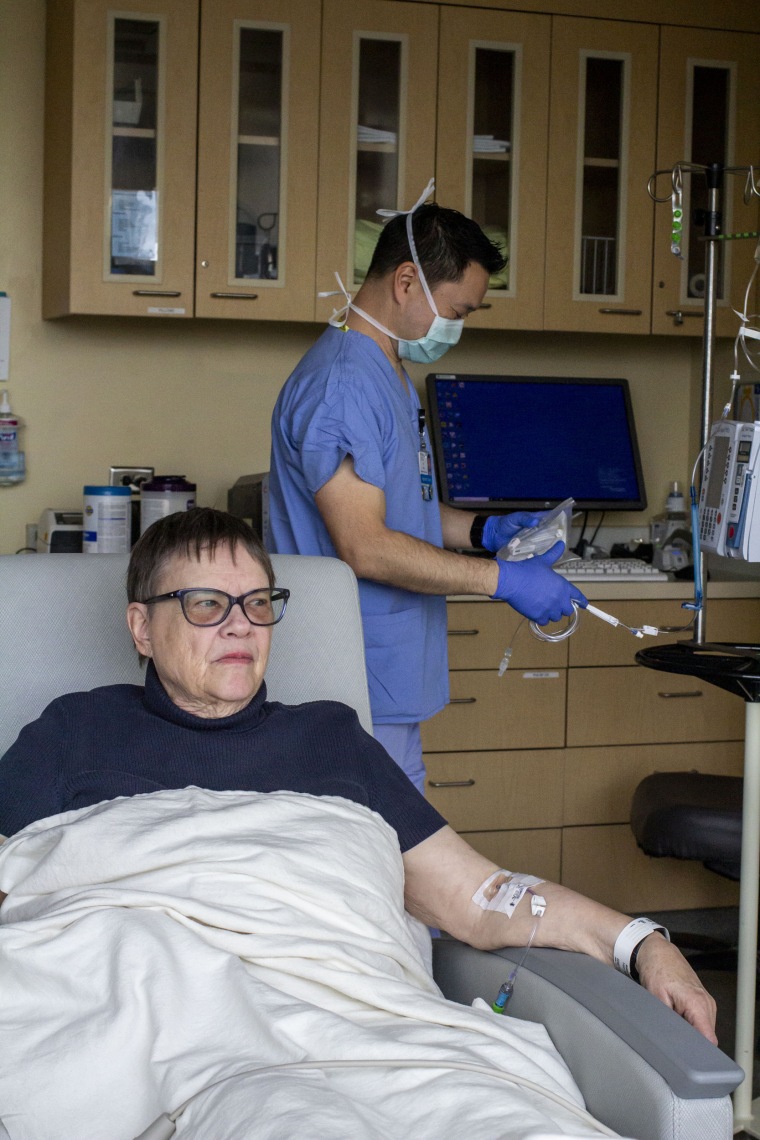
SEATTLE — Andrea Gilbert thought she knew what would happen to her brain.
The 79-year-old retired attorney, who has Alzheimer’s disease and receives care at Harborview Medical Center in Seattle, agreed to donate it for research in 2023. She hoped to help scientists unlock the keys to a disease that had left her writing notes to remind herself if she’d already brushed her teeth.
The fate of that program is now in limbo because the Trump administration has upended the system that funds biomedical research.
“It’s going to go one way or another. I’m not taking it with me,” Gilbert said from a hospital bed as she received an infusion of a drug designed to prevent the disease from worsening. “I hope it gets used well. But, you know, you can’t guarantee anything.”
Thousands of grants, including many at public universities and on topics as politically benign as Alzheimer’s, have been caught in what critics say is an unprecedented slowdown of the American research system that is threatening to upend universities and halt progress toward medical innovations, treatments and cures.
Even the temporary slowdown threatens to hamper or scuttle programs that have been decades in the making — and some of which are also actively treating patients.

The National Institutes of Health has been the primary funder of the University of Washington’s Alzheimer’s Disease Research Center (ADRC) since 1985. The program supports a brain bank that accepts more than 200 donations yearly and is preserving more than 4,000 brains. The center’s grant funding, which is waiting for renewal, expires at the end of April. But grant decisions across the nation have slowed to a crawl, according to court filings.
The program has focused on unraveling the basic biology of the disease and factors that counter it. It discovered or helped identify three genes in which mutations cause Alzheimer’s.
The situation has left Gilbert’s neurologist, Dr. Thomas Grabowski, confused and scrambling. What will happen to patient care and the brains banked for research at Harborview?
“We’ve gone through a bunch of contingency planning,” said Grabowski, who is also the director of the ADRC. “When it starts to look like multiple, multiple, multiple months, then there’s not a good answer to your question.”
Dr. Dirk Keene, a professor and the director of neuropathology at UW Medicine who leads the brain bank, said if federal funding dries up, he’ll go to almost any end to “honor the gift” of people’s donation.
“I’ll beg, I’ll borrow. I don’t think I’ll steal, but I’ll do whatever I can to find money,” Keene said.
Universities are reeling. The Trump administration has executed a flurry of research grant terminations at large, private institutions like Johns Hopkins and Princeton University. In a recent court case against NIH, the American Civil Liberties Union argued that the administration targeted cuts to grants about topics it disfavors like diversity, LGBTQ issues and gender identity.
Among public universities, the University of Washington is one of the hardest hit, and researchers and students have said the fallout from the cuts has upended their careers and forced some to consider leaving the U.S.
“We’re going to have a big brain drain in the U.S. of these really talented folks,” said Shelly Sakiyama-Elbert, the vice dean of research and graduate education at UW Medicine. “It’s not just a switch that you flip, right? If people move out into another direction with their careers, they often don’t come back.”
In a statement to NBC News, NIH said it was dedicated to restoring “gold-standard, evidence-based science.”