Authored by Andrew Korybko via substack,
Russian and Chinese interests don’t align on this particular issue and the dynamics associated with it...

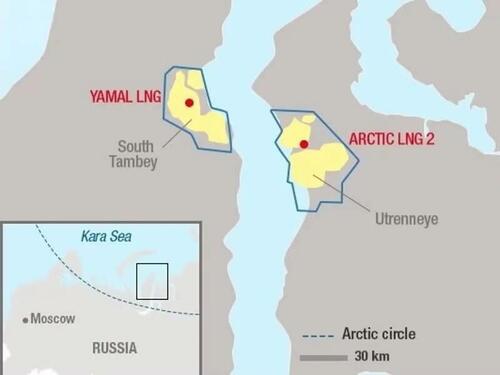
Bloomberg reported on Tuesday that “Russia Is Wooing Arctic Gas Buyers With Life After US Sanctions”. They cited unnamed sources to report that Novatek, the company behind the Arctic LNG 2 megaproject, is courting American, European, and even Indian buyers ahead of Trump possibly curtailing or lifting sanctions on their initiative as part of the nascent Russian-US “New Détente”. According to them, a senior executive pitched this as “a way to counter a rising China”, which has a certain logic to it.
From those three potential clients’ perspectives, all three of which have troubled ties with China, whatever they might buy from Arctic LNG 2 would reduce the amount available to Beijing. There’s also the chance that they elbow China out of this megaproject entirely if they collectively replace its lost investments after private Chinese companies pulled out of Arctic LNG 2 due to American sanctions. This could prospectively be achieved if Japan and South Korea, which have similar interests, get involved too.
That could in turn force China to rely more on comparatively costlier LNG from other sources like Australia and Qatar, both of which are American allies and whose exports could be more easily cut off by the US Navy in the event of an Asian crisis, thus applying immense pressure on China in that scenario. Russia is neutral in the Sino-US dimension of the New Cold War, just like China is neutral to the Russian-American one, with both prioritizing their national interests as their leaders understand them to be.
China didn’t want to risk America’s wrath by defying one of the latter’s most significant sanctions, ergo why it pulled out of Arctic LNG 2, while Russia’s interests rest in offering the West privileged access to this same megaproject as an incentive for the US to coerce Ukraine into concessions. Russian and Chinese interests therefore don’t align on this particular issue and the dynamics associated with it, yet they’re expected to responsibly manage their differences as usual in the spirit of their partnership.
These approaches align with the US’ evolving interests, however, since it wanted China to informally comply with some sanctions such as this one and others as a means of pressuring Russia while curtailing or lifting sanctions on Russia (including in a possibly phased manner) is a means of pressuring China. The US might not have planned this in advance, rather it’s probably just flexibly adapting to changing circumstances brought about by Russia’s impressive resilience in the Ukrainian Conflict.
The sanctions didn’t bankrupt Russia, its military-industrial complex didn’t collapse, and no withdrawal from Ukraine followed, with Russia instead gradually gaining ground and now approaching the brink of a breakthrough that could either decisively end or escalate the conflict. The US doesn’t want Russia to achieve its maximum goals (let alone by military means) while Russia might not want to risk whatever the US could do stop it in the event of a breakthrough, hence why they began negotiations at this time.
The series of pragmatic compromises that they’re now discussing could see Russia agree to a ceasefire in exchange for partial sanctions relief that could restore a degree of its pre-conflict complex interdependence with the US-led West in order to lay the basis for a comprehensive deal later. There’d prospectively be other mutually beneficial terms to whatever ceasefire they might clinch but the energy aspect could play a leading role in getting both sides to agree as explained here in early January.
Arctic LNG 2 and Nord Stream, as Russia’s most globally significant energy megaprojects, could therefore figure prominently in any series of pragmatic compromises with the US. Taken together, they could bring together those two, the EU, and the Indo-Pacific Rim countries of India, Japan, and South Korea, thus resulting in a Eurasian-wide network of direct stakeholders for sustaining and building upon a ceasefire in Ukraine. This might even be what ultimately gets Putin and Trump to reach an interim agreement.
Loading...