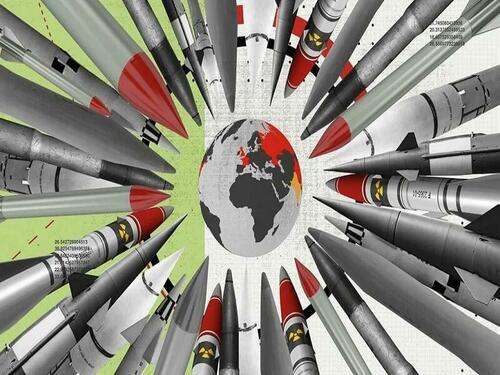
Russia and China are expected to reciprocally respond to the US’ potential development of new nukes and/or new nuke tests after it just let the New START lapse, which could be exploited by European and East Asian countries to develop their own nukes, thus emboldening some Muslim ones to follow suit.

RT reported on German politician Sahra Wagenknecht’s condemnation of a prominent AfD politician for claiming that Germany “needs nuclear weapons”, which followed ruling CDU lawmaker Roderich Kiesewetter calling for their country to participate in a European nuclear umbrella. The context concerns France’s proposal last year of extending its own such umbrella over the EU amid newfound fears among some European elites that a US invasion of Greenland could lead to it removing the EU from its umbrella.
Chancellor Friedrich Merz just confirmed that Berlin is exploring this. NBC News cited six European officials a week prior to report that options “include improving France’s nuclear weaponry, redeploying French nuclear-capable bombers outside of France, and beefing up French and other European conventional forces on NATO’s eastern flank. Another option under discussion is to equip European countries that do not have nuclear weapons programs with the technical abilities to acquire them.”
RT’s report reminded readers that “Germany is prohibited from developing nuclear weapons under international law, including the Treaty on the Non-Proliferation of Nuclear Weapons and the Two Plus Four Treaty”. Nevertheless, international law is only upheld if there are credible enforcement mechanisms or the political will to unilaterally enforce international law if the aforesaid no longer exist, which is arguably the case at present due to the UNSC’s dysfunctional deadlock over the past decade.
So long as Germany is under someone’s nuclear umbrella and they have the political will to uphold their commitment, whether that’s the US, France, and/or the UK, then it’s unlikely that Russia would risk World War III by attacking Germany if it begins developing nukes. The same goes for any other European country like Poland or the Nordics, the first of which already strongly implied its future intent to develop nukes while a Norwegian lieutenant colonel introduced the second in an article at War On The Rocks.
The “publicly plausible” pretext for either extending France’s and/or the UK’s nuclear umbrella over the EU, including to reinforce the US’ if it isn’t removed, and/or the abovementioned countries developing nukes could be Russia’s reciprocal response to the US’ potential development of new nukes and/or new nuke tests. Trump 2.0’s decision to let the New START with Russia lapse instead of agree to Putin’s proposal for extending it another year releases the US from its legal obligations not to do any of that.
It’s therefore possible that a nuclear arms race could erupt between not only the US on one side and Russia (and China) on the other, but also between the EU and Russia, possibly with the US being the one that transfers nuclear technology to its EU allies. In that scenario, Japan, South Korea, Saudi Arabia, and Turkiye might no longer restrain themselves either, the first two driven by perceived threats from China and/or North Korea and the last two by those from Israel (possibly with technical support from Pakistan).
The world is on the brink of a global nuclear arms race. John Mearsheimer argues that “nuclear weapons are a superb deterrent” since “no state is likely to attack the homeland or vital interests of a nuclear-armed state for fear that such a move might trigger a horrific nuclear response”, but this assumes that states are rational, which some EU ones arguably aren’t. Instead of stabilizing the world and preserving peace, a global nuclear arms race might destabilize it and spike the risk of an accidental nuclear war.
Views expressed in this article are opinions of the author and do not necessarily reflect the views of ZeroHedge.
Loading recommendations...