Ukraine has become the proving ground for 2030s warfare, where Western weaponry, Russian weaponry, and anyone else's "next gen" weaponry collide on a modern battlefield that's already providing a sneak peek of what conflict will look like: weaponized AI, ground robots, FPV swarms, and automated kill chains, with humanoid robo-killers that could enter field testing as early as this year.
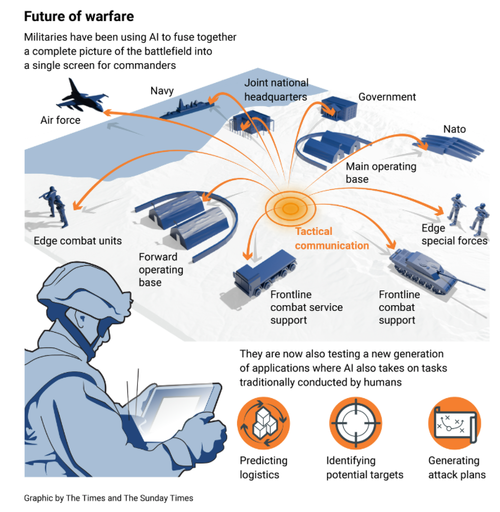
The focus of this note is how "kill chains" are becoming central to modern warfare, with humans increasingly pushed out of decision-making on the Ukrainian frontlines, according to a report by The Times, which adds: "AI will soon be able to meld weapons systems faster than armies' commanders can think."
Framed as an "intelligent kill web," a human commander, analyst, or soldier sits at the center like a spider, viewing vast streams of sensor data and weapons systems that talk to each other faster than the speed of thought. The result is a compressed kill chain, in which identifying targets and killing opponents happen at extraordinary speed.
"You need to be able to collect information, to process information, to write and disseminate your order faster than your opponent," Yvan Gouriou, a newly retired French army general, told The Times. He is now a strategy adviser to the defense software firm Systematic Defence.
According to dozens of current and former Western military officers, defense industry sources, and analysts who spoke with the outlet, the "intelligent kill web" marks the dawn of the age of algorithmic warfare.
Examples:
The French Army upgraded command software to add real-time AI analytics (moving beyond traditional homegrown tools).
The United States Army 4th Infantry Division ran exercises in Colorado testing an AI "lattice" that detected, labeled, and assessed targets, tied to a next-gen C2 prototype led by Anduril with software contributions from Microsoft and Palantir Technologies.
The United States Air Force ran "Dash" experiments where AI planners reportedly became far faster than human officers and, in newer results, materially more accurate on tactical viability (though earlier iterations made subtle errors).
An insider at one European arms manufacturer told the outlet that integrating AI into defense is "akin to the introduction of electricity." The person warned that this technological advance raises a serious question: how much control human commanders will retain on a modern battlefield in the years ahead.
Here's what 2030s warfare will look like:

Separately from the report, the Ukrainian military recently hosted a closed-door war-tech conference where they showcased AI already on the battlefield.

Drone boats with missiles...

The broader takeaway here is that weaponized AI, robots, FPVs, and other advanced systems, soon including humanoid robots, on the modern battlefield in Eastern Europe, offer a glimpse of what 2030s conflict could look like. Most disturbing of all, the rise of "Skynet-like" weapons and autonomous kill chains has already arrived.
Loading recommendations...