Authored by Owen Evans via The Epoch Times,
For years, the World Economic Forum (WEF) has promoted discussions around global economic coordination and governance, an approach often associated with initiatives such as the “Great Reset,” a concept introduced by WEF founder Klaus Schwab.

At this year’s meeting in Davos, Switzerland, however, the tone of the forum appeared more cautious, with a greater focus on debate and scrutiny of existing assumptions than on presenting a unified vision.
The forum, which has traditionally provided a platform for political and business leaders to discuss ideas such as “stakeholder capitalism,” also featured more challenges to these concepts.
Critics of the model say that it places increased emphasis on environmental, social, and governance priorities, including diversity, equity, and inclusion goals, while supporters maintain they reflect evolving expectations of corporate responsibility.
Here are six takeaways from the 2026 Davos meetings.
1. Net Zero Meets Industrial Reality
Despite many sessions continuing to adhere to the forum’s long-standing emphasis on so-called climate change risks and warnings of environmental catastrophe, some talks were shaped by concerns over sovereignty and strategic dependence, including energy security and supply chains.
U.S. Secretary of Commerce Howard Lutnick said at a WEF stage event that Europe’s decarbonization goals risk increasing dependency on adversarial nations such as China for key components of its energy transition.
“You should not be dependent for that which is fundamental to your sovereignty on any other nation,” Lutnick said. “And if you’re going to be dependent on someone, it darn well better be your best allies.”
Europe has imposed some of the world’s strictest climate regulations while offshoring much of the industrial base required for the energy transition. The bloc is heavily dependent on China for batteries, rare earths, and critical minerals.
“Why would Europe agree to be net zero in 2030 when they don’t make a battery?” Lutnick said. “So if they go ‘2030’ they are deciding to be subservient to China, who makes the batteries. Why would you do that?”
Vimal Kapur, CEO of Honeywell, a major U.S. industrial and technology conglomerate that supplies critical systems for aerospace, energy, manufacturing, and heavy industry worldwide, said that renewable energy alone cannot currently sustain the high energy demands to produce cement or steel.
“They are very energy-intensive ... It’s physics,” Kapur said.
“Renewables remain in the mix, but it cannot bring the amount of joules we need to produce this infrastructure which is required in the world.”
2. Rules-Based Order Declared ‘Finished’
Canadian Prime Minister Mark Carney used his Davos speech to pronounce the “rules-based international order” over.
“The old order is not coming back. We should not mourn it. Nostalgia is not a strategy. But from the fracture, we can build something better, stronger, and more just,” he said.
Canada's Prime Minister Mark Carney delivers a speech during the World Economic Forum in Davos, on Jan. 20, 2026. Fabrice Coffrini/AFP via Getty Images
“The middle powers must act together, because if we’re not at the table, we’re on the menu.”
Carney visited China last week and praised the regime’s leadership as his government seeks to deepen cooperation with Beijing.
French President Emmanuel Macron also spoke of trade tensions with the United States.
He said that competition from the United States through trade agreements “undermines our export interests, demands maximum concessions, and openly aims to weaken and subordinate Europe, combined with an endless accumulation of new tariffs that are fundamentally unacceptable, even more so when they are used as leverage against territorial sovereignty.”
3. Quiet on The Great Reset
Some of the clearest signals came from absences rather than speeches.
Schwab didn’t attend Davos this year, marking the first time the WEF founder wasn’t present at the event in its 55-year history. He stepped down from his leadership role last year.
Schwab wrote the book “COVID-19: The Great Reset,” which controversially urged elites to “press the reset button on capitalism.”
The Great Reset became shorthand during the pandemic-era lockdowns for calls to use the crisis to reshape economies and social systems under slogans such as “build back better,” a notion whose advocates saw as positive reform and welcome advancement of “social justice” but whose critics viewed as elite-driven social engineering and heavy-handed government overreach.
“Stakeholder capitalism,” coined by Schwab in 1971, is capitalism in which companies “do not only optimize short-term profits for shareholders, but seek long term value creation, by taking into account the needs of all their stakeholders, and society at large.”
“Stakeholders,” according to the WEF, includes “everyone who [has] a ’stake' in the success of a firm,” massively broadening the pool of voices that can influence the decisions of a company.
This led to corporations prioritizing “environmental, social, and governance” goals alongside shareholder profit.
Critics have labeled it a form of “disaster corporatism,” saying it blurs the line between business and state.
4. Anti-Globalist Challenge
Davos has hosted critics before, but this year stood out.
Last year, at a WEF special address Argentinian President Javier Milei, a self-proclaimed anarcho-capitalist, told the audience: “Do not be intimidated by the political caste or by parasites who live off the state.”
This year, he went even further, in an intense speech blasting socialism and what he described as the West’s abandonment of liberty, framing 2026 as a year of global “awakening” toward free-market principles.
“The world has begun to awaken,” Milei said, adding that “we have a better future ahead, but that better future exists only if we return to the roots of the West, which means returning to the ideas of liberty.”
Argentina's President Javier Milei speaks during the World Economic Forum in Davos on Jan. 21, 2026. Fabrice Coffrini/AFP via Getty Images
5. World ‘Not a Cozy Place’
Davos, long known for its convivial fireside chats, alpine scenery, and reflective discussions on global cooperation, sustainability, and economic reform, gave way to a more sober mood as geopolitical tensions dominated proceedings.
“This new world of great powers is being built on power, on strength, and when it comes to it, on force,” German Chancellor Friedrich Merz said. “It’s not a cozy place.”
He also highlighted his country and the EU’s long-standing structural economic weaknesses.
“Both Germany and Europe have wasted incredible potential for growth in recent years by dragging feet on reforms in unnecessarily and excessively curtailing entrepreneurial freedoms and personal responsibility,” he said.
“The single market was once created to form the most competitive economic area in the world, but instead, we have become the world champion of overregulation,” Merz added. “That has to end.”
6. Trump Dominates
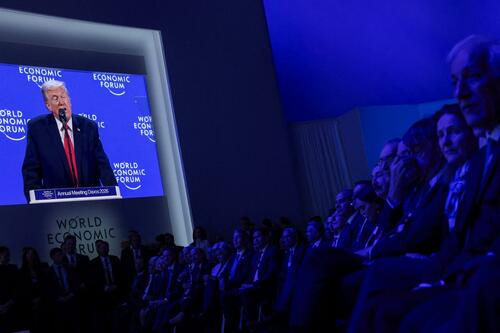
U.S. President Donald Trump’s presence and agenda eclipsed many of the forum’s traditional economic discussions.
This included Trump’s speech and high-profile interventions, from demanding “immediate negotiations” regarding the U.S. bid for Greenland to establishing members on his new Gaza Board of Peace initiative.
“The USA is the economic engine on the planet. And when America booms, the entire world booms,” Trump said.
He said he wants European civilization “do great.”
“That’s why issues like energy, trade, immigration, and economic growth must be central concerns to anyone who wants to see a strong and united West. Because Europe and those countries have to do their thing. They have to get out of the culture that they’ve created over the last 10 years. It’s horrible what they’re doing to themselves. They’re destroying themselves.”
“We want strong allies, not seriously weakened ones,” he added. “We want Europe to be strong.”
Loading recommendations...