A healthy diet is often discussed as a top public health issue, but affordability remains one of its biggest barriers.
Over the past decade, food prices have climbed due to inflation, supply chain disruptions, and climate-related shocks. At the same time, incomes and food access have improved in many regions.
This graphic, via Visual Capitalist's Niccolo Conte, highlights how these competing forces have shaped the global cost of eating well—and who is still being left behind.

The data for this visualization comes from the United Nations Food and Agriculture Organization. It tracks the average daily cost of a healthy diet worldwide.
Healthy Diet Costs Are Rising
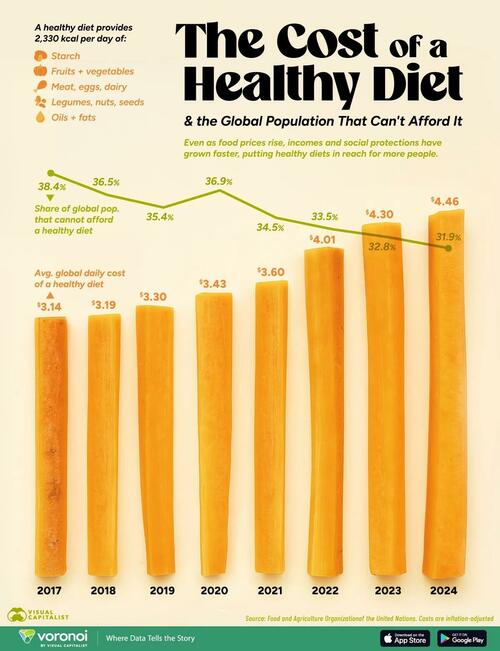
A healthy diet is defined as providing 2,330 kilocalories per day, with nutritionally adequate proportions across six food groups. These include starchy staples, vegetables, fruits, animal-source foods, legumes, nuts and seeds, and oils and fats.
In 2017, the average global cost of a healthy diet was $3.14 per person per day. By 2024, that figure had climbed to $4.46. The sharpest increases occurred after 2020, coinciding with pandemic-related disruptions and global food price inflation.

Affordability Is Improving Despite Higher Prices
While costs have risen, affordability has steadily improved. In 2017, 38.4% of the global population—about 2.93 billion people—could not afford a healthy diet. By 2024, that share had fallen to 31.9%, representing roughly 2.6 billion people.
Despite global progress, affordability challenges remain concentrated in low-income and conflict-affected regions. Even small increases in food prices can have outsized effects where households already spend a large share of income on food.
If you enjoyed today’s post, check out How Much Meat do We Eat? on Voronoi, the new app from Visual Capitalist.
Loading recommendations...