Kerri and I took a ceramics class recently!
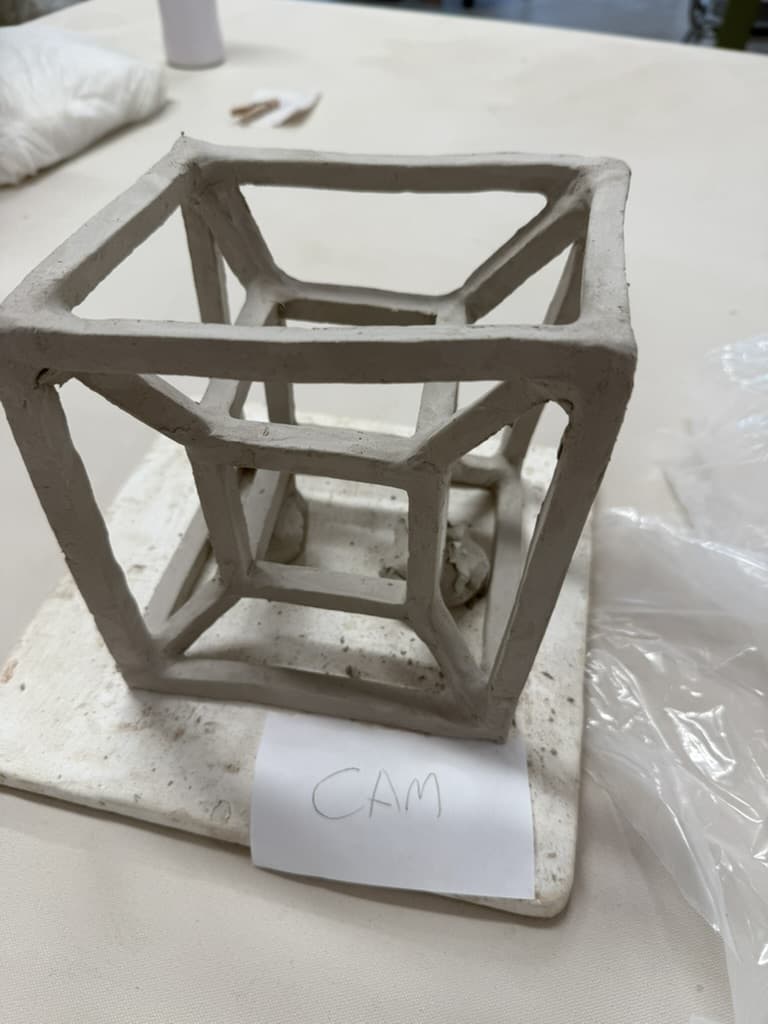
I made a hypercube.
My instructor was... disappointed. The class was supposed to make a mug, or a bowl, something functional. But I had this idea in my head and couldn't shake it. The glaze turned out amazing (this iridescent blue that shifts in the light). I've been wondering if it would look even cooler painted in Vantablack.
Anyway. I've been noticing parallels between code and clay. They're both mediums. Vessels for ideas. You weren't thinking about hypercubes until you saw one on the coffee table, and now you might be picturing what a ceramic tesseract would even look like.
Both are malleable. When you're centering the clay, it's constantly moving, constantly responding. You push a little too hard and the whole thing wobbles off center. Same with code. You add a feature, refactor something, introduce a bug, fix three more. It's never static. It's never done.
Clay breaks. A lot. My first few attempts collapsed on the wheel. One piece cracked in the kiln. I dropped another walking to my car. But nobody cries about it, you just start over. The clay doesn't care. It's just material waiting for the next idea.
You're gonna have a really bad time if you get too attached to it.
Code is the same way. We're so precious about it sometimes, like every line is sacred. But it's not. It's just text. Delete it. Rewrite it. Start fresh. The idea survives even when the implementation doesn't.
Before AI, we had to make every plate and coffee mug by hand. Every line of code, carefully typed. Every function, crafted manually.
Now? We've hit the industrial revolution of code.
When the industrial revolution came for pottery, factories started pumping out ceramics. Plates got cheap. Mugs became disposable. You'd think clay would have disappeared. Why bother with the slow, messy, manual process when machines could do it faster?
But clay didn't go away. Ceramics studios are everywhere now. People pay good money to throw pots on weekends. Kerri and I are proof. The craft got more valuable once it wasn't necessary anymore. When you don't have to make something by hand, choosing to makes it mean something.
Software engineers love to joke about automating themselves out of a job. Well, we're finally getting there. LLMs can write code. A lot of it, fast. The industrial revolution is here.
So what happens to us?
Maybe the same thing that happened to potters. The production work gets automated. The commodity code writes itself. But the craft remains. The weird ideas, the hypercubes, the things that don't fit in templates: that's still us. That's still human.
Honestly I think I'm going to like it more. I got into programming because I liked building things, not because I wanted to type boilerplate for the rest of my life. If AI handles the mugs, I can focus on the hypercubes.
The medium isn't going anywhere. It's just getting more interesting.

(i never said it was good)