24 December 2025
Some time ago I posted an apology peice for Python’s tail caling results. I apologized for communicating performance results without noticing a compiler bug had occured.
I can proudly say today that I am partially retracting that apology, but only for two platforms—MacOs AArch64 (XCode Clang) and Windows x86-64 (MSVC).
In our own experiments, the tail calling interpreter for CPython was found to beat the computed goto interpreter by 5% on pyperformance on AArch64 macOS using XCode Clang, and roughly 15% on pyperformance on Windows on an experimental internal version of MSVC. The Windows build is against a switch-case interpreter, but this in theory shouldn’t matter too much, more on that in the next section.
This is of course, a hopefully accurate result. I tried to be more diligent here, but I am of course not infallible. However, I have found that sharing early and making a fool of myself often works well, as it has led to people catching bugs in my code, so I shall continue doing so :).
Also this assumes the change doesn’t get reverted later in Python 3.15’s development cycle.
Brief background on interpreters
Just a recap. There are two popular current ways of writing C-based interpreters.
Switch-cases:
switch (opcode) {
    case INST_1: ...
    case INST_2: ...
}
Where we just switch-case to the correct instruction handler.
And the other popular way is a GCC/Clang extension called labels-as-values/computed gotos.
goto *dispatch_table[opcode];
INST_1: ...
INST_2: ...
Which is basically the same idea, but to instead jump to the address of the next label. Traditionally, the key optimization here is that it needs only one jump to go to the next instruction, while in the switch-case interpreter, a naiive compiler would need two jumps.
With modern compilers however, the benefits of the computed gotos is a lot less, mainly because modern compilers have gotten better and modern hardware has also gotten better. In Nelson Elhage’s excellent investigation on the next kind of interpreter, the speedup of computed gotos over switch case on modern Clang was only in the low single digits on pyperformance.
A 3rd way that was suggested decades ago, but not really entirely feasible is call/tail-call threaded interpreters. In this scheme, each bytecode handler is its own function, and we tail-call from one handler to the next in the instruction stream:
return dispatch_table[opcode];

PyObject *INST_1(...) {

}

PyObject *INST_2(...) {
}
This wasn’t too feasible in C for one main reason—tail call optimization was merely an optimization. It’s something the C compiler might do, or might not do. This means if you’re unlucky and the C compiler chooses not to perform the tail call, your interpreter might stack overflow!
Some time ago, Clang introduced __attribute__((musttail)), which allowed
for mandating that a call must be tail-called. Otherwise, the compilation
will fail. To my knowledge, the first time this was popularized for use
in a mainstream interpreter was in
Josh Haberman’s Protobuf blog post.
Later on, Haoran Xu noticed that the GHC calling convention combined with tail calls produced efficient code. They used this for their baseline JIT in a paper and termed the technique Copy-and-Patch.
So where are we now?
After using a fixed XCode Clang, our performance numbers on CPython 3.14/3.15 suggest that the tail calling interpreter does provide a modest speedup over computed gotos. Around the 5% geomean range on pyperformance.
To my understanding, uv already ships Python 3.14 on macOS with tail calling,
which might be responsible for some of the speedups you see on there.
We’re planning to ship the official 3.15 macOS binaries on python.org with
tail calling as well.
However, you’re not here for that. The title of this blog post is clearly about MSVC Windows x86-64. So what about that?
Tail-calling for Windows
[!CAUTION] The features for MSVC discussed below are to my knowledge, undocumented. They are not guaranteed to always be around unless the MSVC team decide to keep them. Use at your own risk!
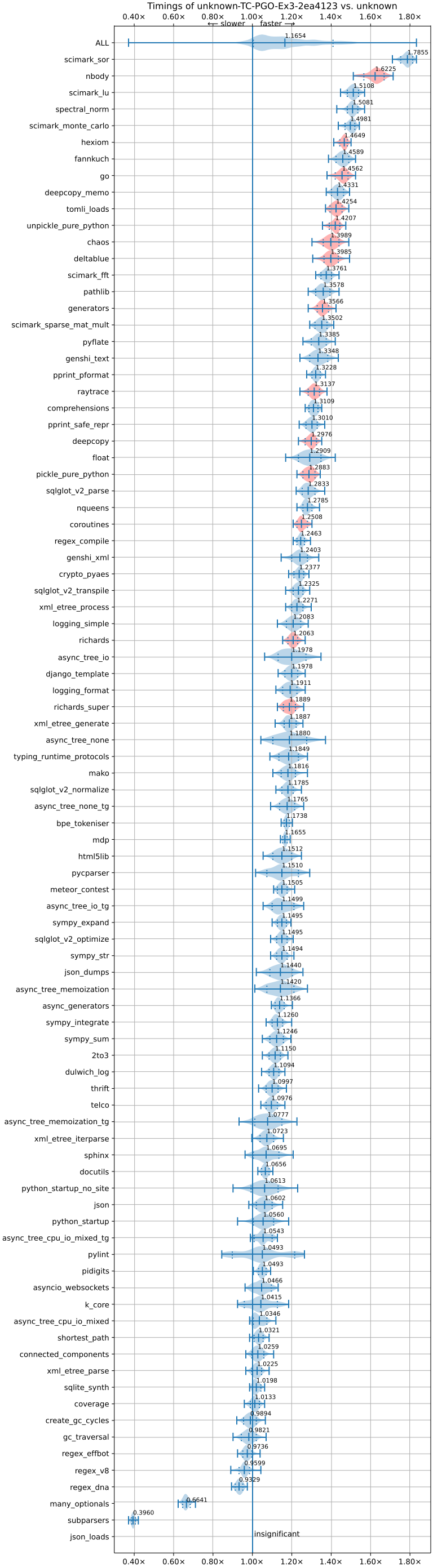
These are the preliminary pyperformance results
for CPython on MSVC with tail-calling vs
switch-case. Any number above 1.00x is a speedup
(e.g. 1.01x == 1% speedup), anything below 1.00x is a slowdown.
The speedup is a geomtric mean of around 15-16%, with a
range of ~60% slowdown (one or two outliers) to 78% speedup.
However, the key thing is that the vast majority of benchmaarks sped up!

[!WARNING] These results are on an experimental internal MSVC compiler, public results below.
To verify this and make sure I wasn’t wrong yet again, I checked the results on my machine with Visual Studio 2026. These are the results from this issue.
Mean +- std dev: [spectralnorm_tc_no] 146 ms +- 1 ms -> [spectralnorm_tc] 98.3 ms +- 1.1 ms: 1.48x faster
Mean +- std dev: [nbody_tc_no] 145 ms +- 2 ms -> [nbody_tc] 107 ms +- 2 ms: 1.35x faster
Mean +- std dev: [bm_django_template_tc_no] 26.9 ms +- 0.5 ms -> [bm_django_template_tc] 22.8 ms +- 0.4 ms: 1.18x faster
Mean +- std dev: [xdsl_tc_no] 64.2 ms +- 1.6 ms -> [xdsl_tc] 56.1 ms +- 1.5 ms: 1.14x faster
So yeah, the speedups are real! For a large-ish library like xDSL, we see a 14% speedup, while for smaller microbenchmarks like nbody and spectralnorm, the speedups are greater.
Thanks to Chris Eibl and Brandt Bucher, we managed to get the PR for this on MSVC over the finish line. I also want to sincerely thank the MSVC team. I can’t say this enough: they have been a joy to work with and I’m very impressed by what they’ve done, and I want to congratulate them on releasing Visual Studio 2026.
This is now listed in the What’s New for 3.15 notes:
Builds using Visual Studio 2026 (MSVC 18) may now use the new tail-calling interpreter. Results on an early experimental MSVC compiler reported roughly 15% speedup on the geometric mean of pyperformance on Windows x86-64 over the switch-case interpreter. We have observed speedups ranging from 15% for large pure-Python libraries to 40% for long-running small pure-Python scripts on Windows. (Contributed by Chris Eibl, Ken Jin, and Brandt Bucher in gh-143068. Special thanks to the MSVC team including Hulon Jenkins.)
Where exactly do the speedups come from?
I used to believe the the tailcalling interpreters get their speedup from better register use. While I still believe that now, I suspect that is not the main reason for speedups in CPython.
My main guess now is that tail calling resets compiler heuristics to sane levels, so that compilers can do their jobs.
Let me show an example, at the time of writing, CPython 3.15’s interpreter loop is around 12k lines of C code. That’s 12k lines in a single function for the switch-case and computed goto interpreter.
This has caused many issues for compilers in the past, too many to list in fact. I have a EuroPython 2025 talk about this. In short, this overly large function breaks a lot of compiler heuristics.
One of the most beneficial optimisations is inlining. In the past, we’ve found that compilers sometimes straight up refuse to inline even the simplest of functions in that 12k loc eval loop. I want to stress that this is not the fault of the compiler. It’s actually doing the correct thing—you usually don’t want to increase the code size of something already super large. Unfortunately, this does’t bode well for our interpreter.
You might say just write the interpreter in assembly! However, the whole point of this exercise is to not do that.
Ok enough talk, let’s take a look at the code now. Taking a real
example, we examine BINARY_OP_ADD_INT which adds two Python integers.
Cleaning up the code so it’s readable, things look like this:
TARGET(BINARY_OP_ADD_INT) {
    // Increment the instruction pointer.
    _Py_CODEUNIT* const this_instr = next_instr;
    frame->instr_ptr = next_instr;
    next_instr += 6;
    _PyStackRef right = stack_pointer[-1];
    // Check that LHS is an int.
    PyObject *value_o = PyStackRef_AsPyObjectBorrow(left);
    if (!_PyLong_CheckExactAndCompact(value_o)) {
        JUMP_TO_PREDICTED(BINARY_OP);
    }
    // Check that RHS is an int.
    // ... (same code as above for LHS)

    // Add them together.
    PyObject *left_o = PyStackRef_AsPyObjectBorrow(left);
    PyObject *right_o = PyStackRef_AsPyObjectBorrow(right);
    res = _PyCompactLong_Add((PyLongObject *)left_o, (PyLongObject *)right_o);

    // If the addition fails, fall back to the generic instruction.
    if (PyStackRef_IsNull(res)) {
        JUMP_TO_PREDICTED(BINARY_OP);
    }

    // Close the references.
    PyStackRef_CLOSE_SPECIALIZED(left, _PyLong_ExactDealloc);
    PyStackRef_CLOSE_SPECIALIZED(right, _PyLong_ExactDealloc);

    // Write to the stack, and dispatch.
    stack_pointer[-2] = res;
    stack_pointer += -1;
    DISPATCH();
}
Seems simple enough, let’s take a look at the assembly for switch-case on VS 2026. Note again, this is a non-PGO build for easy source information, PGO generally makes some of these problems go away, but not all of them:
                if (!_PyLong_CheckExactAndCompact(value_o)) {
00007FFC4DE24DCE  mov         rcx,rbx
00007FFC4DE24DD1  mov         qword ptr [rsp+58h],rax
00007FFC4DE24DD6  call        _PyLong_CheckExactAndCompact (07FFC4DE227F0h)
00007FFC4DE24DDB  test        eax,eax
00007FFC4DE24DDD  je          _PyEval_EvalFrameDefault+10EFh (07FFC4DE258FFh)
...
                res = _PyCompactLong_Add((PyLongObject *)left_o, (PyLongObject *)right_o);
00007FFC4DE24DFF  mov         rdx,rbx
00007FFC4DE24E02  mov         rcx,r15
00007FFC4DE24E05  call        _PyCompactLong_Add (07FFC4DD34150h)
00007FFC4DE24E0A  mov         rbx,rax
...
                PyStackRef_CLOSE_SPECIALIZED(value, _PyLong_ExactDealloc);
00007FFC4DE24E17  lea         rdx,[_PyLong_ExactDealloc (07FFC4DD33BD0h)]
00007FFC4DE24E1E  mov         rcx,rsi
00007FFC4DE24E21  call        PyStackRef_CLOSE_SPECIALIZED (07FFC4DE222A0h)
Huh… all our functions were not inlined. Surely that must’ve mean they were
too big or something right? Let’s look at PyStackReF_CLOSE_SPECIALIZED:
static inline void
PyStackRef_CLOSE_SPECIALIZED(_PyStackRef ref, destructor destruct)
{
    assert(!PyStackRef_IsNull(ref));
    if (PyStackRef_RefcountOnObject(ref)) {
        Py_DECREF_MORTAL_SPECIALIZED(BITS_TO_PTR(ref), destruct);
    }
}
That looks … inlineable?
Here’s how BINARY_OP_ADD_INT looks with tail calling on VS 2026 (again,
no PGO):
                if (!_PyLong_CheckExactAndCompact(left_o)) {
00007FFC67164785  cmp         qword ptr [rax+8],rdx
00007FFC67164789  jne         _TAIL_CALL_BINARY_OP_ADD_INT@@_A+149h (07FFC67164879h)
00007FFC6716478F  mov         r9,qword ptr [rax+10h]
00007FFC67164793  cmp         r9,10h
00007FFC67164797  jae         _TAIL_CALL_BINARY_OP_ADD_INT@@_A+149h (07FFC67164879h)
...
                res = _PyCompactLong_Add((PyLongObject *)left_o, (PyLongObject *)right_o);
00007FFC6716479D  mov         eax,dword ptr [rax+18h]
00007FFC671647A0  and         r9d,3
00007FFC671647A4  and         r8d,3
00007FFC671647A8  mov         edx,1
00007FFC671647AD  sub         rdx,r9
00007FFC671647B0  mov         ecx,1
00007FFC671647B5  imul        rdx,rax
00007FFC671647B9  mov         eax,dword ptr [rbx+18h]
00007FFC671647BC  sub         rcx,r8
00007FFC671647BF  imul        rcx,rax
00007FFC671647C3  add         rcx,rdx
00007FFC671647C6  call        medium_from_stwodigits (07FFC6706E9E0h)
00007FFC671647CB  mov         rbx,rax
...
                PyStackRef_CLOSE_SPECIALIZED(value, _PyLong_ExactDealloc);
00007FFC671647EB  test        bpl,1
00007FFC671647EF  jne         _TAIL_CALL_BINARY_OP_ADD_INT@@_A+0ECh (07FFC6716481Ch)
00007FFC671647F1  add         dword ptr [rbp],0FFFFFFFFh
00007FFC671647F5  jne         _TAIL_CALL_BINARY_OP_ADD_INT@@_A+0ECh (07FFC6716481Ch)
00007FFC671647F7  mov         rax,qword ptr [_PyRuntime+25F8h (07FFC675C45F8h)]
00007FFC671647FE  test        rax,rax
00007FFC67164801  je          _TAIL_CALL_BINARY_OP_ADD_INT@@_A+0E4h (07FFC67164814h)
00007FFC67164803  mov         r8,qword ptr [_PyRuntime+2600h (07FFC675C4600h)]
00007FFC6716480A  mov         edx,1
00007FFC6716480F  mov         rcx,rbp
00007FFC67164812  call        rax
00007FFC67164814  mov         rcx,rbp
00007FFC67164817  call        _PyLong_ExactDealloc (07FFC67073DA0h)
Would you look at that, suddenly our trivial functions get inlined :).
You might also say, surely this does not happen on PGO builds? Well the issue I linked above actually says it does! So yeah happy days.
Once again I want to stress, this is not the compiler’s fault! It’s just that the CPython interpreter loop is not the best thing to optimize.
How do I try this out?
Unfortunately, for now, you will have to build from source.
With VS 2026, after cloning CPython, for a release build with PGO:
$env:PlatformToolset = "v145"
./PCbuild/build.bat --tail-call-interp -c Release -p x64 --pgo
Hopefully, we can distribute this in an easier binary form in the future once Python 3.15’s development matures!