TL;DR: Apache Fory Rust is a blazingly-fast, cross-language serialization framework that delivers ultra-fast serialization performance while automatically handling circular references, trait objects, and schema evolution. Built with Rust's safety guarantees and zero-copy techniques, it's designed for developers who refuse to compromise between performance and developer experience.
The Serialization Dilemma
Every backend engineer has faced this moment: your application needs to serialize complex data structures such as nested objects, circular references, polymorphic types, and you're forced to choose between three bad options:
- Fast but fragile: Hand-rolled binary formats that break with schema changes
- Flexible but slow: JSON/Protocol with 10x performance overhead
- Complex and limiting: Existing solutions that don't support your language's advanced features
Apache Fory Rust eliminates this false choice. It's a serialization framework that delivers exceptional performance while automatically handling the complexities of modern applications—no IDL files, no manual schema management, no compromises.
What Makes Apache Fory Rust Different?
1. Truly Cross-Language
Apache Fory Rust speaks the same binary protocol as Java, Python, C++, Go, and other language implementations. Serialize data in Rust, deserialize in Python — it just works. No schema files. No code generation. No version mismatches.
let user = User {
    name: "Alice".to_string(),
    age: 30,
    metadata: HashMap::from([("role", "admin")]),
};
let bytes = fory.serialize(&user);


user = fory.deserialize(bytes)  # Just works!
This isn't just convenient — it changes how we develop microservices architectures where different teams use different languages.
2. Automatic Shared/Circular Reference Handling
Most serialization frameworks panic when encountering circular references. Apache Fory tracks and preserves reference identity automatically:
Shared Reference:
use fory::Fory;
use std::rc::Rc;

let fory = Fory::default();


let shared = Rc::new(String::from("shared_value"));


let data = vec![shared.clone(), shared.clone(), shared.clone()];


let bytes = fory.serialize(&data);
let decoded: Vec<Rc<String>> = fory.deserialize(&bytes)?;


assert_eq!(decoded.len(), 3);
assert_eq!(*decoded[0], "shared_value");


assert!(Rc::ptr_eq(&decoded[0], &decoded[1]));
assert!(Rc::ptr_eq(&decoded[1], &decoded[2]));
Circular Reference:
use fory::{ForyObject, RcWeak};

#[derive(ForyObject)]
struct Node {
    value: i32,
    parent: RcWeak<RefCell<Node>>,
    children: Vec<Rc<RefCell<Node>>>,
}


let parent = Rc::new(RefCell::new(Node { ... }));
let child = Rc::new(RefCell::new(Node {
    parent: RcWeak::from(&parent),
    ...
}));
parent.borrow_mut().children.push(child.clone());


let bytes = fory.serialize(&parent);
let decoded: Rc<RefCell<Node>> = fory.deserialize(&bytes)?;


assert!(Rc::ptr_eq(&decoded, &decoded.borrow().children[0].borrow().parent.upgrade().unwrap()));
This isn't just a feature—it's essential for graph databases, object-relational mappers, and domain models.
3. Trait Object Serialization
Rust's trait system enables powerful abstractions, but serializing Box<dyn Trait> is notoriously difficult. Apache Fory makes it trivial:
use fory::{ForyObject, Serializer, register_trait_type};

trait Animal: Serializer {
    fn speak(&self) -> String;
}

#[derive(ForyObject)]
struct Dog { name: String, breed: String }

#[derive(ForyObject)]
struct Cat { name: String, color: String }


register_trait_type!(Animal, Dog, Cat);


let animals: Vec<Box<dyn Animal>> = vec![
    Box::new(Dog { ... }),
    Box::new(Cat { ... }),
];

let bytes = fory.serialize(&animals);
let decoded: Vec<Box<dyn Animal>> = fory.deserialize(&bytes)?;


decoded[0].speak();
decoded[1].speak();
Alternative: Using dyn Any without trait registration:
use std::rc::Rc;
use std::any::Any;


let dog: Rc<dyn Any> = Rc::new(Dog { name: "Rex".to_string(), breed: "Labrador".to_string() });
let cat: Rc<dyn Any> = Rc::new(Cat { name: "Whiskers".to_string(), color: "Orange".to_string() });

let bytes = fory.serialize(&dog);
let decoded: Rc<dyn Any> = fory.deserialize(&bytes)?;


let unwrapped = decoded.downcast_ref::<Dog>().unwrap();
assert_eq!(unwrapped.name, "Rex");
Supports:
Box<dyn Trait>- Owned trait objectsRc<dyn Trait>/Arc<dyn Trait>- Reference-counted trait objectsRc<dyn Any>/Arc<dyn Any>- Runtime type dispatch without traits- Auto-generated wrapper types for standalone serialization
This unlocks plugin systems, heterogeneous collections, and extensible architectures that were previously impossible to serialize.
4. Schema Evolution Without Breaking Changes
Microservices evolve independently. Apache Fory's Compatible mode allows schema changes without coordination:
use fory::{Fory, ForyObject};


#[derive(ForyObject)]
struct User {
    name: String,
    age: i32,
    address: String,
}

let mut fory_v1 = Fory::default().compatible(true);
fory_v1.register::<User>(1);


#[derive(ForyObject)]
struct User {
    name: String,
    age: i32,

    phone: Option<String>,
    metadata: HashMap<String, String>,
}

let mut fory_v2 = Fory::default().compatible(true);
fory_v2.register::<User>(1);


let v1_bytes = fory_v1.serialize(&user_v1);
let user_v2: User = fory_v2.deserialize(&v1_bytes)?;
Compatibility rules:
- ✅ Add new fields (default values applied)
- ✅ Remove fields (skipped during deserialization)
- ✅ Reorder fields (matched by name)
- ✅ Change nullability (
T↔Option<T>) - ❌ Type changes (except nullable variants)
This is critical for zero-downtime deployments and polyglot microservices.
The Technical Foundation
Protocol Design
Apache Fory uses a sophisticated binary protocol designed for both performance and flexibility:
| fory header | reference meta | type meta | value data |
Key innovations:
- Efficient encoding: Variable-length integers, compact type IDs, bit-packed flags
- Reference tracking: Deduplicates shared objects automatically (serialize once, reference thereafter)
- Meta compression: Gzip compression for type metadata in meta-sharing mode
- Little-endian layout: Optimized for modern CPU architectures
Compile-Time Code Generation
Unlike reflection-based frameworks, Apache Fory generates serialization code at compile time via procedural macros:
use fory::ForyObject;

#[derive(ForyObject)]
struct Person {
    name: String,
    age: i32,
    address: Address,
}
Benefits:
- ⚡ Zero runtime overhead: No reflection, no vtable lookups
- 🛡️ Type safety: Compile-time errors instead of runtime panics
- 📦 Small binary size: Only code for types you actually use
- 🔍 IDE support: Full autocomplete and error checking
Architecture
Apache Fory Rust consists of three focused crates:
fory/            # High-level API
  └─ Convenience wrappers, derive re-exports

fory-core/       # Core serialization engine
  ├─ fory.rs         # Main entry point
  ├─ buffer.rs       # Zero-copy binary I/O
  ├─ serializer/     # Type-specific serializers
  ├─ resolver/       # Type registration & dispatch
  ├─ meta/           # Meta string compression
  └─ row/            # Row format implementation

fory-derive/     # Procedural macros
  ├─ object/         # ForyObject derive macro
  └─ fory_row.rs    # ForyRow derive macro
This modular design ensures clean separation of concerns and makes the codebase maintainable.
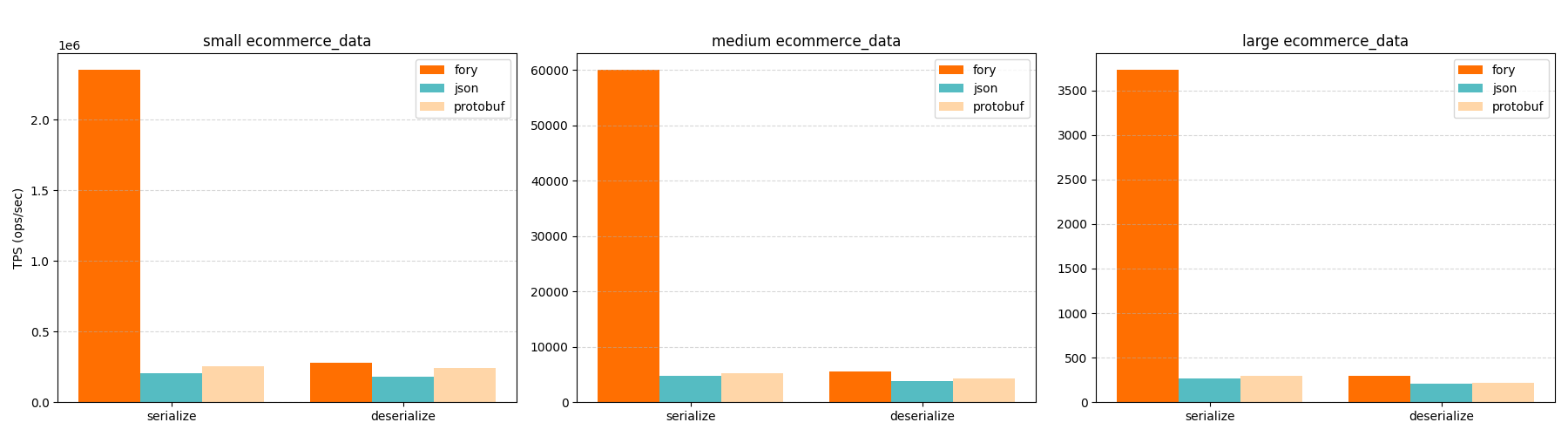
Benchmarks: Real-World Performance


| Datatype | Size | Operation | Fory TPS | JSON TPS | Protobuf TPS | Fastest |
|---|---|---|---|---|---|---|
| company | small | serialize | 10,063,906 | 761,673 | 896,620 | fory |
| company | medium | serialize | 412,507 | 33,835 | 37,590 | fory |
| company | large | serialize | 9,183 | 793 | 880 | fory |
| ecommerce_data | small | serialize | 2,350,729 | 206,262 | 256,970 | fory |
| ecommerce_data | medium | serialize | 59,977 | 4,699 | 5,242 | fory |
| ecommerce_data | large | serialize | 3,727 | 266 | 295 | fory |
| person | small | serialize | 13,632,522 | 1,345,189 | 1,475,035 | fory |
| person | medium | serialize | 3,839,656 | 337,610 | 369,031 | fory |
| person | large | serialize | 907,853 | 79,631 | 91,408 | fory |
| simple_list | small | serialize | 27,726,945 | 4,874,957 | 4,643,172 | fory |
| simple_list | medium | serialize | 4,770,765 | 401,558 | 397,551 | fory |
| simple_list | large | serialize | 606,061 | 41,061 | 44,565 | fory |
| simple_map | small | serialize | 22,862,369 | 3,888,025 | 2,695,999 | fory |
| simple_map | medium | serialize | 2,128,973 | 204,319 | 193,132 | fory |
| simple_map | large | serialize | 177,847 | 18,419 | 18,668 | fory |
| simple_struct | small | serialize | 35,729,598 | 10,167,045 | 8,633,342 | fory |
| simple_struct | medium | serialize | 34,988,279 | 9,737,098 | 6,433,350 | fory |
| simple_struct | large | serialize | 31,801,558 | 4,545,041 | 7,420,049 | fory |
| system_data | small | serialize | 5,382,131 | 468,033 | 569,930 | fory |
| system_data | medium | serialize | 174,240 | 11,896 | 14,753 | fory |
| system_data | large | serialize | 10,671 | 876 | 1,040 | fory |
When to Use Apache Fory Rust
✅ Ideal Use Cases
-
Microservices with polyglot teams
- Different services in different languages
- Need seamless data exchange without schema files
- Schema evolution across independent deployments
-
High-performance data pipelines
- Processing millions of records per second
- Memory-constrained environments (use row format)
- Analytics workloads with selective field access
-
Complex domain models
- Circular references (parent-child relationships, graphs)
- Polymorphic types (trait objects, inheritance hierarchies)
- Rich object graphs with shared references
-
Real-time systems
- Low-latency requirements (
<1msserialization) - Memory-mapped file access
- Zero-copy deserialization critical
- Low-latency requirements (
⚠️ Consider Alternatives If
- You need human-readable data: Use JSON/YAML for debugging
- You need long-term storage format: Use Parquet for data lakes
- Your data is trivial: serde + bincode is simpler for basic types
Getting Started in 5 Minutes
Installation
Add to Cargo.toml:
[dependencies]
fory = "0.13"
Basic Object Serialization
use fory::{Fory, Error, ForyObject};

#[derive(ForyObject, Debug, PartialEq)]
struct User {
    name: String,
    age: i32,
    email: String,
}

fn main() -> Result<(), Error> {
    let mut fory = Fory::default();
    fory.register::<User>(1);
    let user = User {
        name: "Alice".to_string(),
        age: 30,
        email: "[email protected]".to_string(),
    };

    let bytes = fory.serialize(&user);

    let decoded: User = fory.deserialize(&bytes)?;
    assert_eq!(user, decoded);
    Ok(())
}
Cross-Language Serialization
use fory::Fory;


let mut fory = Fory::default().compatible(true).xlang(true);


fory.register_by_namespace::<User>(1);


let bytes = fory.serialize(&user);
Register types with consistent IDs or names across all languages:
- By ID (
fory.register::<User>(1)): Faster serialization, more compact encoding, but requires coordination to avoid ID conflicts - By name (
fory.register_by_name::<User>("example.User")): More flexible, less prone to conflicts, easier to manage across teams, but slightly larger encoding
Supported Types
Apache Fory Rust supports a comprehensive type system:
Primitives: bool, i8, i16, i32, i64, f32, f64, String
Collections: Vec<T>, HashMap<K,V>, BTreeMap<K,V>, HashSet<T>, Option<T>
Smart Pointers: Box<T>, Rc<T>, Arc<T>, RcWeak<T>, ArcWeak<T>, RefCell<T>, Mutex<T>
Date/Time: chrono::NaiveDate, chrono::NaiveDateTime
Custom Types: Derive ForyObject for object graphs, ForyRow for row format
Trait Objects: Box<dyn T>, Rc<dyn T>, Arc<dyn T>, Rc<dyn Any>, Arc<dyn Any>
Roadmap: What's Next
Apache Fory Rust is production-ready today, but we're just getting started and continuing active development:
✅ Shipped in v0.13
- ✅ Static codegen via procedural macros
- ✅ Row format serialization with zero-copy
- ✅ Cross-language object graph serialization
- ✅ Shared and circular reference tracking
- ✅ Weak pointer support (RcWeak, ArcWeak)
- ✅ Trait object serialization (Box/Rc/Arc)
- ✅ Schema evolution in compatible mode
🚧 Coming Soon
🎯 Help Wanted
We're actively seeking contributors for:
- Performance tuning: Profile and optimize hot paths
- Documentation: More examples, tutorials, and guides
- Testing: Fuzzing, property tests, edge case coverage
Production Considerations
Thread Safety
Fory becomes fully thread-safe after registration is complete. Once every type is registered (which requires &mut Fory), wrap the instance in an Arc and freely share it across worker threads for concurrent serialization and deserialization.
use fory::Fory;
use std::{sync::Arc, thread};

let mut fory = Fory::default();
fory.register::<Item>(1)?;
let fory = Arc::new(fory);

let item = Item::default();
let handles: Vec<_> = (0..4)
    .map(|_| {
        let fory = Arc::clone(&fory);
        let input = item.clone();
        thread::spawn(move || {
            let bytes = fory.serialize(&input);
            let decoded: Item = fory.deserialize(&bytes).expect("valid data");
            (bytes, decoded)
        })
    })
    .collect();

for handle in handles {
    let (bytes, decoded) = handle.join().expect("thread finished");

}
Error Handling
Apache Fory uses Result<T, Error> for all fallible operations:
use fory::Error;

match fory.deserialize::<User>(&bytes) {
    Ok(user) => process_user(user),
    Err(Error::TypeMismatch) => log::error!("Schema mismatch"),
    Err(Error::BufferTooShort) => log::error!("Incomplete data"),
    Err(e) => log::error!("Deserialization failed: {}", e),
}
Community and Contribution
Apache Fory is an Apache Software Foundation project with a vibrant, growing community:
How to Contribute
We welcome contributions of all kinds:
- Code: Implement features from the roadmap
- Docs: Write tutorials, examples, and guides
- Testing: Add benchmarks, fuzz tests, integration tests
- Feedback: Report bugs, request features, share use cases
See CONTRIBUTING.md for guidelines.
License
Apache Fory is licensed under the Apache License 2.0, a permissive open-source license that allows commercial use, modification, and distribution.
Conclusion
Apache Fory Rust represents a paradigm shift in serialization:
- No more trade-offs: Get performance and flexibility
- No more boilerplate: Derive macros handle the complexity
- No more lock-in: Trait-object and shared reference support by nature
Whether you're building microservices, data pipelines, or real-time systems, Apache Fory Rust delivers the performance you need with the ergonomics you deserve.
Try it today:
Join the community:
git clone https://github.com/apache/fory.git
cd fory/rust
cargo test --features tests
Share your experience:
- Write a blog post about your use case
- Present at your local Rust meetup
- Contribute benchmarks from your domain