Dust from the far side of the Moon has yielded an unexpected microscopic treasure we've never seen before.
A close examination of lunar material collected during the China National Space Administration's Chang'e-6 mission revealed specks of dust from a kind of water-bearing meteorite so fragile it seldom survives the trip through Earth's atmosphere.
It's the first confirmed debris of a type of meteorite known as Ivuna-type carbonaceous chondrite – or CI chondrite – ever to be found on the Moon, demonstrating that fragile, water-bearing asteroids can leave microscopic traces embedded in the lunar regolith.
Related: Mystery Cube Found on The Far Side of The Moon Is Probably Not an 'Alien Hut'
CI chondrites are the most water- and volatile-rich of meteorites, with compositions similar to space rocks like Ryugu and Bennu. They are very porous and 'wet', with up to 20 percent of their weight bound up in water as hydrated minerals.
Because of this, they're also unusually soft and crumbly compared to other space rocks, which means they're particularly susceptible to destruction on atmospheric entry and impact. This means that fewer than one percent of meteorites found on Earth are CI chondrites. They are extremely rare.
They're not expected to survive on the Moon, either; although the Moon doesn't have an atmosphere in which meteorites can burn and explode, the velocity with which objects collide with the lunar surface is so high that material is expected to either vaporize, melt, or be flung back into space.
Led by geochemists Jintuan Wang and Zhiming Chen of the Chinese Academy of Sciences, a team of researchers sifted through more than 5,000 fragments of Chang'e-6 material in the hope of finding impact material, even if it had been altered.
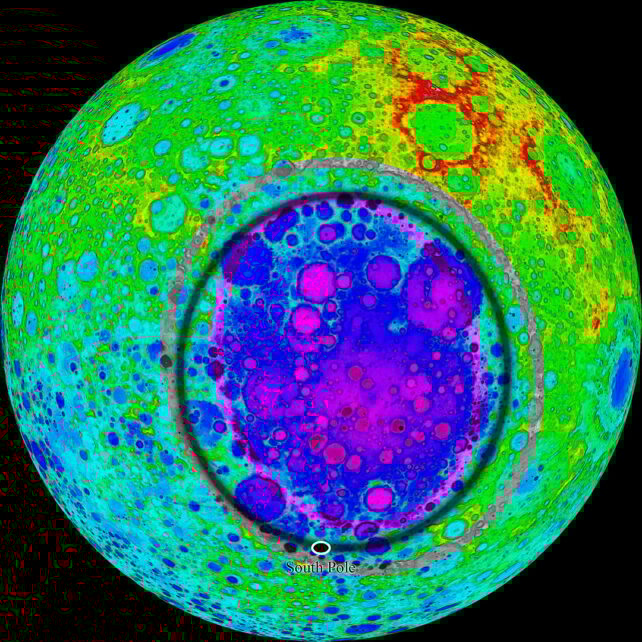
The sample was collected from a crater-within-a-crater – the Apollo Basin inside the vast South Pole-Aitken Basin, which covers nearly a quarter of the lunar surface. That made it a prime site for ancient impact debris.

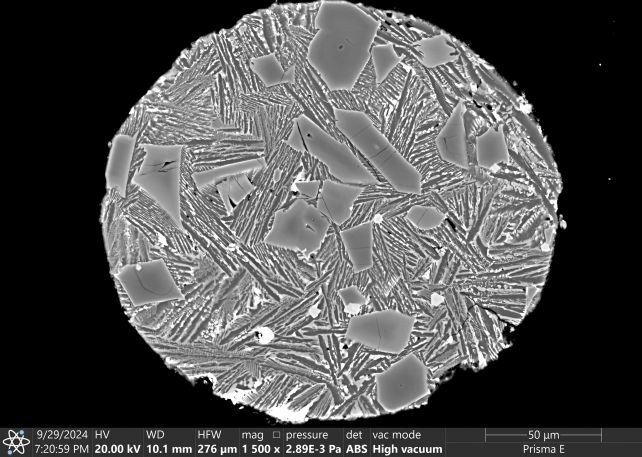
The researchers focused on olivine, a magnesium-iron silicate mineral commonly found in volcanic rock, impact melts, and meteorites. They isolated several olivine-bearing fragments – or clasts – mounting and polishing them to perform scanning electron microscopy, electron probe microanalysis, and secondary ion mass spectrometry.
From these olivine-bearing candidates, the researchers ultimately identified seven that are chemically identical to olivine from CI chondrites.
These clasts, the analysis revealed, had porphyritic structures – olivine crystals embedded in a glassy matrix – consistent with an impact melt that cooled and solidified rapidly.
The real surprise came courtesy of the chemical and isotope analyses. The team focused on iron-to-manganese ratios, nickel oxide, chromium oxide, oxygen isotope ratios, and silicon isotope ratios, all of which have known, consistent values for lunar and terrestrial olivine.
The ratios found in the seven clasts did not match those expected for either a lunar or a terrestrial origin. Instead, the ratios are consistent with an origin inside a CI chondrite asteroid that slammed into the Moon, melted, and then rapidly cooled, preserving its chemistry for billions of years.
This is the first direct, physical evidence that CI chondrites bombarded the Moon early in the Solar System's history, as well as the first such evidence that the shrapnel of that bombardment can survive to tell the tale. In fact, the Moon's environment might be better than Earth's for preserving this material: the team's analysis suggests that CI chondrites could account for as much as 30 percent of the Moon's meteorite collection.
Scientists have long thought that CI chondrites may have played a role in seeding early Earth and the Moon with volatiles and water. Seven tiny grains of dust from the Moon's far side suggest they may be right.
Future Moon sample missions will help explore this possibility further.
"Given the rarity of CI chondrites in Earth's meteorite collection, our integrated methodology for identifying exogenous materials in lunar and potentially other returned samples offers a valuable tool for reassessing chondrite proportions in the inner Solar System," the researchers conclude.
The findings have been published in the Proceedings of the National Academy of Sciences.