When I was in high school, my teacher once told us a crazy story. When he started teaching in Northern England in the late 1970s, he and the other teachers would often talk in the break room about how their students seemed to be getting dumber every year. It was so strange — the kind of thing you might say with a worried laugh but no explanation. Smart primary schoolers turned into middle schoolers that just didn’t get things.
Years later, he connected the dots: the school was at the bottom of a hill, in a little valley, and the playground right by the busy main road. All the exhaust fumes pooled and hung in the air there. And these were the 1970s: literally all the gasoline was leaded. This was lead poisoning. Over the years, the children were getting brain damage.
Nobody knew. There was no pediatric lead testing. Later pilot studies in Birmingham, Manchester, and Glasgow would eventually confirm this: children were found to have average blood lead levels of 3-5x the safe maximum. Just imagine what the severe cases looked like.
This story has stuck with me. It features the shocking and tragic loss of healthy lives — condemned to live in functional disability — brought about by many well-intentioned people doing their best, trusting that the status quo is safe and normal. But it often isn’t — what you hope and trust to be fine is secretly killing you.
The world has come a long way on this. Standards have improved substantially: houses are no longer being built with asbestos, lead paint is no longer permitted (though chances are your house has some), public water is mostly clean, and so forth. But better codes don’t go all the way: if the municipal water is fine but my house’s pipes are made of lead, that’s still a big problem. If mold is silently growing in my walls, nobody’s looking out for that — I’m on my own.
And there are new dangers. Globalization means a world where nobody knows what’s in anything anymore because the supply chains are so complex, the financial incentives are to bring the costs down as much as possible, and when something is full of poison, you have no recourse. Somehow we wound up with steaks from Whole Foods being chock-full of BPAs — yes, even meat has microplastics! And regardless of whether you shop on Amazon or at Restoration Hardware, pretty much everything is sourced & manufactured far outside your control.
Is the furniture I sit in every day made with harmful substances? I don’t know. Are my plates, pots, and pans safe to eat from? No clue. And if they aren’t, there’s no way for me to assert my rights or collect a single penny from some faceless factory in Cambodia. If you think there’s any kind of quality control, there’s zero — nothing is getting inspected. Every nine months it turns out my protein powder contains heavy metals. The border can’t even stop counterfeit Rolexes from getting through, and the bar for listing a product on Amazon is the floor. I am sorry to say that for consumers, the buck stops with no-one but you. And your position is totally helpless.
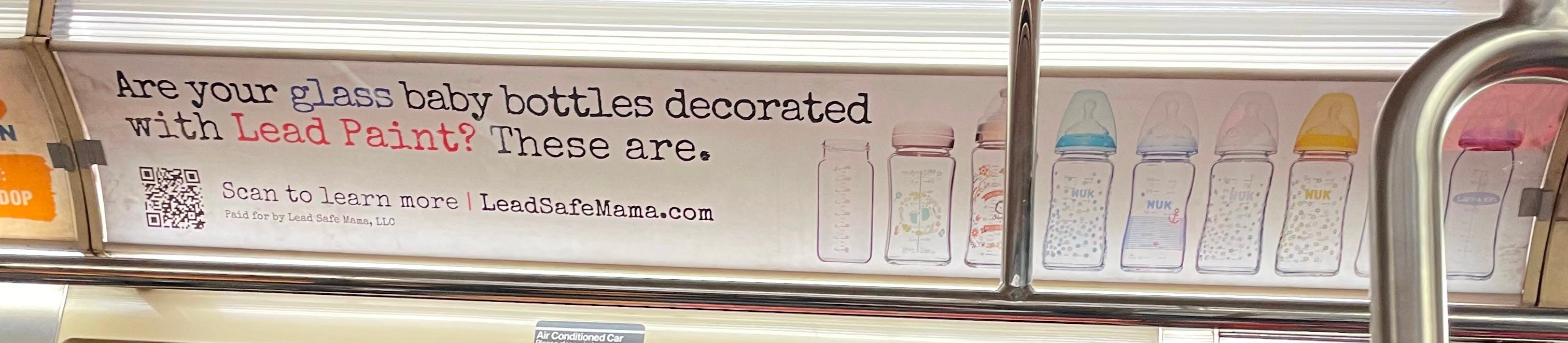
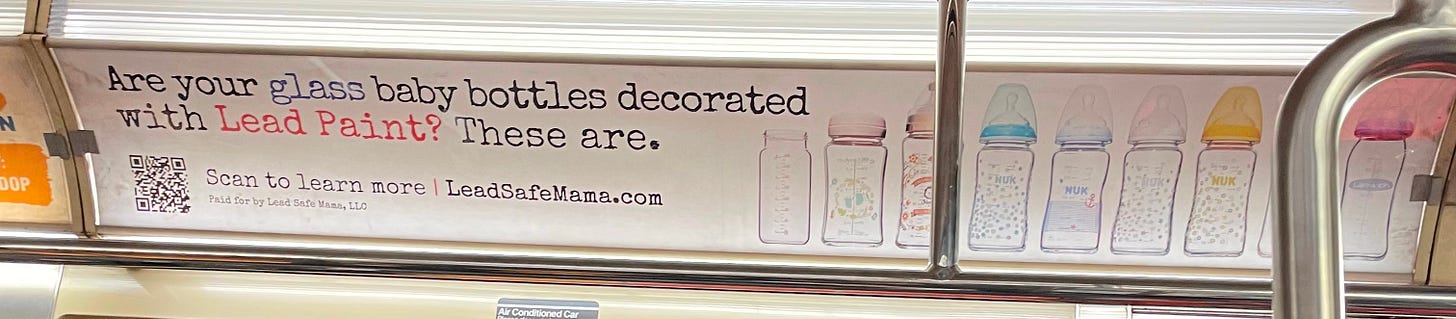
Two years ago, I kept seeing these ads on the NYC subway. It’s so crazy: in one of the wealthiest cities on the planet, babies eating from lead-contaminated glassware is so pervasive a problem that a private company has to step up to do basic quality control.
NYC babies are not the only ones silently getting their IQs nuked because of careless manufacturers. Afghan children probably have the catastrophically highest levels of blood lead — even in the diaspora abroad — because virtually all the manufacturers of traditional Afghan cookpots were using lead-contaminated metals. Even when this was found out, it took Amazon over a year to take down the listings for the damn things. The level of public harm is off-the-charts. Chances are you don’t own one of these, but when’s the last time you might have eaten in a restaurant that does?
The problem is so overwhelming that you almost can’t engage it. There’s just too much stuff to check on your own. This is catnip for neurotic Type-As. You’ll drive yourself crazy if you try to fix it. And, in fairness, none of these hazards are big and likely enough on their own to warrant your deep-dive attention. It’s in aggregate that they’re impactful: in your life, most risk factors aren’t an issue at all, but there’s probably something that needs to be found out and fixed. The only solution is to delegate it to a third party that you can trust to do a really thorough job. Only a business with this as its core competency is capable of the breadth and depth required for this Herculean task.
In Germany, there’s a popular nonprofit which tests consumer goods for safety and publishes the results. When I was a baby, my mom followed their publications, and only bought the baby foods, diapers, etc. that had been deemed high-quality. Those ratings alone directed many thousands of dollars of high-margin spend for her. Consumer goods are as big as markets get, parents are willing to spend virtually any amount of money for the benefit of their children, and the product scope is endless. There’s going to be a generational company that uncompromisingly creates trust and will charge a hefty premium for never breaking that trust. Providing infallible peace of mind is the strongest of moats.
I am seeing the latent demand. Technology is empowering citizen scientists: consumers are taking charge of their health. They’re buying Whoop, Mira, Levels, Eight Sleep, Nucleus, Ezra, Function, etc. to understand their bodies, optimize their health, and catch potential issues way ahead of time. They’re starting to want things like Blueprint, where the manufacturer is staking their credibility on the work they’ve done to own the whole supply chain.
Soon the penny will drop with the public: health is not just about your body, but about your environment. People are starting to pay attention to air quality. They’re realizing that the “premium” consumer brands are full of microplastics. They’re waking up to the fact that life can and should feel better. Everyone wakes up congested, everyone gets headaches, everyone gets a rash sometimes — but these “normal” experiences are your body telling you that something is wrong. It’s just so common that it’s normalized. And so many health outcomes that people talk about in terms of luck are actually deterministic, but people gloss over there being causality at work. The problem is large. And we have the science to do better.
Health is the final frontier. The idea of luxury was once conferred by design, materials, and manufacturing — but today, even the highest-end goods are now instantly replicated for pennies on the dollar. The question that remains is what lurks inside: the peace-of-mind escape from hidden hazards is not just necessary, but offers infinite optimization.
This will be a big business. It has been on my mind for many years now. I’ve seen all the startups that have taken a stab here — Yuka, Oasis, Tap Score, you name it. But while I admire their missions, I don’t think anyone’s historically gotten this right as a business. Now I’ve finally met the right founders taking the right approach: empowering people as citizen scientists, and taking on the big task of monitoring for and remediating hazards at home. This is very important to me, and I am excited to help them succeed. If this mission sounds interesting to you, email me at [email protected] and I’ll put you in touch.