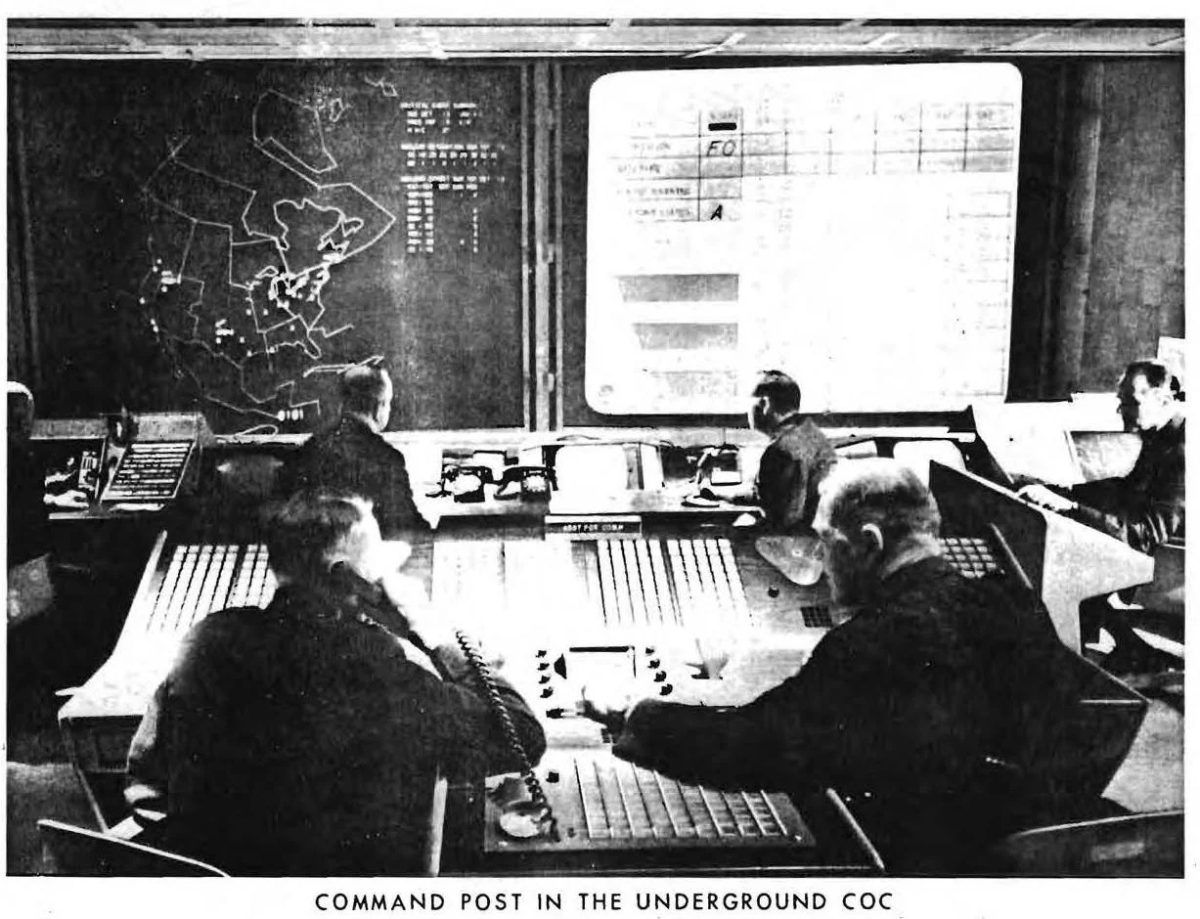
“These display screens would display signs of air attack against Canada and the United States. By pushing buttons, the NORAD battle staff members can take an electronic look at the tracks of space satellites or aircraft, which are chartered on the display by computers This is the nerve center which would give the first warning of attack, and the command post from which NORAD battle commanders would direct the defensive air battle.”
– NORAD Command Post: The City Inside Cheyenne Mountain
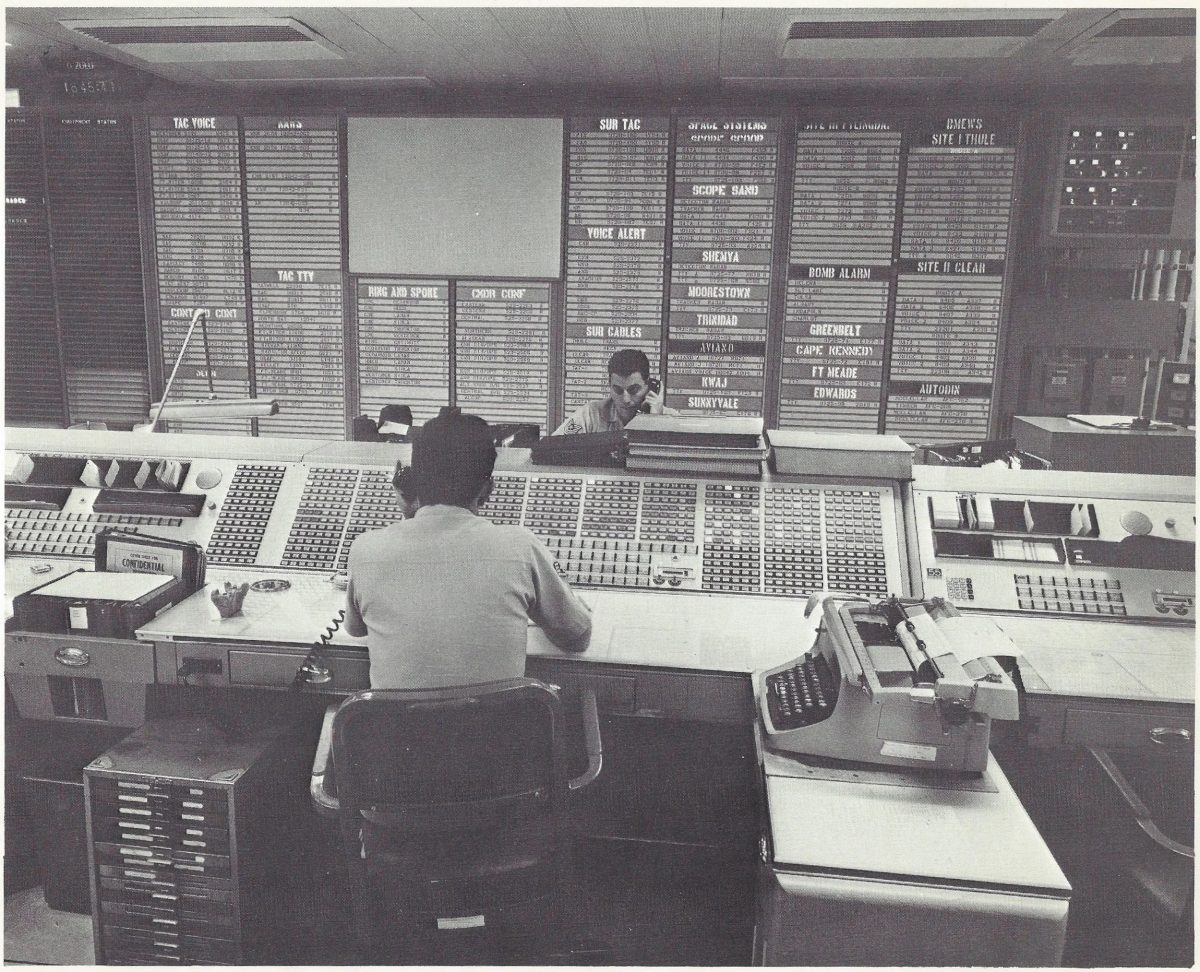
In 1966, the North American Air Defense Command (NORAD) Cheyenne Mountain underground facility became America’s command and control centre for when the Cold War turned white and the nuclear apocalypse became real.
We can take a look around the bunker in pictures published in a 1966 official NORAD report by David W. Shircliffe, Directorate of Command History, Command Public Affairs Office, and the 1970s book NORAD Command Post: The City Inside Cheyenne Mountain by Henry W. Hough.
The Need
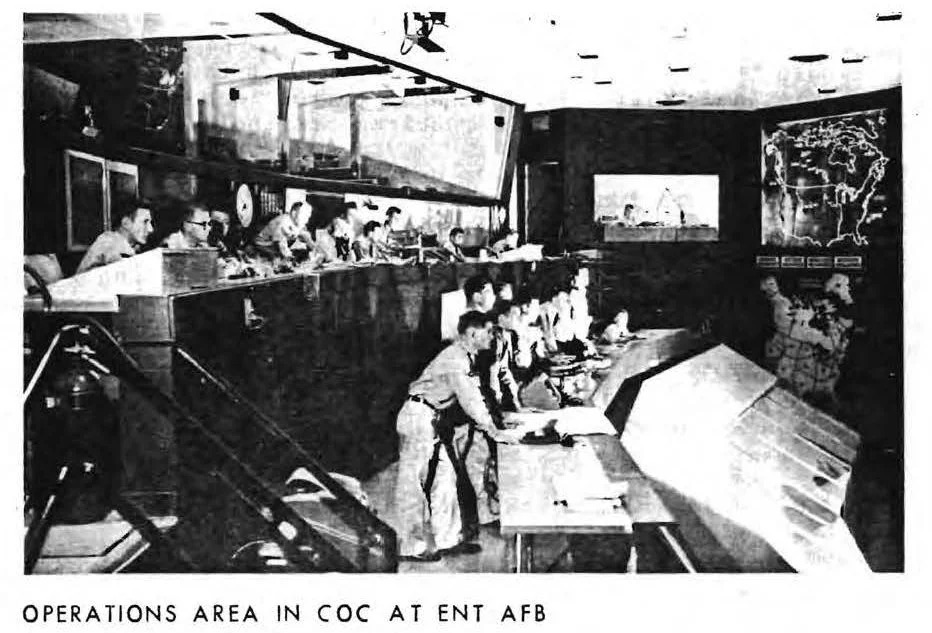
When the USAF Air Defense Command moved to Ent AFB in Colorado Springs in January 1951, it set up a tiny combat operations center in one of the office buildings by combining one room, a latrine with the plumbing removed, and part of a hallway. Control of the air battle from such cramped quarters became virtually impossible by 1952. A new concrete block COC built on Ent AFB, became operational on 15 May 1954.
In comparison with the first COC, this new center was luxurious. Although this new COC had some 15,000 square feet of floor space, by the end of 1955 it was evident that even it would soon be inadequate.
In response to General Partridge’s directive, the CONAD/ADC staff began preliminary planning in January 1956 on a larger COC, located underground. The existing above-ground COC would eventually be too small to manage the growing air defense system and currently was highly vulnerable to attack and sabotage. General Partridge gave a clear picture of the COC:’s vulnerability when he said: ‘The Combat Operations Center is a concrete block building of extremely light construction and is exposed to the traffic on the adjacent street so that a man with a bazooka passing in a car could put the establishment out of commission.”
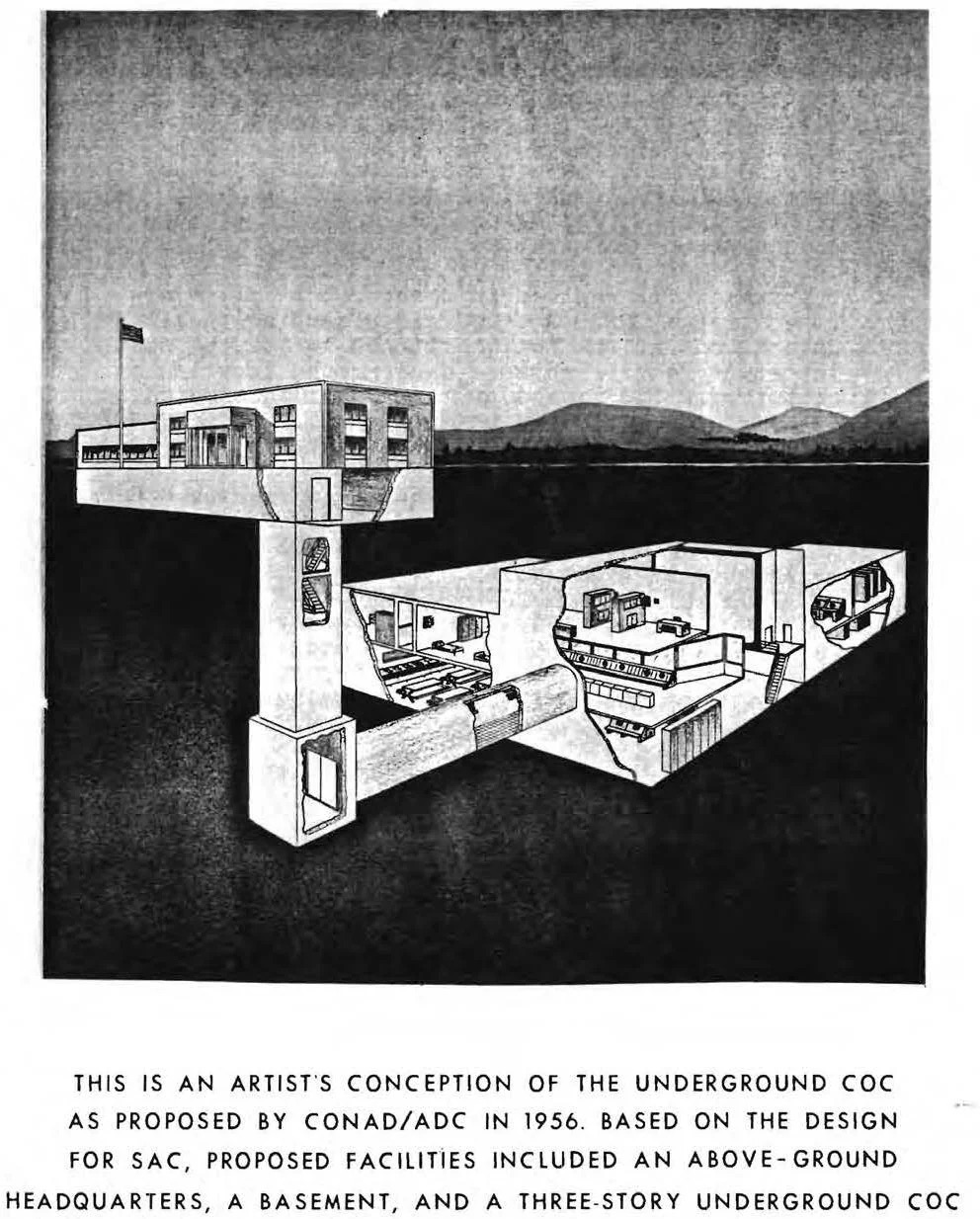
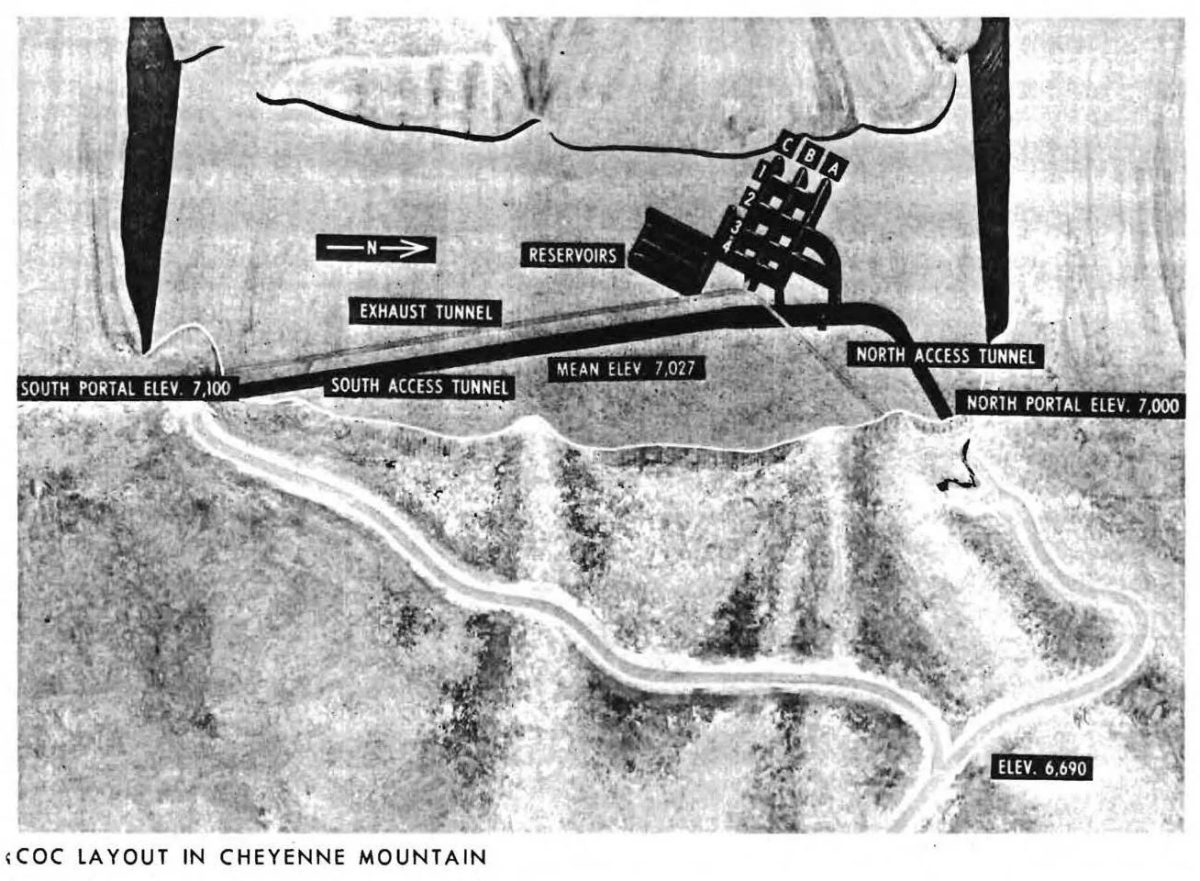
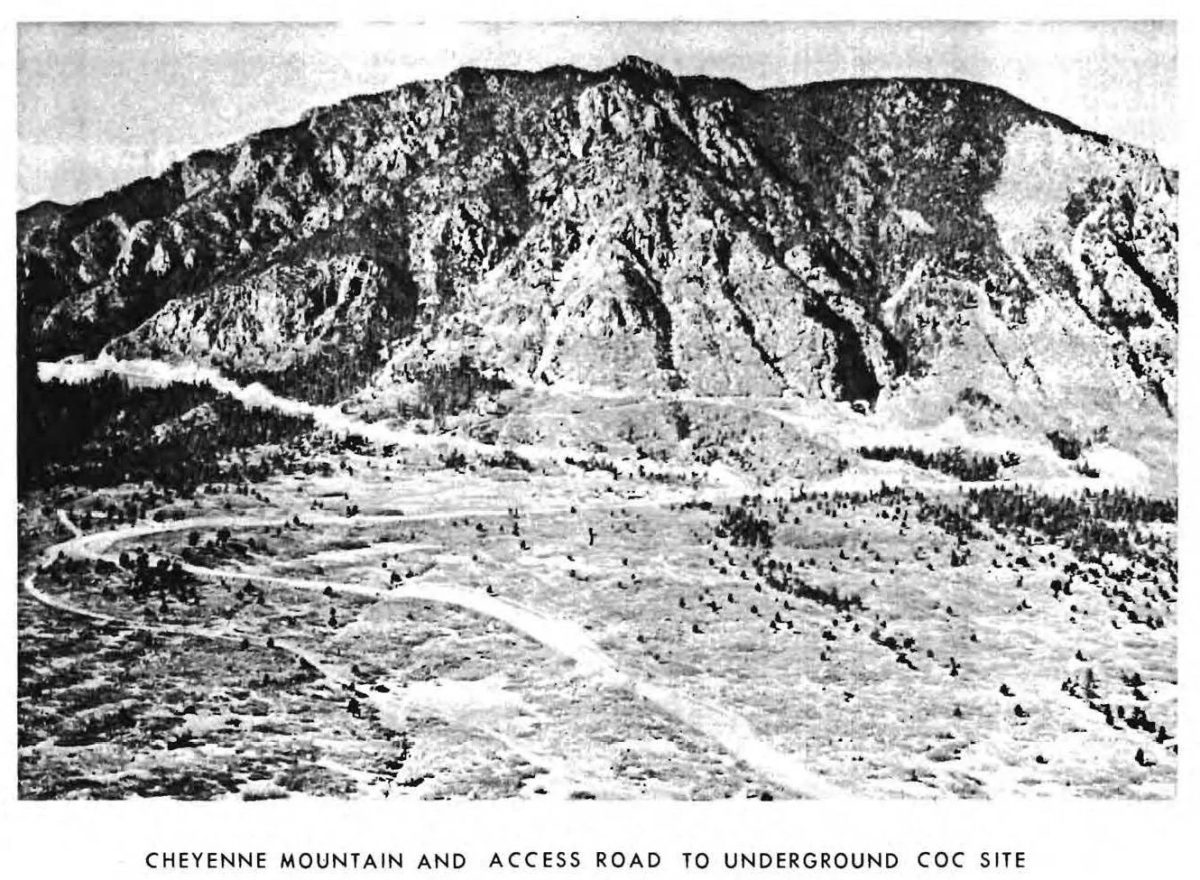
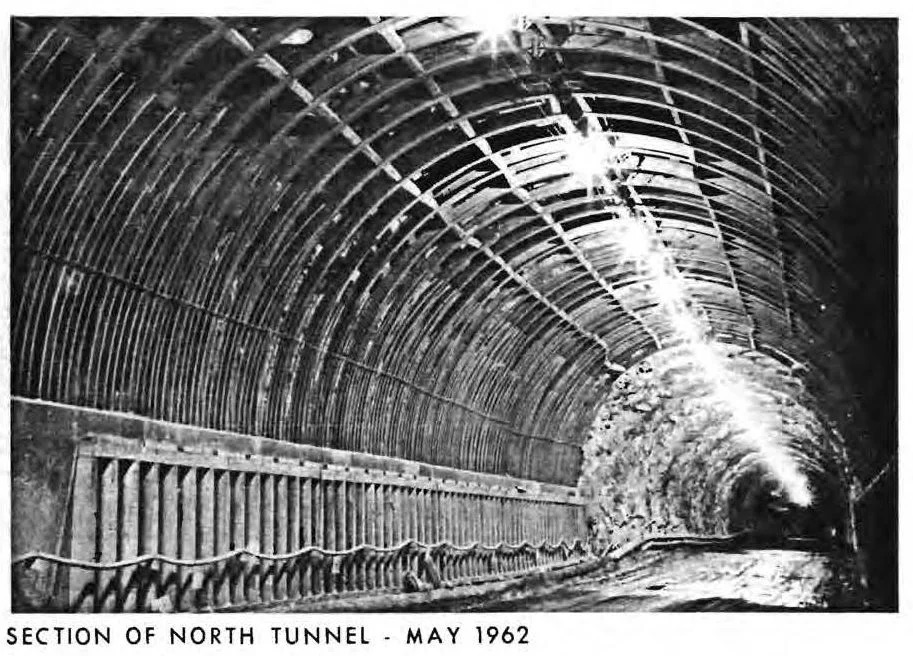
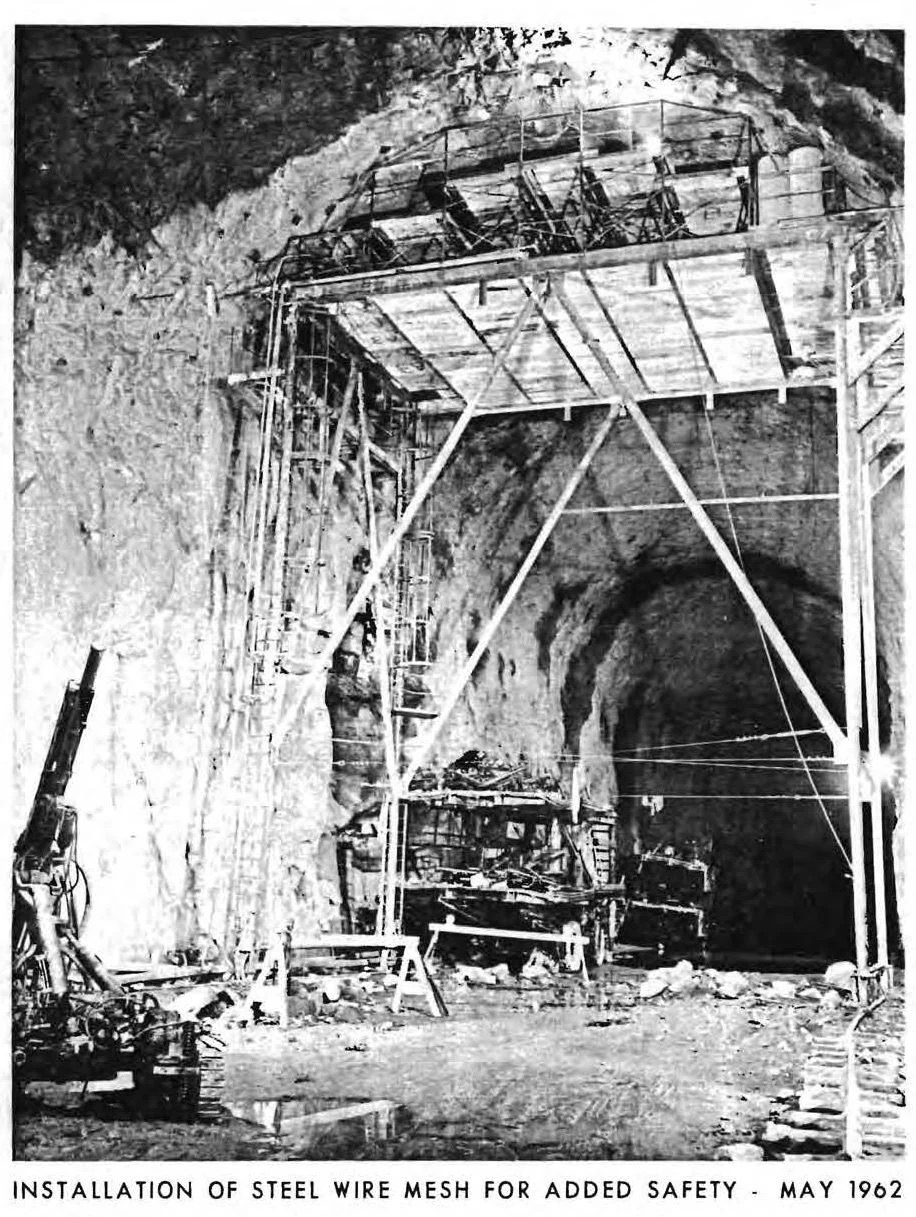
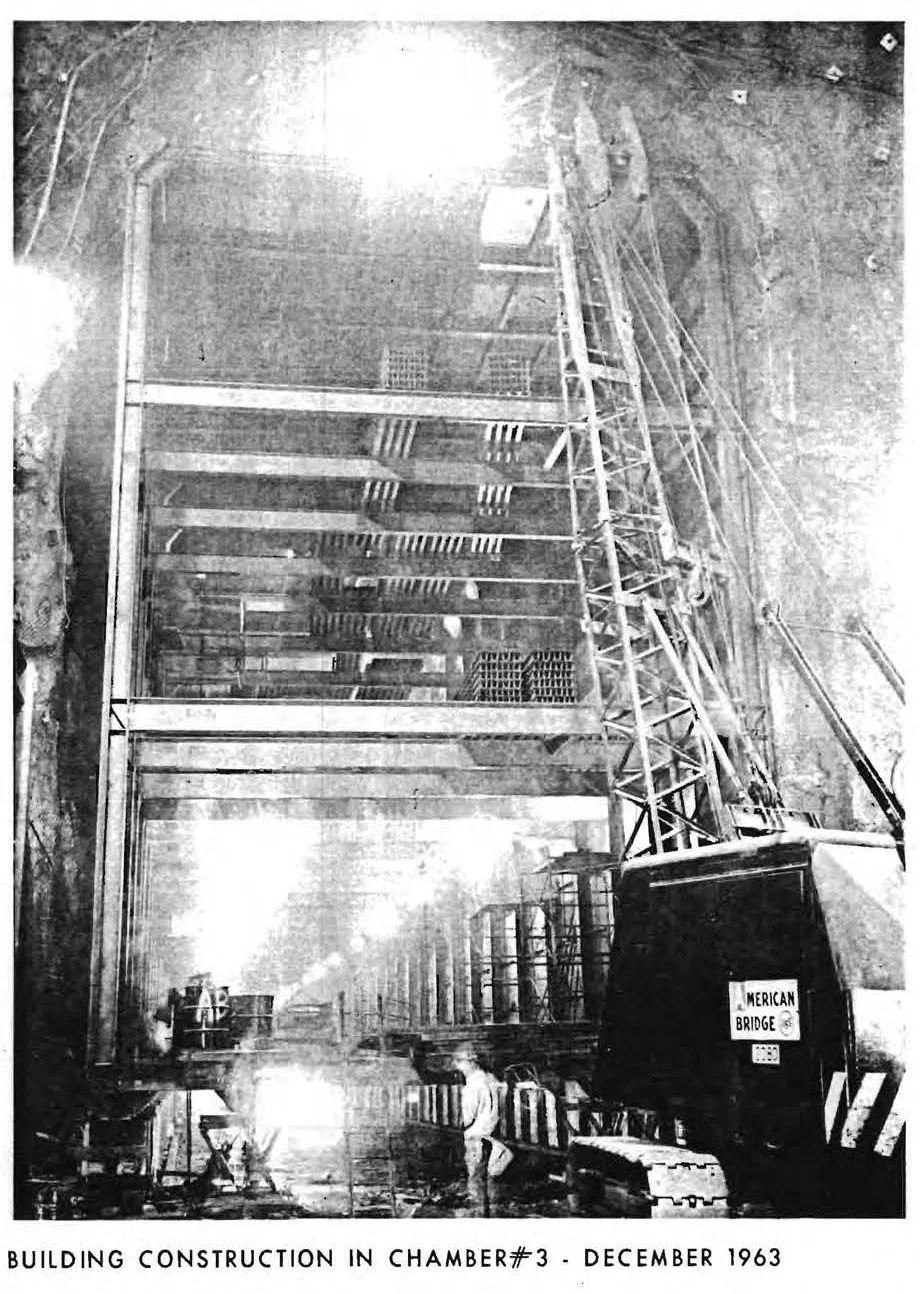
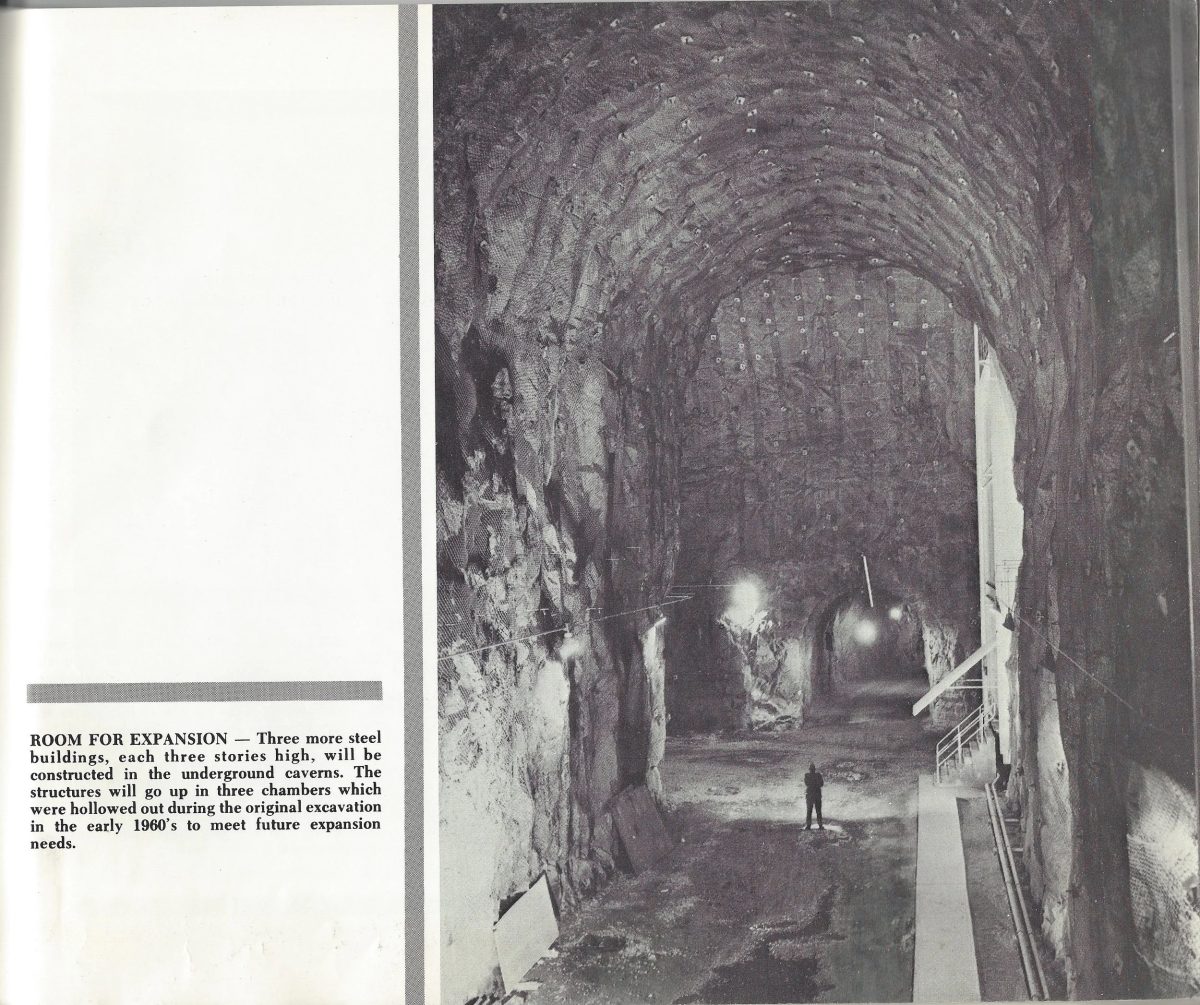
Excavation for the hardened COC in the 9,565-foot Cheyenne Mountain began on 19 June 1961 and was essentially completed by August 1962. It was completely finished on 1 May 1964. NORAD moved its headquarters to nearby Peterson Air Force Base in 2006, but the underground complex is still used by a number of military and intelligence agencies.
The Threat
The USSR was expected to have a significant ICBM capability by 1960 or earlier. To defend against this threat, CONAD wanted an automated defense system controlled from within an underground COC.
The advent of ICBMs, with their incredible speed, would greatly reduce the time available for defensive reaction and national strategic warning. Automation, wherever possible, was considered essential. Their plans also included computers and computer-operated displays of air traffic, weapon status, and ICBM attack warning data.
Computing Power At The Cheyenne Mountain Combat Center
GENERAL REQUIREMENTS
1. Near 100 per cent probability of continuing to function against multi-megaton weapons (i.e., underground location).
2. Duplexed large computers and enough floor space to accommodate more computers for anti-ICBM operations.
3. Displays of hostile ICBM status, weapon status, states of alert, aircraft and missile traffic, target damage, radioactive areas, and weather and jet stream information.
4. Communications, and backup facilities, with subordinate, lateral, and higher commands.
5. completely independent water and power supply.
6. Protection against radioactive fallout, biological and chemical warfare, and all other external covert and overt actions.
7. Location within 10 minutes travel time of CONAD and component headquarters.
Adding:
The COC, wherever located, will be a prime target. The site should be selected, as far as practicable, away from other facilities so, if attacked, a minimum “bonus effect” to the enemy would result.
30 Days
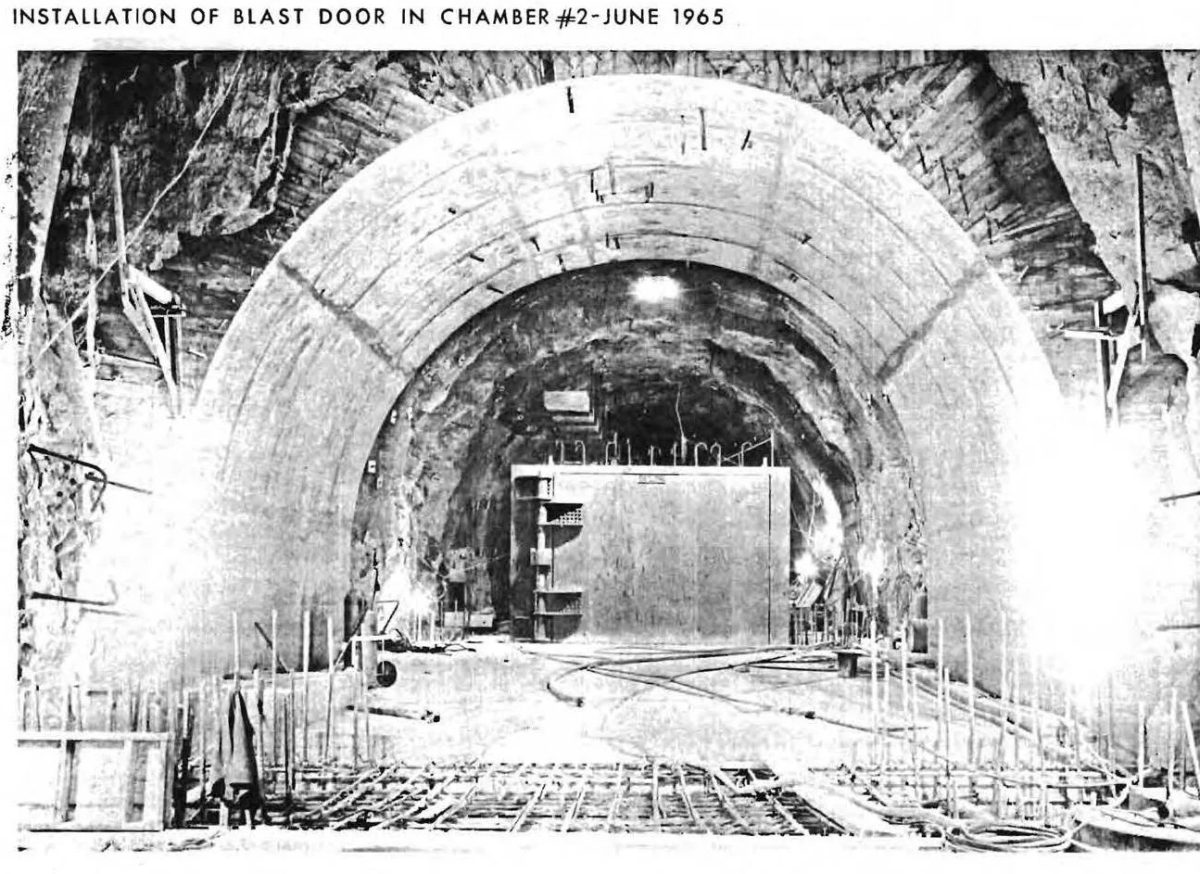
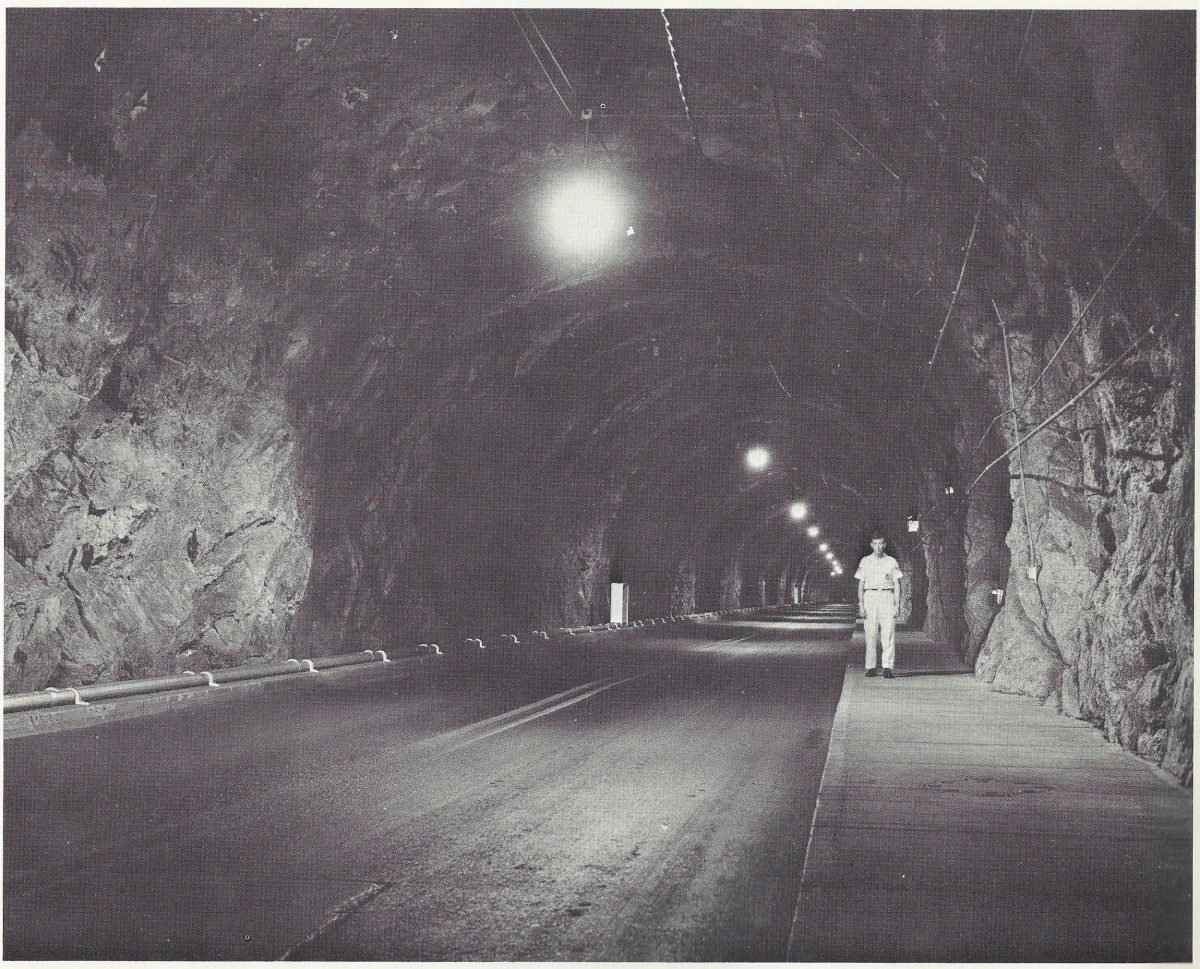
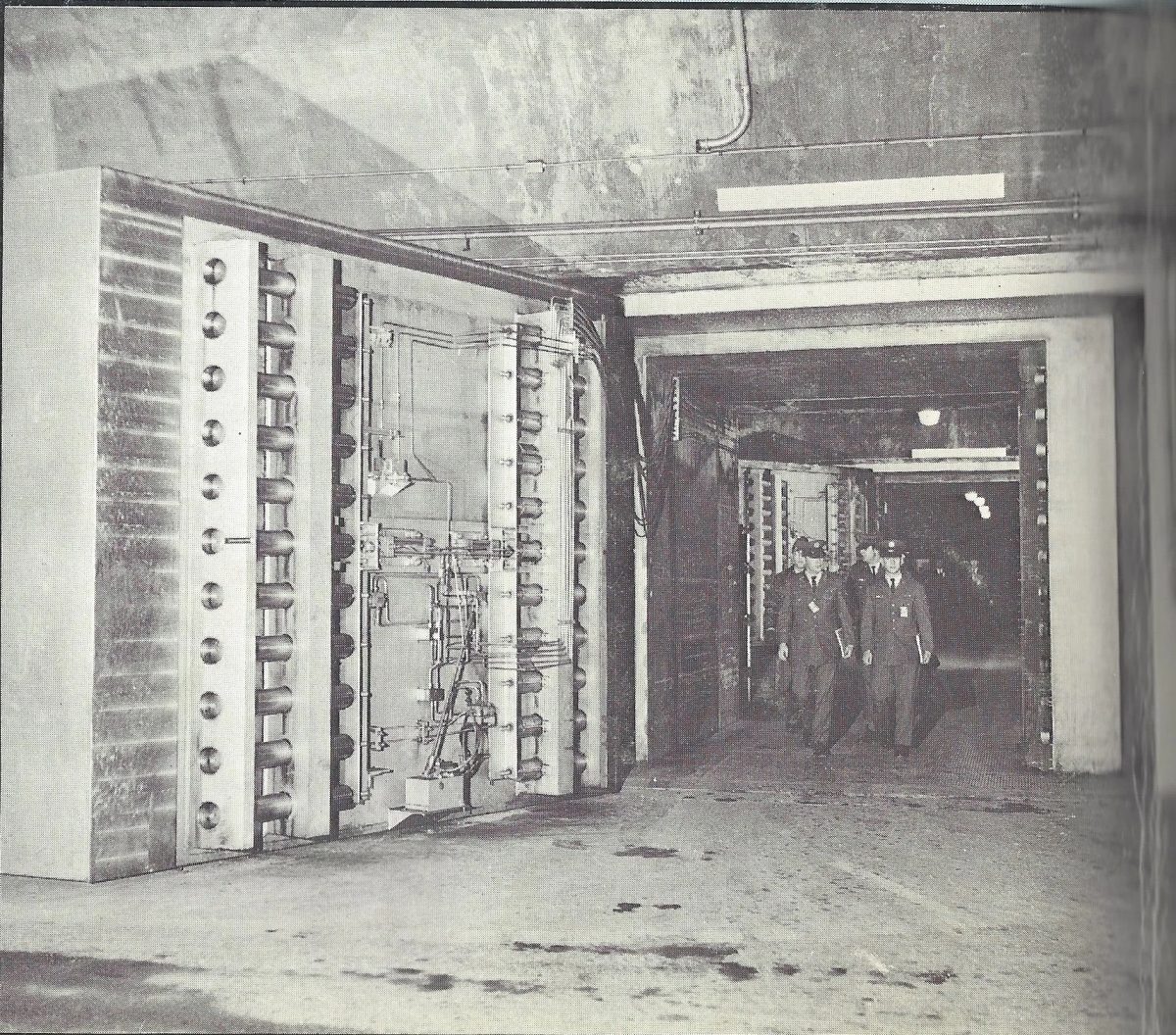
Provisions were made so that, in an emergency, the COC could be operated for 30 days in a sealed condition, During that time, except for air from the outside that could be filtered for people inside the mountain, the COC would need no other outside support. Its resources include a built-in power plant, heating and air conditioning systems, dormitories, dining areas, maintenance and storage areas, and a dispensary, Southeast of the buildings there are three large underground res~rvoirs. These hold 350,000 gallons of diesel fuel; 1,375,000 gallons of drinkable water; and 4,125,000 gallons of water for industrial uses,1
The Tech
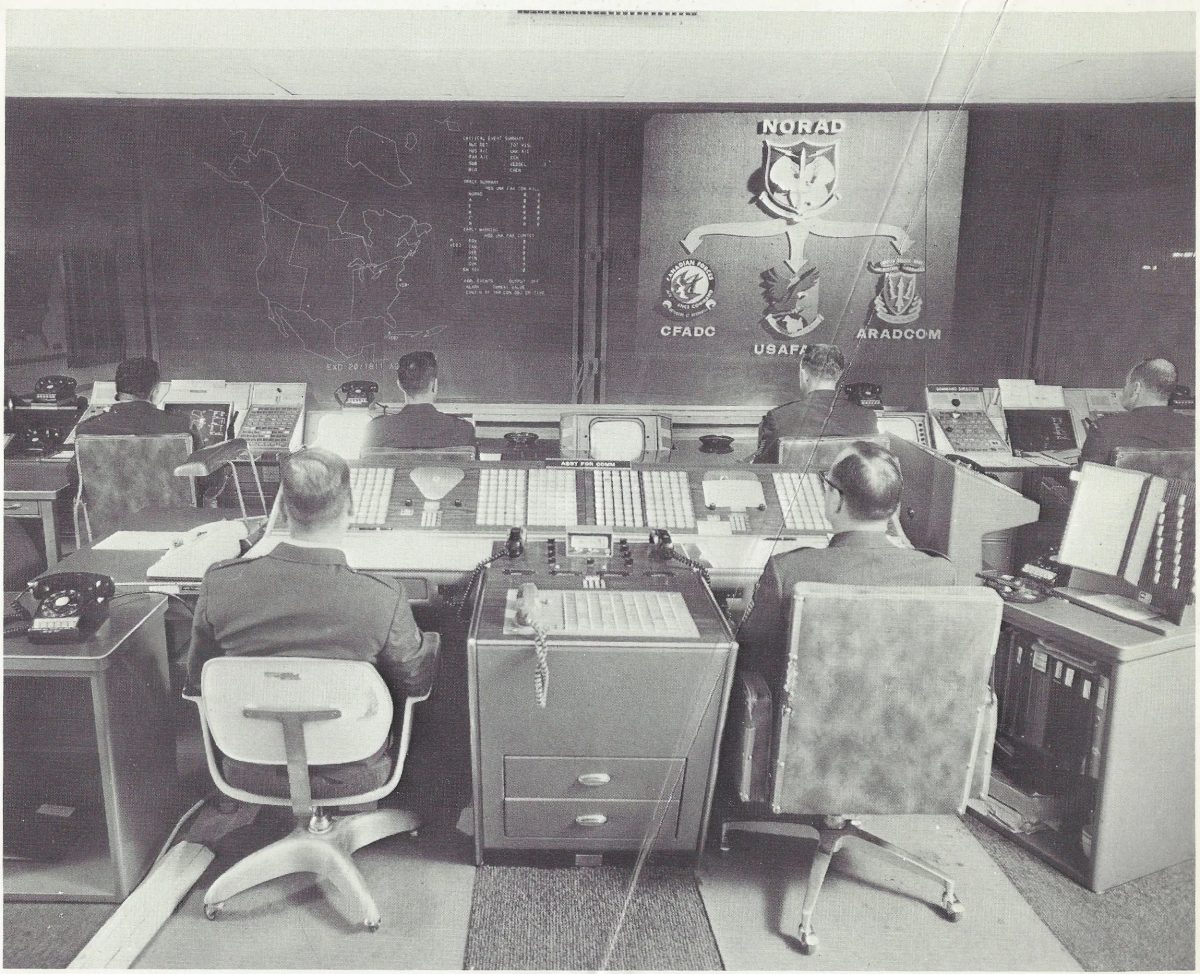
During the spring and summer of 1965, 15 consoles, two Philco 212 computers, and a large board display were installed in the new COC. Except fo·r four Type I I I consoles, all of this equipment had been operating in the Group II facility. A third Philco 212 computer was to be moved in January 1966 from the Spacetrack Center Alternate Facility at L. G. Hanscom Field to the new COC.
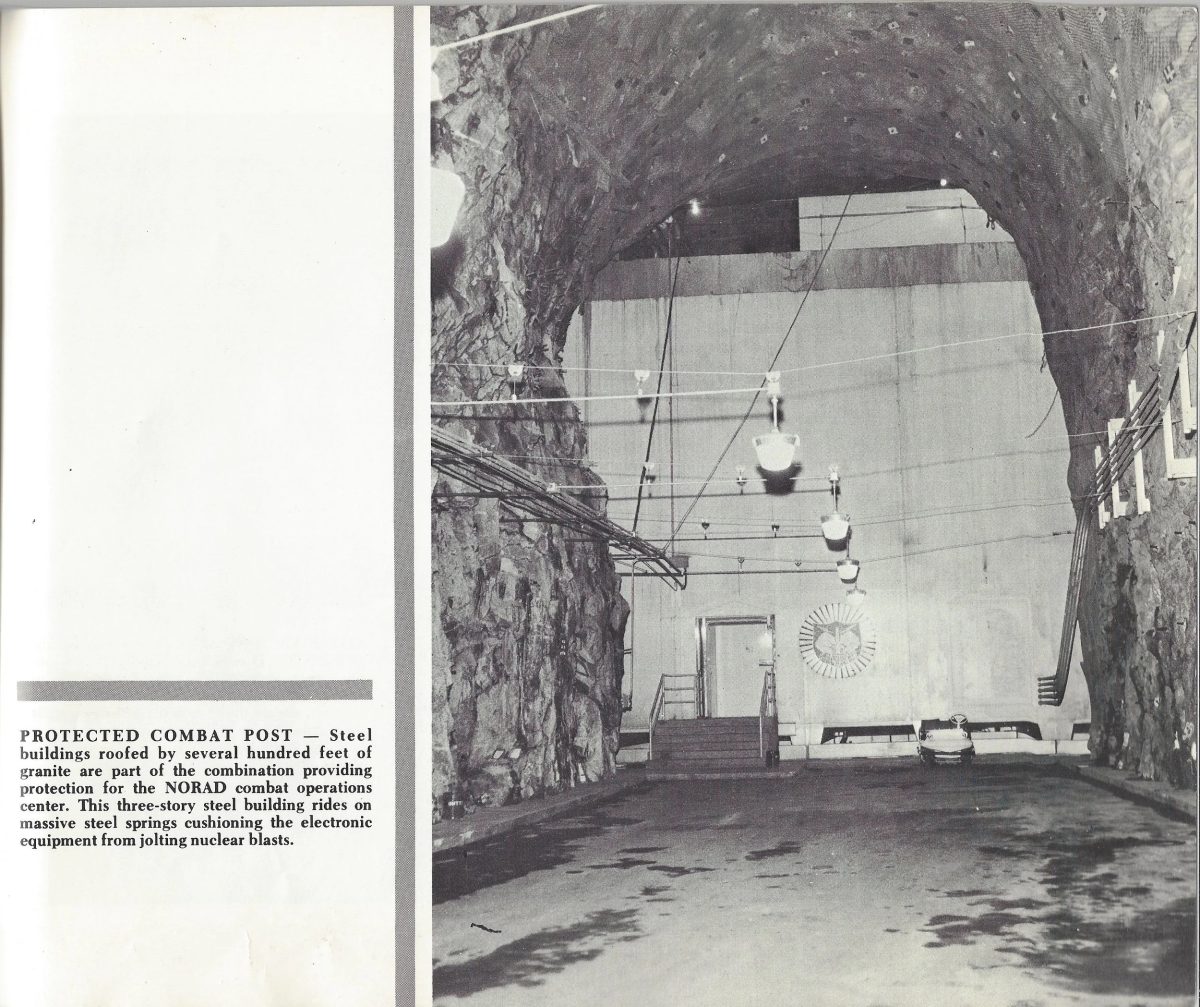
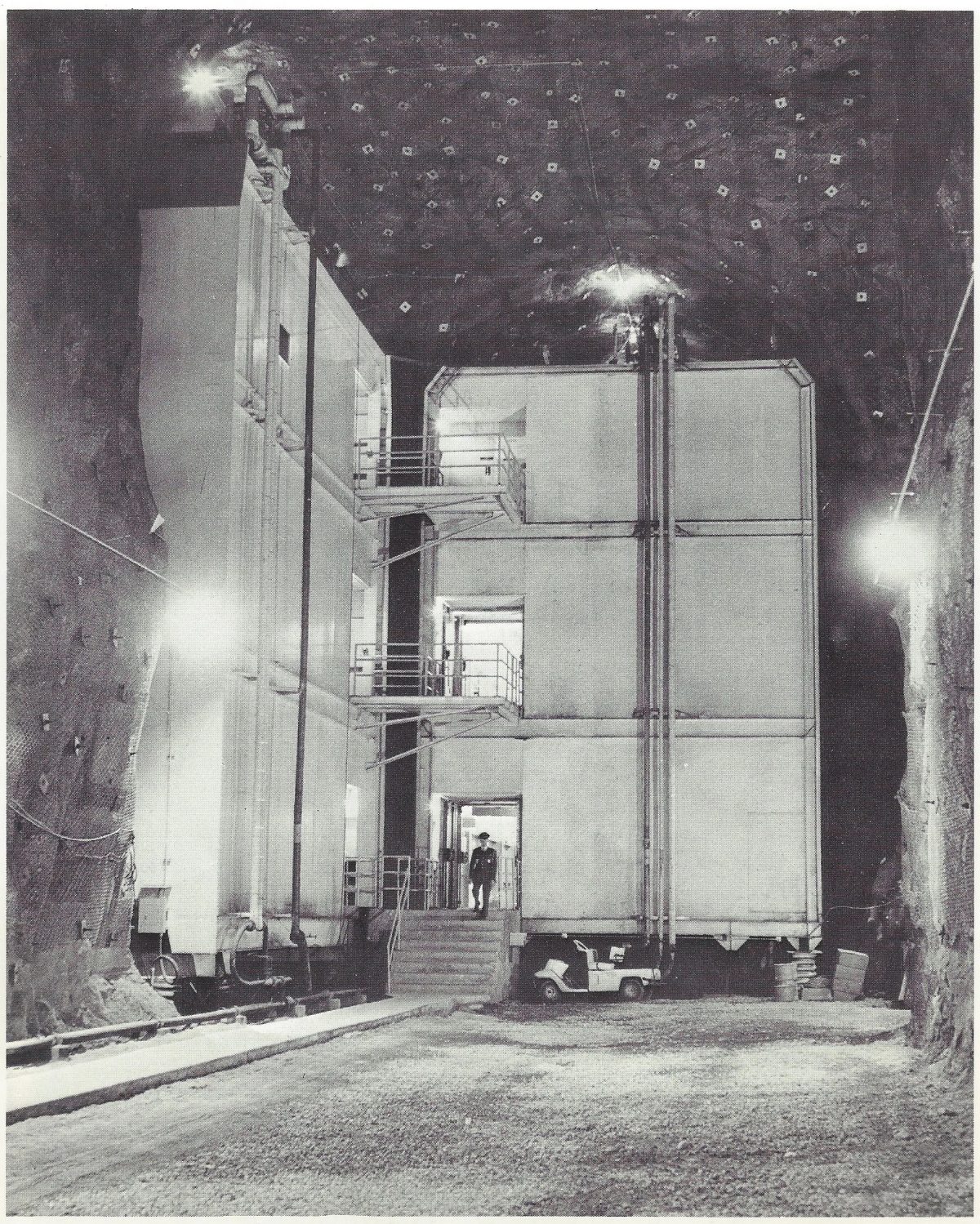
Caption Above:
“These are two of the eleven buildings in the NORAD complex. While it possible to pass from one building to another through vestibules, the structures do not touch one another, nor do they touch the ceilings or walls of their granite cave. All the buildings are mounted on huge steel springs to protect the people and electronic equipment from shock waves.”
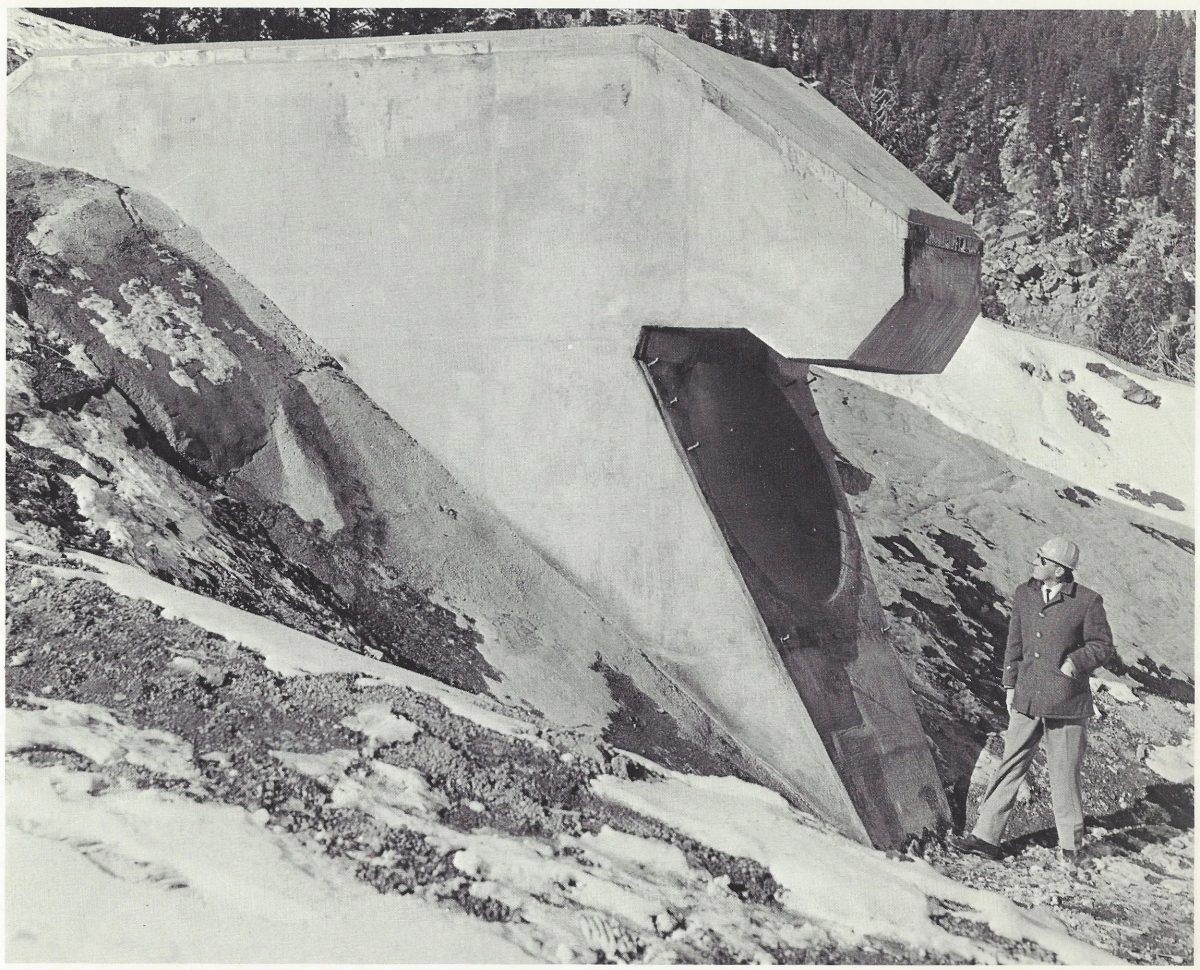
Caption Above:
“NORAD LOOKOUT – High on the steep slopes of Cheyenne Mountain, looking out over the eastern Colorado plains, is this single-eyed structure. It is a blast resistant radio antenna and the messages it picks up are channeled to the Combat Operations Center hundreds of feet below and inside of the mountain. There are two of the microwave antennas and they are part of the center’s communications link with the outisde world. These two structures used 12,00 hundred-pound bags of cement and 60 tons of reinformcing steel to meet the hardness specifications.”
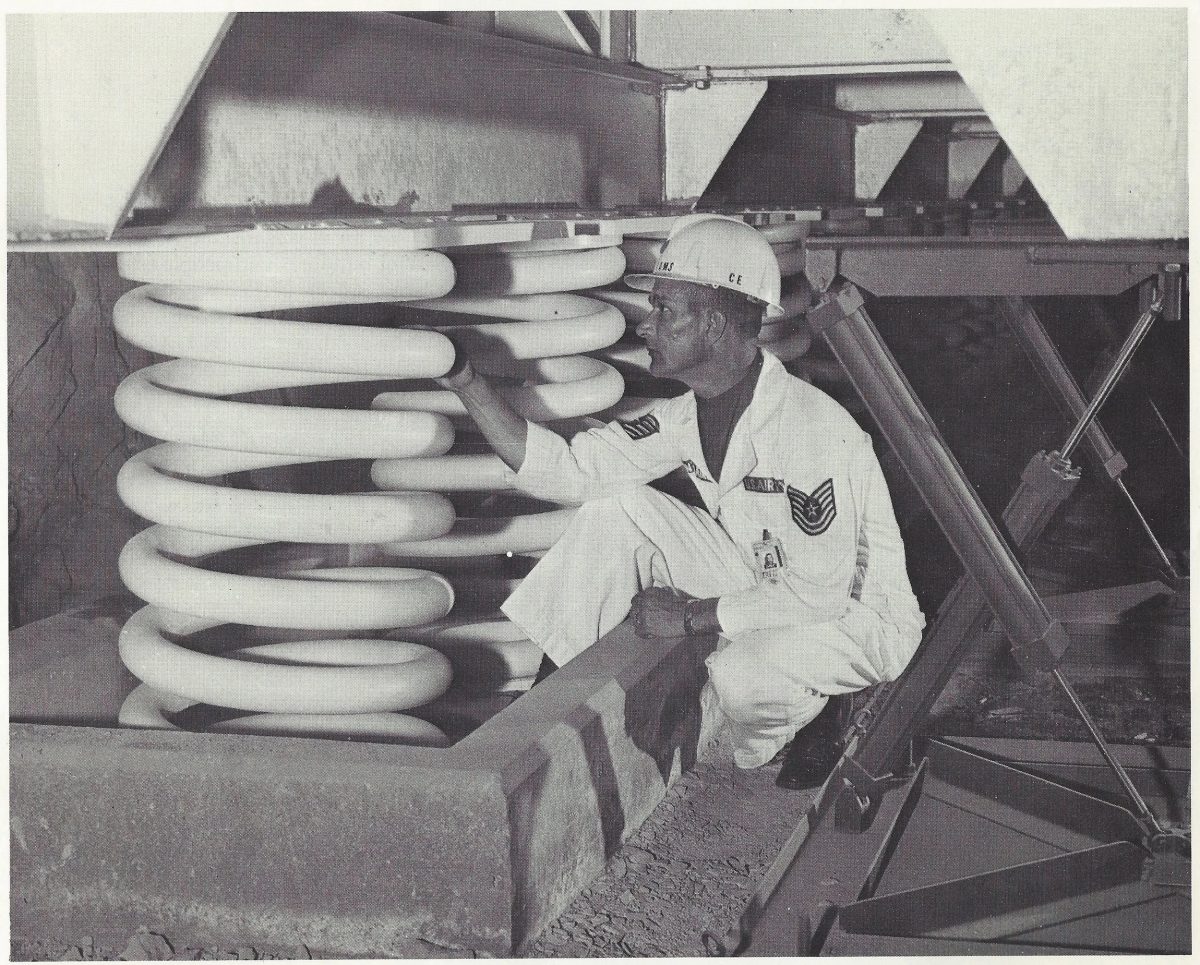
Caption Above:
“CALLED FOR DEFENSE- Rows of mammoth springs made from three-inch diameter steel support the NORAD buildings. More than 900 of the springs, weighing 1,000 pounds eaach, cushion the buildings and their contents against jarring nuclear blasts or earthquakes. Working with the springs are the hydraulic dampers seen in the row at right. Like automobile shock absorbers, the dampers would reduce oscillations caused by a shock wave.”
Caption Above:
“AIR DEFENSE WATCH – These display screens would display signs of air attack against Canada and the United States. By pushing buttons, the NORAD battle staff members can take an electronic look at the tracks of space satellites or aircraft, which are chartered on the display by computers This is the nerve center which would give the first warning of attack, and the command post from which NORAD battle commanders would direct the defensive air battle.”
Caption Above:
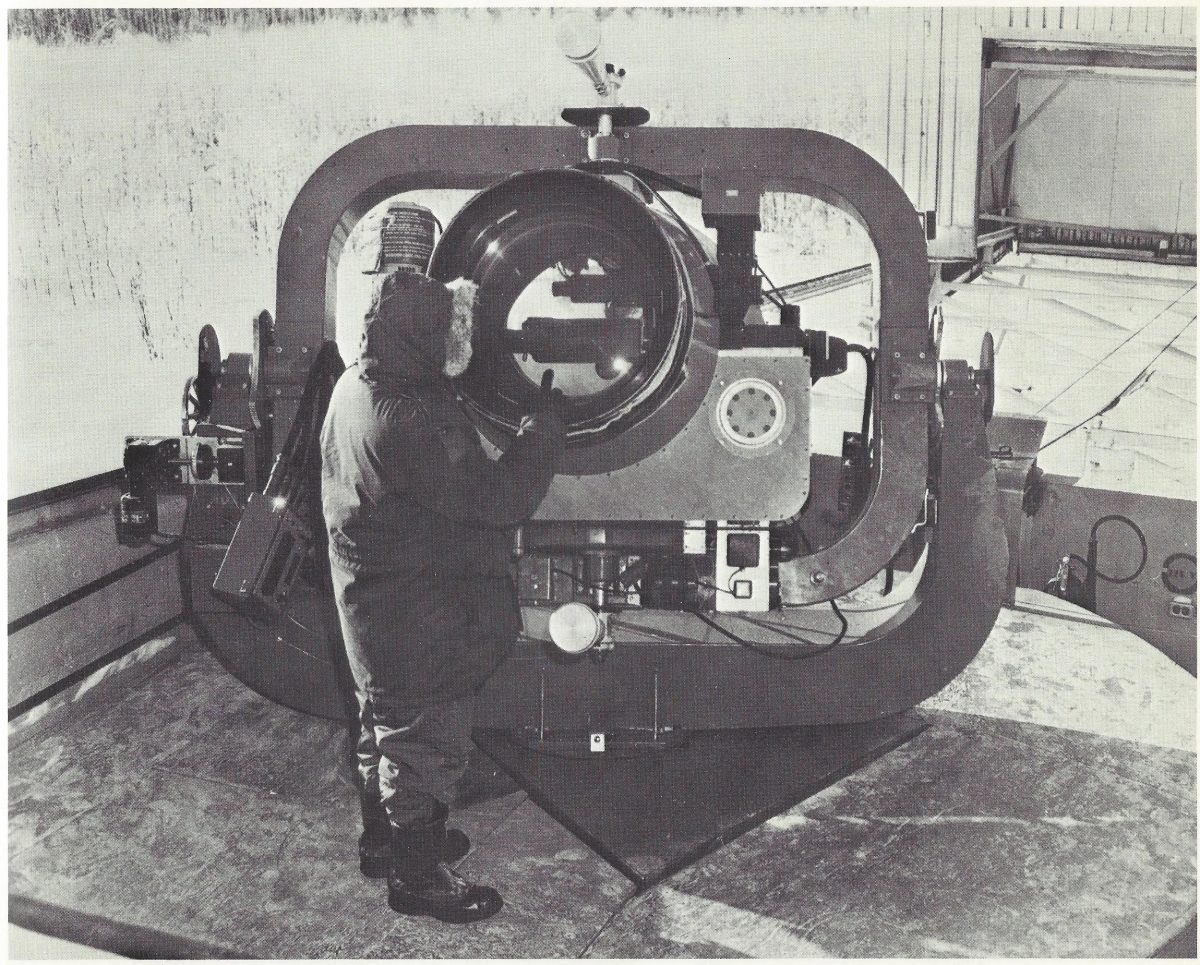
“SPACE BROWNIE – The most sensitive and precise satellite-tracking instrument in NORAD’s satellite detection and tracking network is the Baker-Nunn camera, shown here. It can photograph light reflected from an object the size of a basketball out in space about 25,000 miles. This camera, at Cold Lake, Alberta, is operated by the Canadian Forces Air Defense Command. Others supplying data to the NORAD Space Defense Center in Colorado are operated by the U.S. Air Force and the Smithsonian Astrophysical Observatory. By identification and correlation of known star backgrounds in the Baker-Nunn photographs, a satellite’s position can be determined with great precision.”
Caption Above:
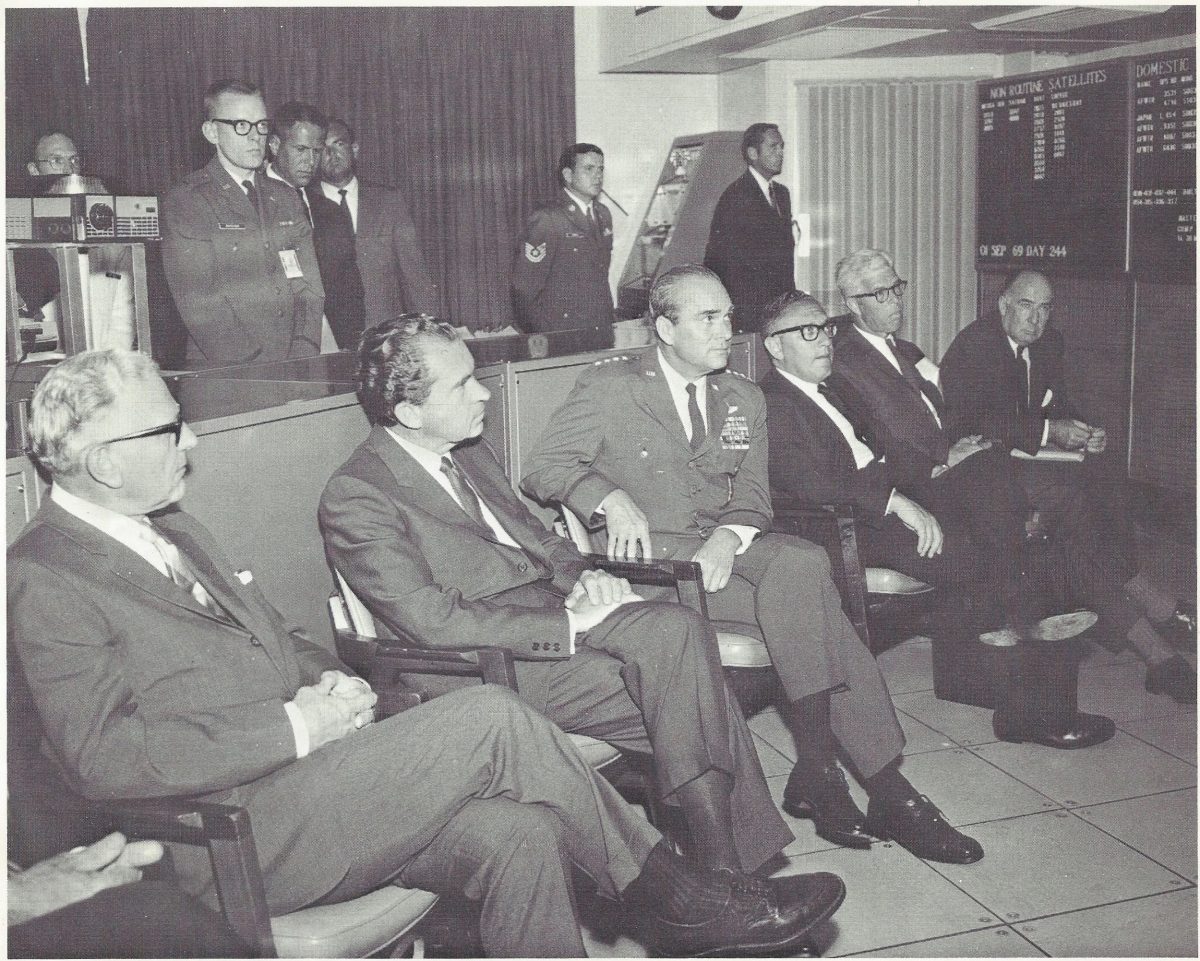
“DISTINGUISHED VISITORS – Richard M. Nixon is September 1969 became the first U.S. President to visit the underground command post of the North American Air Defense Command. He is shown here in NORAD’s Space Defense Center being briefed by General Seth J. McKee, commander in chief of NORAD. Left to right are: Gordon Allott, U.S. Senator from Colorado; President Nixon; General McKee; Dr. Henry A. Kissinger, Presidential assistant; Peter H. Dominick, U.S. Senator from Colorado; and John N. Mitchell, U.S. Attorney General.”
Caption Above:
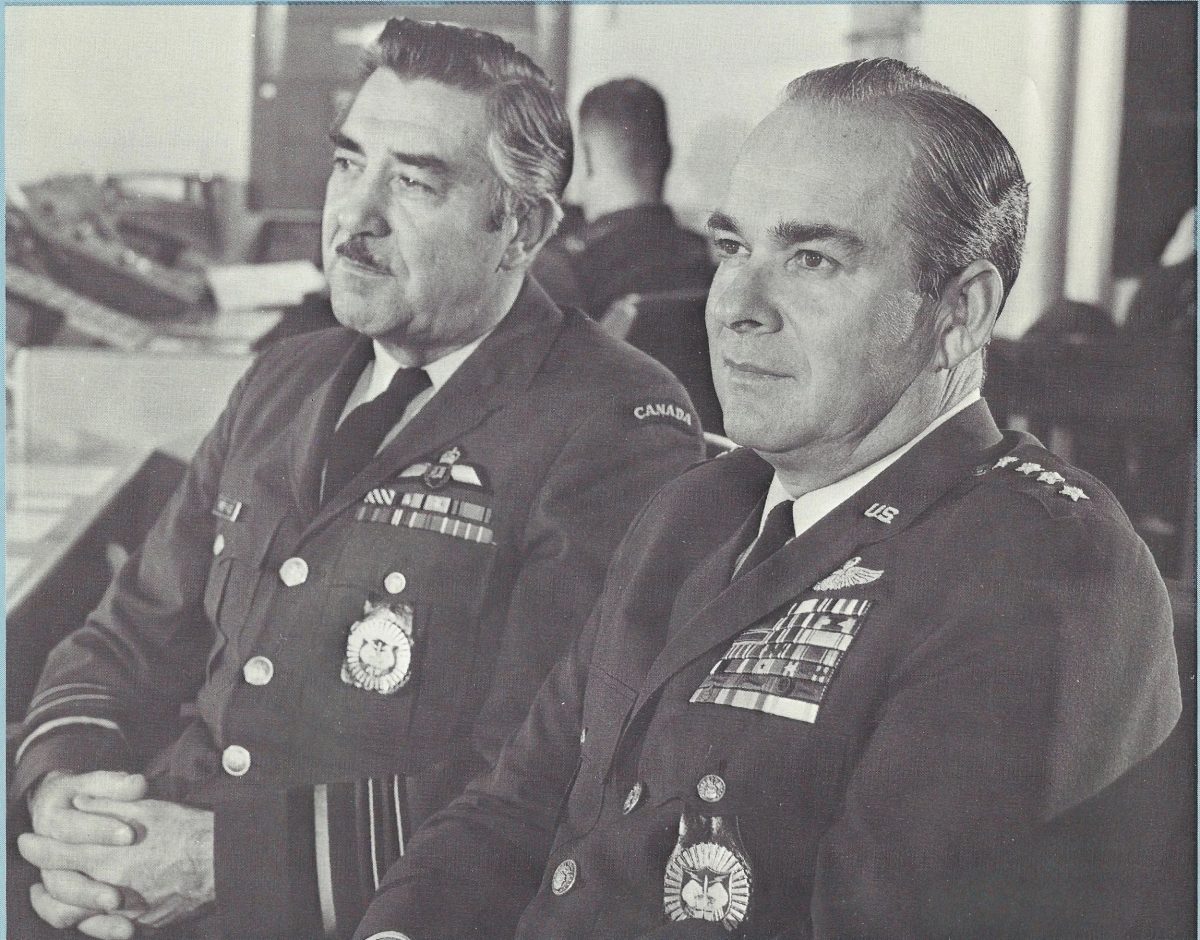
“DIRECTING AIR DEFENSE FORCES – These men shoulder the responsibility for determining whether an enemy has launched an air attack against North America, and of directing the defensive air battles should one ever be fought. directing air defense forces. U.S. Air Force General Seth J. McKee (foreground) is the commander in chief of the North American Air Defense Command, and Canadian Forces Lieutenant General Edward M Reyno is the deputy commander in chief. They are shown at their command positions in NORAD’s underground Combat Operations Center near Colorado Springs. Data channeled to the center give the generals and their battle staff the information they need to assess the threat to the continent, to give warning of an impending air attack and, finally, to direct the actions of Canadian and U.S. air defense forces in thwarting the attack.
Lead Photo:
“PATHS OF A SATELLITE – Deep within Colorado’s Cheyenne Mountain are large display screens which show what is going on in space. These screens in the NORAD Combat Operations Center can show the routes space satellites will take as they circle the earth, such as the ones here charted by a computer. By pushing buttons the battle staff members can see the paths a satellite will follow for as many as twelve revolutions in the future. While guarding the continent against air attack, the command is also responsible for keeping tabs on space objects orbiting the earth.”
Via: GovernmentAttic; photos of the Cheyenne Mountain Combat Center scanned by The Memory Hole.