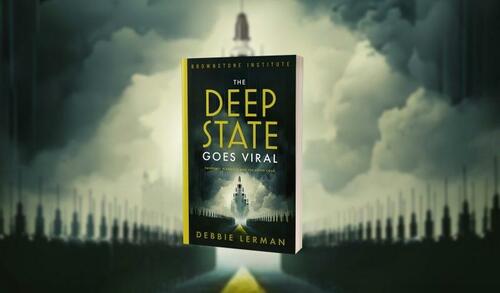
The following is Jeffrey Tucker’s Foreword introduction to Debbie Lerman’s new book, The Deep State Goes Viral: Pandemic Planning and the Covid Coup.
It was about a month into lockdowns, April 2020, and my phone rang with an unusual number. I picked up and the caller identified himself as Rajeev Venkayya, a name I knew from my writings on the 2005 pandemic scare. Now the head of a vaccine company, he once served as Special Assistant to the President for Biodefense, and claimed to be the inventor of pandemic planning.

Venkayya was a primary author of “A National Strategy for Pandemic Influenza” as issued by the George W. Bush administration in 2005.
It was the first document that mapped out a nascent version of lockdowns, designed for global deployment.
“A flu pandemic would have global consequences,” said Bush, “so no nation can afford to ignore this threat, and every nation has responsibilities to detect and stop its spread.”
It was always a strange document because it stood in constant contradiction to public health orthodoxies dating back decades and even a century.
With it, there were two alternative paths in place in the event of a new virus: the normal path that everyone is taught in medical school (therapeutics for the sick, caution with social disturbances, calm and reason, quarantines only in extreme cases) and a biosecurity path that invoked totalitarian measures.
Those two paths existed side-by-side for a decade and a half before the lockdowns.
Now I found myself speaking with the guy who claims credit for having mapped out the biosecurity approach, which contradicted all public health wisdom and experience. His plan was finally being implemented. Not too many voices dissented, partially due to fear but also due to censorship, which was already very tight. He told me to stop objecting to the lockdowns because they have everything under control.
I asked a basic question. Let’s say we all hunker down, hide under the sofa, eschew physical meetings with family and friends, stop all gatherings of all kinds, and keep businesses and schools closed. What, I asked, happens to the virus itself? Does it jump in a hole in the ground or head to Mars for fear of another press conference by Andrew Cuomo or Anthony Fauci?
After some fallacy-filled banter about the R-naught, I could tell he was getting exasperated with me, and finally, with some hesitation, he told me the plan. There would be a vaccine. I balked and said that no vaccine can sterilize against a fast-mutating respiratory pathogen with a zoonotic reservoir. Even if such a thing did appear, it would take 10 years of trials and testing before it was safe to release to the general population. Are we going to stay locked down for a decade?
“It will come much faster,” he said. “You watch. You will be surprised.”
Hanging up, I recall dismissing him as a crank, a has-been with nothing better to do than call up poor writers and bug them.
I had entirely misread the meaning, simply because I was not prepared to understand the sheer depth and vastness of the operation now in play. All that was taking place struck me as obviously destructive and fundamentally flawed but rooted in a kind of intellectual error: a loss of understanding of virology basics.
Around the same time, the New York Times posted without fanfare a new document called PanCAP-A: Pandemic Crisis Action Plan – Adapted. It was Venkayya’s plan, only intensified, as released on March 13, 2020, three days before President Trump’s press conference announcing the lockdowns. I read through it, reposted it, but had no idea what it meant. I hoped someone could come along to explain it, interpret it, and tease out its implications, all in the interest of getting to the bottom of the who, what, and why of this fundamental attack on civilization itself.
That person did come along. She is Debbie Lerman, intrepid author of this wonderful book that so beautifully presents the best thoughts on all the questions that had eluded me. She took the document apart and discovered a fundamental truth therein. The rule-making authority for the pandemic response was not vested in public-health agencies but the National Security Council.
This was stated as plain as day in the document; I had somehow missed that. This was not public health. It was national security. The antidote under development with the label vaccine was really a military countermeasure. In other words, this was Venkayya’s plan times ten, and the idea was precisely to override all tradition and public health concerns and replace them with national security measures.
Realizing this fundamentally changes the structure of the story of the last five years. This is not a story of a world that mysteriously forgot about natural immunity and made some intellectual error in thinking that governments could shut down economies and turn them back on again, scaring a pathogen back to where it came from. What we experienced in a very real sense was quasi-martial law, a deep-state coup not only on a national but on an international level.
These are terrifying thoughts and hardly anyone is prepared to discuss them, which is why Lerman’s book is so crucial. In terms of public debate about what happened to us, we are barely at the beginning. There is now a willingness to admit that the lockdowns did more overall harm than good. Even the legacy media has started venturing out to grant permission for such thoughts. But the role of the pharmaceuticals in driving the policy and the role of the national-security state in backing this grand industrial project is still taboo.
In 21st-century journalism and advocacy designed to influence the public mind, the overwhelming concern of all writers and institutions is professional survival. That means fitting into an approved ethos or paradigm regardless of the facts. This is why Lerman’s thesis is not debated; it is hardly spoken of at all in polite society. That said, my work at Brownstone Institute has put me in close contact with many thinkers in high places. This much I can say: what Lerman has written in this book is not disputed but admitted in private.
Strange isn’t it? We saw during the Covid years how professional aspiration incentivized silence even in the face of egregious violations of human rights, including mandatory school closures that robbed children of education, followed by face-covering requirements and forced injections for the whole population. The near-silence was deafening even if anyone with a brain and a conscience knew that all of this was wrong. Not even the excuse that “We didn’t know” works anymore because we did know.
This same dynamic of social and cultural control is fully in operation now that we are through that stage and onto another one, which is precisely why Lerman’s findings have not yet made their way to polite society, to say nothing of mainstream media. Will we get there? Maybe. This book can help; at least it is now available for everyone brave enough to confront the facts. You will find herein the most well-documented and coherent presentation of answers to the core questions (what, how, why) that all of us have been asking since this hell was first visited upon us.
Loading...