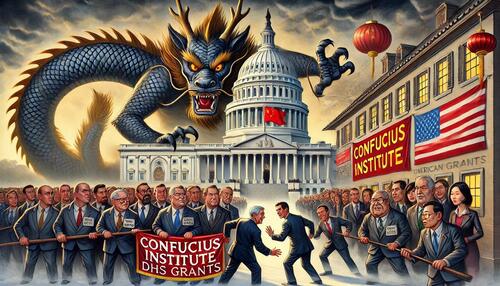
In a move aimed at curbing China's growing influence on American soil, the House of Representatives passed a bill aimed squarely at slashing Chinese sway in U.S. universities. This legislative punch landed on the second day of "China Week," a concerted effort by House Republican leadership to tackle China's expanding footprint across multiple sectors.
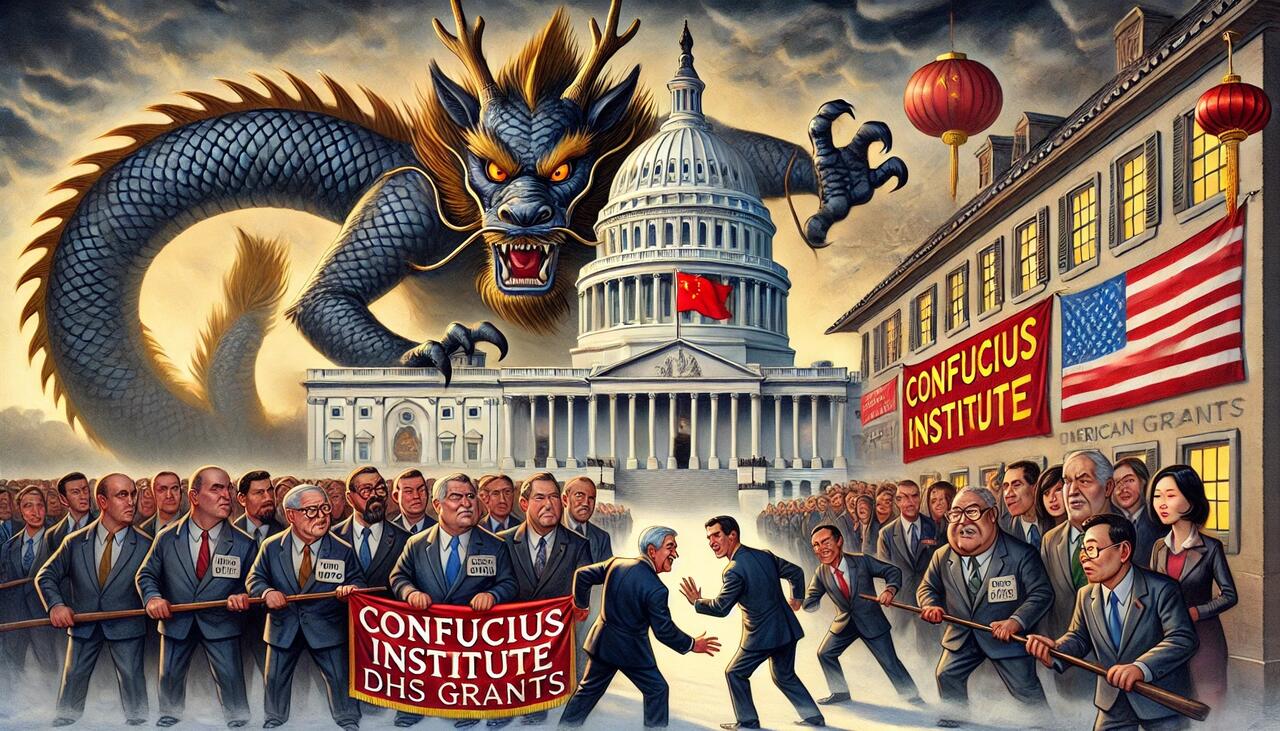
On September 9th, the House passed 15 bills, all designed to ensure that the United States keeps its edge in tech and to combat China's alleged subversive activities. Front and center was a bill introduced by Rep. August Pfluger (R-TX) that bars American schools, which are cozy with Confucius Institutes (CIs)—widely seen as CCP propaganda hubs—or are recipients of Chinese funds, from getting any grants from the Department of Homeland Security (DHS).
The Senate now holds the bill's fate in its hands as it sits with the relevant committee. But for schools that cozy up to CIs, the writing's on the wall—you're either with the U.S. or you're helping the Chinese Communist Party (CCP) undermine America’s institutions.
“You’re either going to take a step in support of the strength of the United States and push back on the CCP... or you’re going to be on the side of somebody else’s security,” Pfluger thundered on the House floor.
Confucius Institutes Under Fire
The Confucius Institutes are funded by the CCP, which not only picks and pays for the textbooks but also sends over Chinese nationals to teach. A 2018 report from the U.S.–China Economic and Security Review Commission even laid bare the "longstanding and formal ties" between CIs and the CCP's United Front Work Department—a well-oiled machine for influence operations. And while many Confucius Institutes were forced to shut their doors in 2020 and 2021 after a State Department crackdown, the CCP has simply povited. Some of these so-called institutes just got a facelift, rebranding under different banners but maintaining the same mission.
As the Epoch Times notes further, A 2022 report revealed that although the institutes went through massive closure in the United States in 2020 and 2021 after the State Department designated the Confucius Institute U.S. Center (CIUS) as a Chinese foreign mission, a significant portion of them re-branded under similar programs.
Rep. Bennie Thompson (D-Miss.) and Rep. Seth Magaziner (D-R.I.) spoke against the bill, saying that the language was too broad to ban all types of DHS funding, including disaster relief, for all American colleges that receive money from China.
In a statement issued on Sept. 10, the White House supported the spirit of the bill but questioned the approach.
“The administration appreciates Congress’s efforts to ensure that DHS funding is made available only to partners that advance U.S. interests, homeland security, and democratic norms.
“However, there may be more appropriate ways to prevent DHS funding from being directed toward academic institutions that are vulnerable to the PRC’s increasing monetary influence.”
The bill passed later in the afternoon with a vote of 249–161, with most representatives voting on party lines. Thirty-six Democrats voted for the bill.
The amended version narrowed down the definition of Chinese entities of concern to those that assist the persecution of Uyghur Muslims, work against U.S.–Taiwan relations, or take part in the Thousand Talents Program, a Chinese initiative to attract talent with critical military technology.
Only the recipient of funding from these Chinese entities of concern will disqualify an American higher education institution from receiving DHS funding.
The amended version also requires the Secretary of Homeland Security to report to Congress any colleges among DHS grant recipients that work with a Confucius Institute or Chinese entity of concern.
After the passage of his bill, Pfluger wrote in an emailed statement to The Epoch Times that the CCP is using Confucius Institutes to “infiltrate American university campuses and engage in espionage, steal intellectual property, intimidate Chinese dissidents, promote communist propaganda, and funnel sensitive information back to the People’s Liberation Army.”
“This bill protects students and universities while ensuring that American dollars are not enabling foreign malign influence,” he said.
The bill passed shortly after a prominent American university cut ties with the CCP.
On Sept. 6, Georgia Tech announced that it would not continue its Shenzhen Institute (GTSI) in Shenzhen, China’s southern city bordering Hong Kong. Georgia Tech reached an agreement with Tianjin University, a public research university in China, in 2016 to establish the GTSI.
The university cited its “extensive role in national security” and the fact that the Commerce Department has blacklisted Tianjin University since December 2020 as reasons to pull the plug on the institute in China.
Current students can still graduate through the program.
Several months ago, Rep. John Moolenaar (R-Mich.), chair of the House China panel, launched an investigation into Georgia Tech’s Tianjin University partnership.
Moolenaar welcomed Georgia Tech’s decision.
“I appreciate Georgia Tech’s productive engagement with the committee’s investigation and look forward to continuing to work with Georgia Tech as they proceed with the termination.”
The congressman also called for other colleges with similar ties to consider the potential impact.
“It is my hope that other American institutions of higher learning who have similar arrangements with Chinese institutions will pay close attention here and likewise think hard about the impact their pursuits in China are having on America’s long-term national security.”