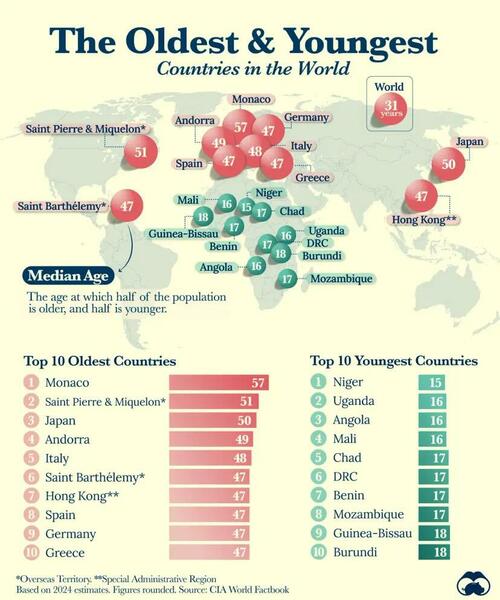
The median age of a country denotes the midpoint age of a country's population - meaning that half the population is younger, and half is older.
Factors which influence this are birth rate - with a high birth rate typically leading to a younger population, and lower birthrates contributing to an older median age, as well as death rate - the number of deaths per 1,000 people. Other factors include life expectancy, migration patters, healthcare and sanitation, and economic conditions. Wealthier nations tend to have fewer children, leading to a higher median age, while developing countries tend to have higher birth rates and therefore a lower median age.
As Visual Capitalist's Pallavi Rao notes, the median age can help government and private companies plan for age-specific demand for goods and services from the resident population.
Monaco and Japan—two countries with high life expectancies and low birth rates—have some of the highest median ages (50+) in the world.
A high median age is indicative of an aging population. Without policy support, this can lead to economic ramifications.
Here are the median ages of 200+ countries and territories in the world.
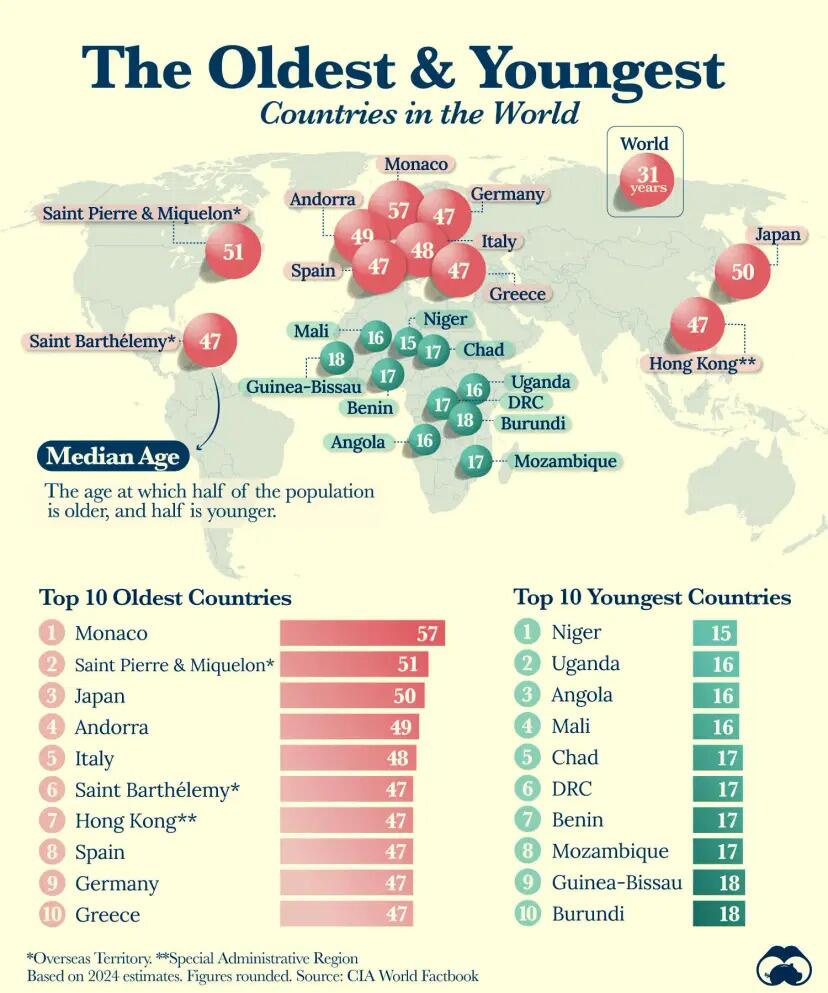
Meanwhile, the presence of six European nations on the oldest countries list is a quick insight into the continent’s changing demographic. The UN estimates that one in four Europeans are currently aged 60 and over.
Conversely, many countries in Africa have low life expectancies and high birth rates. This results in the opposite phenomenon: lower median ages.
A low median age also has its own concerns. A higher proportion of children and adolescents can strain the education infrastructure. Without enough job growth, underemployment and unemployment can rise.
However, if managed well, low median ages can lead to a demographic dividend, where the workforce temporarily grows faster than the dependent population, increasing per capita income.