
Hawaii has the heaviest state and local tax burden at 13.3% of personal income, nearly three times Alaska's 4.92%, according to WalletHub's 2026 figures, compiled by Visual Capitalist.
New York is second at 12.39% and Vermont third at 11.1%, and only five states top 10%. California ranks 11th at 9.24% and Texas 36th at 7.69%, against a national average of 8.43%. The measure combines property, individual income, and sales and excise taxes as a share of personal income, and excludes federal taxes.
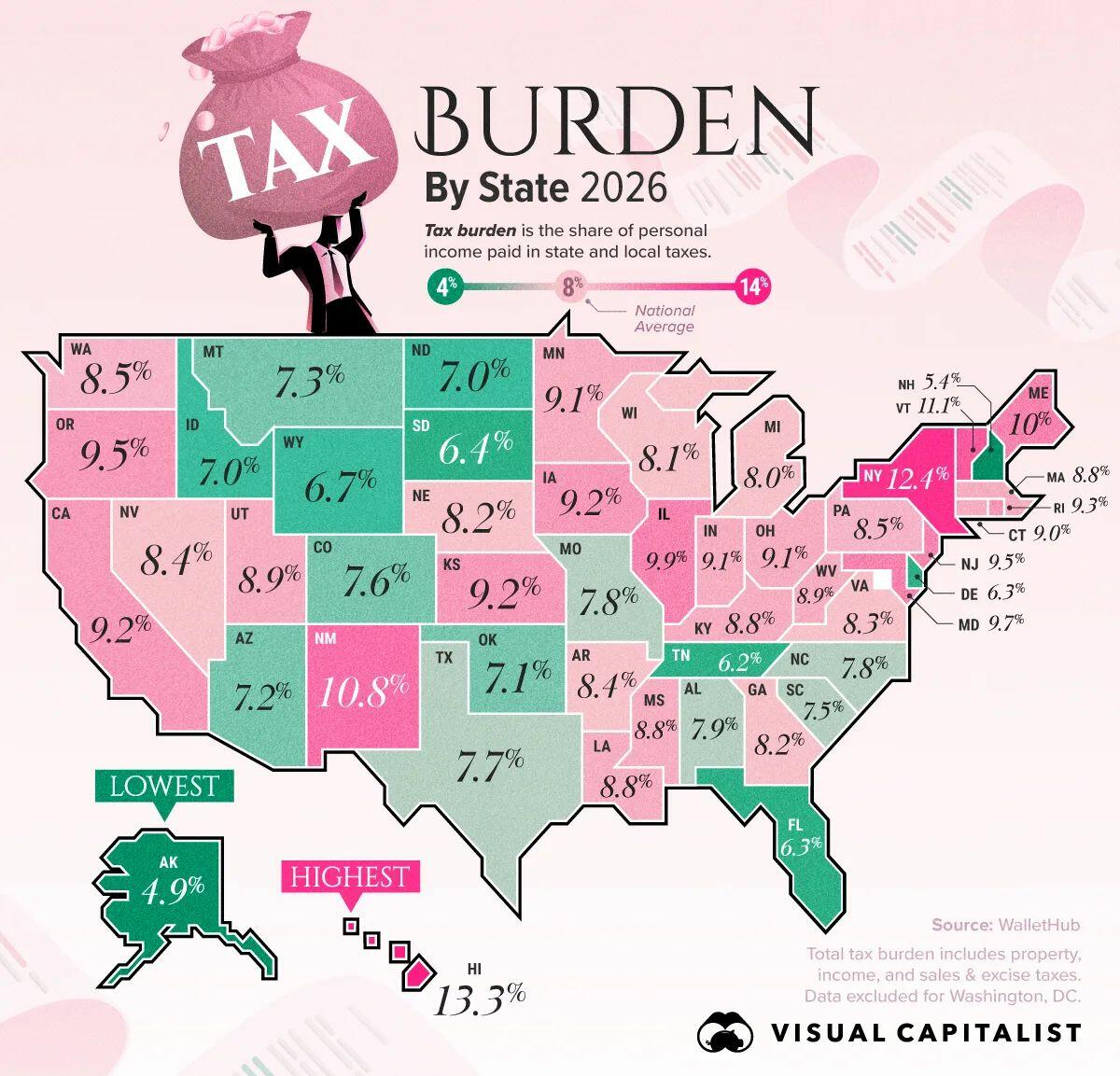
As Visual Capitalist explains further,
Where Americans live can make a substantial difference in how much of their income goes toward state and local taxes.
This map compares tax burdens across all 50 states using 2026 figures from WalletHub. Total tax burden combines property, individual income, and sales and excise taxes as a share of personal income, excluding federal taxes.
Nationwide, the average tax burden is 8.43%, but states differ considerably in both how much they collect and which taxes account for the largest share.
Where Tax Burdens Are Highest and Lowest
The difference between the highest- and lowest-tax states is substantial: Hawaii's tax burden is nearly three times Alaska's, highlighting how differently states fund public services.
The Northeast accounts for half of the 10 highest tax burdens, while New Mexico stands out at 10.75%, among the highest outside the region.
The table below ranks all 50 states by their overall tax burden in 2026.
| Rank | State | Overall Tax Burden in 2026 (%) |
|---|---|---|
| 1 | Hawaii | 13.30 |
| 2 | New York | 12.39 |
| 3 | Vermont | 11.10 |
| 4 | New Mexico | 10.75 |
| 5 | Maine | 10.01 |
| 6 | Illinois | 9.92 |
| 7 | Maryland | 9.70 |
| 8 | New Jersey | 9.52 |
| 9 | Oregon | 9.46 |
| 10 | Rhode Island | 9.29 |
| 11 | California | 9.24 |
| 12 | Iowa | 9.21 |
| 13 | Kansas | 9.20 |
| 14 | Indiana | 9.12 |
| 15 | Minnesota | 9.08 |
| 16 | Ohio | 9.05 |
| 17 | Connecticut | 9.00 |
| 18 | West Virginia | 8.89 |
| 19 | Utah | 8.87 |
| 20 | Mississippi | 8.84 |
| 21 | Louisiana | 8.82 |
| 22 | Massachusetts | 8.82 |
| 23 | Kentucky | 8.76 |
| 24 | Pennsylvania | 8.47 |
| 25 | Washington | 8.47 |
| 26 | Arkansas | 8.44 |
| 27 | Nevada | 8.37 |
| 28 | Virginia | 8.26 |
| 29 | Nebraska | 8.16 |
| 30 | Georgia | 8.15 |
| 31 | Wisconsin | 8.12 |
| 32 | Michigan | 7.98 |
| 33 | Alabama | 7.93 |
| 34 | Missouri | 7.84 |
| 35 | North Carolina | 7.81 |
| 36 | Texas | 7.69 |
| 37 | Colorado | 7.56 |
| 38 | South Carolina | 7.49 |
| 39 | Montana | 7.29 |
| 40 | Arizona | 7.24 |
| 41 | Oklahoma | 7.05 |
| 42 | Idaho | 7.04 |
| 43 | North Dakota | 7.02 |
| 44 | Wyoming | 6.70 |
| 45 | South Dakota | 6.38 |
| 46 | Delaware | 6.28 |
| 47 | Florida | 6.27 |
| 48 | Tennessee | 6.21 |
| 49 | New Hampshire | 5.38 |
| 50 | Alaska | 4.92 |
Beyond the highest and lowest rankings, the map reveals striking regional contrasts.
On the West Coast, income taxes contribute the largest share of Oregon's burden, while Washington relies more heavily on sales and excise taxes.
Hawaii's Steep Tax Bill
Hawaii's position at the top of the ranking is driven largely by consumption-related taxes, which account for more than half of its total burden.
Unlike a conventional retail sales tax, Hawaii's broad general excise tax applies to business receipts from goods, services, construction, and rent, not just profits.
Wholesalers and retailers can both owe the tax, meaning a product can generate tax revenue at multiple stages before reaching the final buyer.
Renters can encounter it as well. Landlords owe general excise tax on rental receipts and may pass that cost on to tenants. The tax therefore affects both everyday purchases and housing payments.
Alaska's Resource Wealth Helps Pay the Bills
Alaska levies neither a personal income tax nor a statewide sales tax, although municipalities can collect local taxes. The state also benefits from an unusual funding source: an investment fund built largely from oil and gas revenues.
The Alaska Permanent Fund invests a share of the state's mineral revenue, turning finite natural resources into a source of ongoing investment income.
In fiscal 2026, approximately $3.8 billion was transferred from the Permanent Fund to support Alaska's state budget.
This gives Alaska a funding advantage that most states lack: investment earnings from decades of resource production help finance public services without relying as heavily on taxes paid by residents. The state also distributes annual Permanent Fund dividends to eligible Alaskans.