
Authored by Chris Summers via The Epoch Times,
President Donald Trump has suggested that companies building data centers in the United States should offer local communities a dividend to make them more popular.
“If companies want to make their Data Centers popular, pay the community, and/or individuals within the community, a ‘dividend,’” Trump said in a Truth Social post on Wednesday.
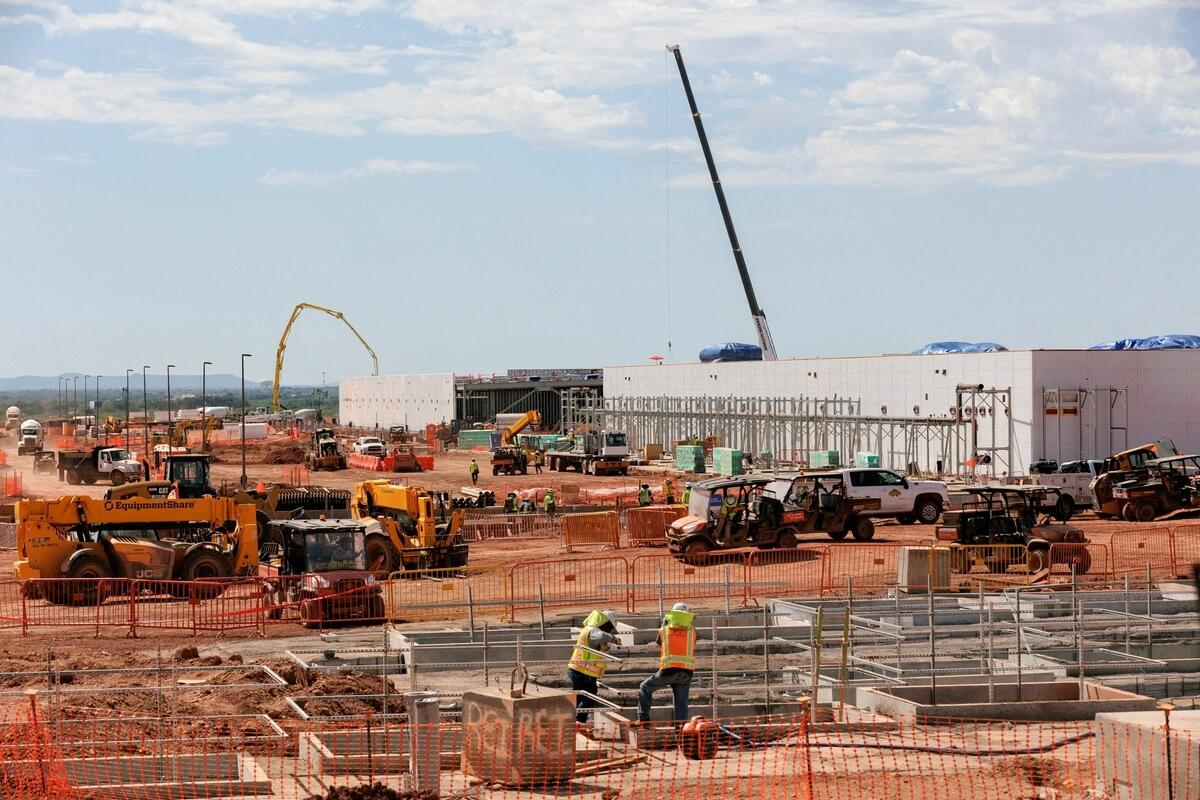
New data centers, which are required to fuel the growth of artificial intelligence (AI), have become politically controversial in some areas because of the amount of electricity and water they consume.
Local resistance blocked or delayed at least 75 data center projects, worth $130 billion, in the first quarter of 2026, according to Data Center Watch.
The Trump administration has supported AI, and the president said last month that U.S. government documents would start referring to it as “super intelligence.”
On Oct. 4, Trump announced the creation of the Super Intelligence Force to coordinate federal efforts to maintain the United States’ lead over China in AI technology.
“As the President of the United States, I have been watching Data Centers very closely, and have come to a very strong conclusion,” Trump wrote on Wednesday.
“New and large, in some cases gigantic, Data Centers are mandated by me to make their own electricity, and give or sell any excess back to the local community, or grid, and therefore there is [an] electric price increase. In fact, there could be a substantial decrease.”
“MAKE DEALS, and get them built!!! GREAT FOR THE U.S.A,” Trump also wrote.
In February, during his State of the Union address, Trump said his administration had secured agreements with tech companies to pay a greater share of the costs electric utilities—and their residential customers—incur when data centers and other high-tech “large load” users boost demand and strain supply.
Trump introduced what he called “a rate payer protection pledge” in which tech companies, or “hyperscalers,” agree to pay more for the electricity they use to power data centers and vow to “pay their own way” so their high demand for electricity doesn’t affect utility customers’ bills.
The president said he supports “co-location” of new energy sources and data centers to accelerate AI infrastructure buildout through initiatives that fast-track permits, reduce regulatory hurdles, and make federal land available for these projects.
Meta has agreed to build a data center on the site of a planned 400-megawatt natural gas plant in New Albany, Ohio, and Google has partnered with Intersect Power to build co-located data centers in so-called energy parks alongside solar and storage generation in a nationwide $20 billion venture.
But how data center development affects residential consumer rates is hotly debated and will likely be an issue in the 2026 midterm elections, including in dozens of House races.
Evidence shows that the Chinese regime is seeking to use the issue of data centers to sow division.
Cleo Paskal, a senior fellow at the Foundation for Defense of Democracies, previously told The Epoch Times that while energy availability and water depletion were real issues, the Chinese Communist Party (CCP) was trying to exploit them to block data centers.
“But it’s also a real issue that the Chinese Communist Party is perfectly happy to exacerbate to create even more division with the goal not of leading to any solution, but of paralyzing the United States,” she said.
OpenAI has accused CCP influence operators of jumping on the data center bandwagon.
“The targeting of OpenAI and US data center buildouts is significant not because the operation appears to have shifted public opinion, but because it shows [People’s Republic of China]-origin influence operators testing narratives against AI infrastructure—a foundation of US technological leadership, economic growth and the broader democratic AI ecosystem,” the company said in a report published in June.