Because every finite field of a given size is equivalent, any field with 256 elements always has the same universal properties. Galois, who died at age 20 in the chaos of post-Napoleon France, blazed the mathematical trail to much of this area, so we call the field with 256 elements GF(28), or "Galois Field with 28 elements".
Weirdly, members of a field of size pn are equivalent to polynomials of degree up to n, with coefficients chosen from integers modulop (a "field with characteristic p"). For example, we might do the obvious thing and represent numbers like 0 or 1 with the polynomial 0 or 1. So far, so good, but 2 is problematic because we can only have coefficients modulo p, so we bump up a power of the polynomial to x, and pick "2=10=1x+0". This results in a simple correspondence between the bits in a binary representation of a number and the terms of the corresponding field polynomial.
| Number |
Binary |
GF(28) Polynomial |
Simplified |
| 0 |
0 |
0 |
0 |
| 1 |
1 |
1 |
1 |
| 2 |
10 |
1x+0 |
x |
| 3 |
11 |
1x+1 |
x+1 |
| 4 |
100 |
1x2+0x+0 |
x2 |
| 5 |
101 |
1x2+0x+1 | x2+1 |
| 8 |
1000 |
1x3+0x2+0x+0 | x3 |
| 16 |
10000 |
1x4+0x3+0x2+0x+0 | x4 |
| 21 |
10101 |
1x4+0x3+1x2+0x+1 | x4+x2+1 |
Luckily, the mathematical structure is just there to compute the values of the substitution tables, or motivate some simple shifting and XOR work--we certainly don't have to "convert numbers to polynomials" at runtime, and we never actually evaluate the polynomials at any x.
Finite Field Addition
We can figure out how addition works in a finite field by adding the underlying polynomials. For example:1 + 2 = 1+10 = (1)+(1x+0) = 1x+1 = 11 = 3
Yet because we only have single-bit
polynomial coefficients,
2 + 2 = 10+10 =
(1x+0)+(1x+0) = 2x = 0x = 0
Because of this single-bit binary
wraparound, it turns out that in GF(28), addition, subtraction, and XOR are
all the same operation. This seems like a pretty radical
departure from ordinary addition, but in a circuit, it just
corresponds to throwing away the carry bits from each single-bit
addition.
Here's an addition table for GF(24), a 4-bit (single hex digit) finite field:
0 1 2 3 4 5 6 7 8 9 a b c d e f
1 0 3 2 5 4 7 6 9 8 b a d c f e
2 3 0 1 6 7 4 5 a b 8 9 e f c d
3 2 1 0 7 6 5 4 b a 9 8 f e d c
4 5 6 7 0 1 2 3 c d e f 8 9 a b
5 4 7 6 1 0 3 2 d c f e 9 8 b a
6 7 4 5 2 3 0 1 e f c d a b 8 9
7 6 5 4 3 2 1 0 f e d c b a 9 8
8 9 a b c d e f 0 1 2 3 4 5 6 7
9 8 b a d c f e 1 0 3 2 5 4 7 6
a b 8 9 e f c d 2 3 0 1 6 7 4 5
b a 9 8 f e d c 3 2 1 0 7 6 5 4
c d e f 8 9 a b 4 5 6 7 0 1 2 3
d c f e 9 8 b a 5 4 7 6 1 0 3 2
e f c d a b 8 9 6 7 4 5 2 3 0 1
f e d c b a 9 8 7 6 5 4 3 2 1 0
(Try this in NetRun now!)
Rather like Sudoku, for inverses to exist we need each output to appear in each row and column exactly once.
Finite Field Multiplication
Multiplication in a finite field works just like polynomial multiplication (remember Algebra II?), which means:2*2=10*10= (1x+0)*(1x+0)=x*x=x2=1x2+0x+0=100=4
This works fine except for the problem of generating polynomial degrees higher than n: for example, 16*16=x4*x4=x8, which is just beyond GF(28). To fix this, we "reduce" higher degrees by subtracting off multiples of a "reducing polynomial", which for AES isx8 + x4 + x3 + x + 1 (in hex, 0x11b). There are lots of choices of reducing polynomial (they need to be "irreducible", the polynomial equivalent of prime, to work out), but it turns out they only permute the numbers, not change the underlying mathematical structure.
In this case, we subtract off the
reducing polynomial once:
16*16=x4*x4=x8=x8-(x8 + x4 + x3 + x + 1)=-(x4 + x3 + x + 1)
Since
every element is its own additive inverse, this is:
...=x4 + x3 + x + 1=11011=27.
Note that an even times an even *can*
give you an odd this way!
The reduction operation gives
multiplication in a finite field a strange flavor. For
example, here's the 256-entry hex multiplication table (from Wikipedia) for multiplying by 2 (1x+0) in GF(28):
0x00,0x02,0x04,0x06,0x08,0x0a,0x0c,0x0e,0x10,0x12,0x14,0x16,0x18,0x1a,0x1c,0x1e,
0x20,0x22,0x24,0x26,0x28,0x2a,0x2c,0x2e,0x30,0x32,0x34,0x36,0x38,0x3a,0x3c,0x3e,
0x40,0x42,0x44,0x46,0x48,0x4a,0x4c,0x4e,0x50,0x52,0x54,0x56,0x58,0x5a,0x5c,0x5e,
0x60,0x62,0x64,0x66,0x68,0x6a,0x6c,0x6e,0x70,0x72,0x74,0x76,0x78,0x7a,0x7c,0x7e,
0x80,0x82,0x84,0x86,0x88,0x8a,0x8c,0x8e,0x90,0x92,0x94,0x96,0x98,0x9a,0x9c,0x9e,
0xa0,0xa2,0xa4,0xa6,0xa8,0xaa,0xac,0xae,0xb0,0xb2,0xb4,0xb6,0xb8,0xba,0xbc,0xbe,
0xc0,0xc2,0xc4,0xc6,0xc8,0xca,0xcc,0xce,0xd0,0xd2,0xd4,0xd6,0xd8,0xda,0xdc,0xde,
0xe0,0xe2,0xe4,0xe6,0xe8,0xea,0xec,0xee,0xf0,0xf2,0xf4,0xf6,0xf8,0xfa,0xfc,0xfe,
0x1b,0x19,0x1f,0x1d,0x13,0x11,0x17,0x15,0x0b,0x09,0x0f,0x0d,0x03,0x01,0x07,0x05,
0x3b,0x39,0x3f,0x3d,0x33,0x31,0x37,0x35,0x2b,0x29,0x2f,0x2d,0x23,0x21,0x27,0x25,
0x5b,0x59,0x5f,0x5d,0x53,0x51,0x57,0x55,0x4b,0x49,0x4f,0x4d,0x43,0x41,0x47,0x45,
0x7b,0x79,0x7f,0x7d,0x73,0x71,0x77,0x75,0x6b,0x69,0x6f,0x6d,0x63,0x61,0x67,0x65,
0x9b,0x99,0x9f,0x9d,0x93,0x91,0x97,0x95,0x8b,0x89,0x8f,0x8d,0x83,0x81,0x87,0x85,
0xbb,0xb9,0xbf,0xbd,0xb3,0xb1,0xb7,0xb5,0xab,0xa9,0xaf,0xad,0xa3,0xa1,0xa7,0xa5,
0xdb,0xd9,0xdf,0xdd,0xd3,0xd1,0xd7,0xd5,0xcb,0xc9,0xcf,0xcd,0xc3,0xc1,0xc7,0xc5,
0xfb,0xf9,0xff,0xfd,0xf3,0xf1,0xf7,0xf5,0xeb,0xe9,0xef,0xed,0xe3,0xe1,0xe7,0xe5
The whole first half of the table is boringly identical to integer multiplication, but the reduction starts being needed halfway through, and the results start bouncing around, especially in the low bits.
Here's a multiplication table for GF(24), using a reduction polynomial of 0x13 == 10011 == x4+x+1. (See some more detailed GF(16) examples here.)
0 0 0 0 0 0 0 0 0 0 0 0 0 0 0 0
0 1 2 3 4 5 6 7 8 9 a b c d e f
0 2 4 6 8 a c e 3 1 7 5 b 9 f d
0 3 6 5 c f a 9 b 8 d e 7 4 1 2
0 4 8 c 3 7 b f 6 2 e a 5 1 d 9
0 5 a f 7 2 d 8 e b 4 1 9 c 3 6
0 6 c a b d 7 1 5 3 9 f e 8 2 4
0 7 e 9 f 8 1 6 d a 3 4 2 5 c b
0 8 3 b 6 e 5 d c 4 f 7 a 2 9 1
0 9 1 8 2 b 3 a 4 d 5 c 6 f 7 e
0 a 7 d e 4 9 3 f 5 8 2 1 b 6 c
0 b 5 e a 1 f 4 7 c 2 9 d 6 8 3
0 c b 7 5 9 e 2 a 6 1 d f 3 4 8
0 d 9 4 1 c 8 5 2 f b 6 3 e a 7
0 e f 1 d 3 2 c 9 7 6 8 4 a b 5
0 f d 2 9 6 4 b 1 e c 3 8 7 5 a
This is generated by the following code:
// Bitwise ("peasant") multiplication, using galois addition
for (int bit=3;bit>=0;bit--) {
	if (b&(1<<bit))
		c=c^(a<<bit);
}

// Reduce back into galois field (can also be folded into above loop)
int irr=0x13; // represents reduction polynomial
int high=0x10; // high bit of above
for (int bit=3;bit>=0;bit--) {
	if (c&(high<<bit))  // if that bit is set
		c=c^(irr<<bit); // galois "subtract" it off
}
For
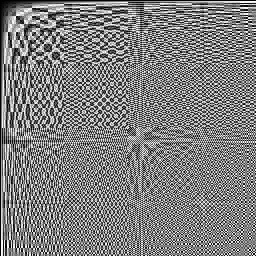
GF(2^8), the AES field, this is the multiplication table:
Note that forward multiplication is just a short algorithm, but it's weirdly nonlinear enough that division in a finite field is hard--typically you build a table of multiplicative inverses, and multiply by the inverse. You can also perform both multiplication and division efficiently by making a table of logarithms and antilogarithms. Tables work for these fields because there are only 256 elements!
AES's Operations
Each round of AES consists of these operations, on a 4x4 grid of bytes.- Each byte in the grid is run through an S-box. This consists of a multiplicative inverse, followed by an affine transformation--a series of additions and multiplies by 0 or 1. The affine transformation fixes the problem with 0 (no multiplicative inverse, so by convention 1/0=0), and messes up the mathematics so you can't string multiplicative inverses together.
- ShiftRows shifts each byte horizontally in the 4x4 grid. Row i is shifted circularly by i bytes.
- MixColumns computes a linear
transformation on each column. A linear transformation is
just a series of finite field multiplications and additions. The
matrix used is invertible, so there's an inverse
operation. It's also chosen such that every output byte
changes if any single input byte changes.
- Finally, the round keys are added (the same operation as XOR in a finite field) to each byte.
Why Bother?
The big advantages of working in a finite field are:- Numbers stay small--everything in GF(28) is always one byte, even after multiplication or division.
- Inverses exist for each operation, which makes decryption
possible. This is superior to the simpler modular
arithmetic in a power of two modulus, where multiplying by 2
loses the high bit.
- The mathematics are well understood, dating to the 1830's. This makes it easy for you to pick good mixing functions, and makes it less likely somebody is going to surprise you with a new analysis technique.
- There are enough operations for them to combine in rich ways:
AES combines division in the first half of the S box, a
transpose in the row shift, and matrix operations during
MixColumns and the second half of the S box. Matrix
operations don't commute with each other, and the transpose and
division keeps you from multiplying the matrices together.
By contrast, for example, if you've only got addition, you're a
shift cipher no matter how many operations you do; if you've
only got addition and multiplication, you're a linear cipher no
matter how many operations you do.