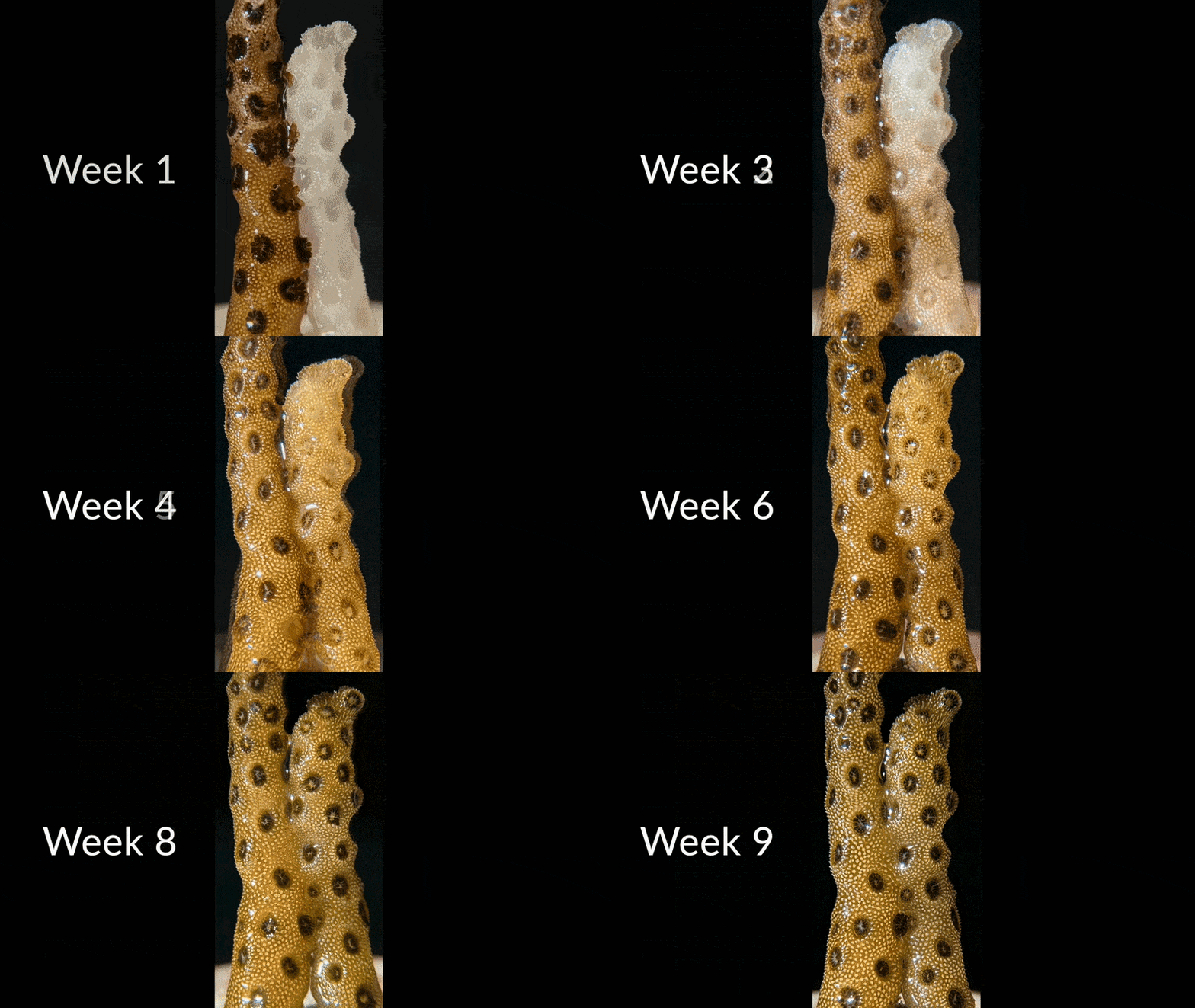

This video shows a bleached coral fragment brought back to health within weeks through fusion with a vibrant fragment from the same individual. Credit: Danny Collins
Scientists have rapidly restored bleached coral in a laboratory by placing it in contact with a healthy fragment, giving hope for reversing widespread coral decline.
Rising sea temperatures are stressing corals, causing the animals to expel the symbiotic algae that live in their tissues and give them their colour — a process known as bleaching. Because the photosynthetic algae (Symbiodiniaceae) provide corals with most of their nutrients, without them, the marine organisms are likely to starve and die.
A team of researchers has now shown that it is possible to fully reverse this bleaching process, in just days. It reported the findings in Science Advances on 14 October1.
“This incredible new result — that fast and full recovery is possible in bleached coral — can inspire solutions that eventually may be scalable,” says Fiorenza Micheli, a marine ecologist at Stanford University’s Center for Ocean Solutions in California and a co-author on the study.
In early 2025, marine scientist, and study co-author, Stephen Palumbi at Hopkins Marine Station in Pacific Grove, California, was working in the lab and noticed that two coral fragments in a tank were accidentally touching. Where the healthy and bleached fragment met, colour had begun to seep into the ghostly branch. “I’d never seen that before,” he remembers.

Symbionts spread from the healthy into the bleached coral.Credit: Danny Collins
Danny Collins, who was studying how disease spreads through coral contact as part of his PhD at Stanford, set out to investigate whether algae can also spread and, if so, how.
He prepared ten pairs of coral fragments from the same animal (Pocillopora damicornis)., Each pair had a bleached and a healthy fragment. He set up five pairs so that their fragments touched each other, and five with their fragments separated by a few millimetres. In the touching pairs, the bleached coral recovered within eight weeks.
“We were blown away when we watched the colour of the algal symbionts transfer over to the bleached coral, reviving it in a very short period of time,” Collins says. By week two, the symbiont population was doubling every four days, which is much faster than the recovery times seen in studies of coral recovering naturally in the wild2,3.
After touching the healthy fragment for a week, a bleached branch could fully recover on its own, even if separated from the healthy branch.
In the slightly separated pairs, the bleached fragments died after 20 weeks.
Using high-powered microscopy, the team showed that two coral fragments fuse together by creating a tissue bridge — enabling symbiont transfer. This only occurred for coral fragments taken from an individual of the same genetic make-up, called a genet. Fragments from different species and even different animals of the same species did not fuse together, and so did not nurse the bleached piece back to health.