Garfield Hylton has long known that Amazon monitors and logs every minute of his working day. Every product he scans, every second he takes between scans, every time his scanner is briefly inactive – all of it is tracked, recorded, and used to set productivity targets and predictions.
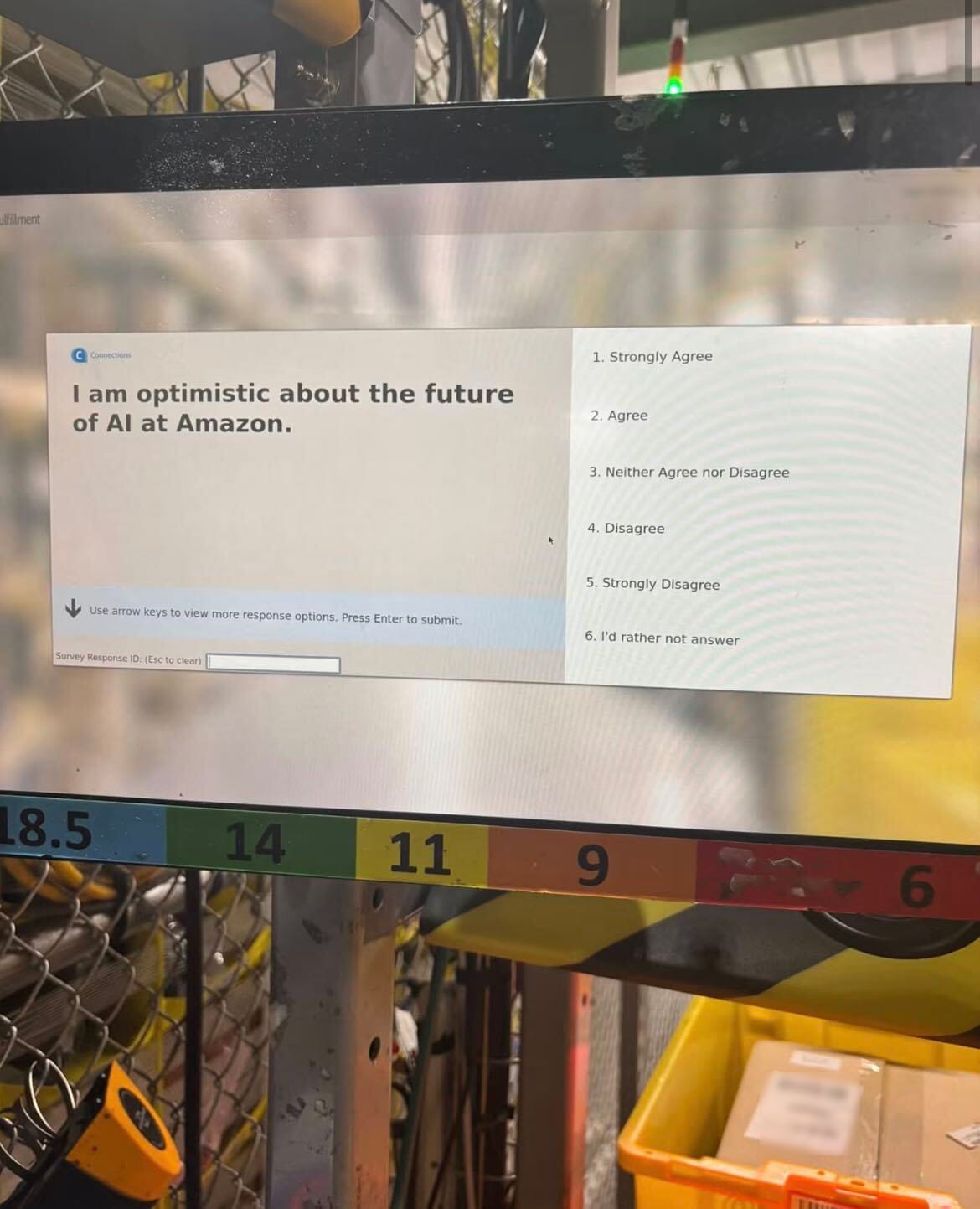
But what 62-year-old Hylton didn’t know is that Amazon seemingly also monitors potential “dissent” in the Coventry warehouse where he works, using AI to surveil posts on social media and the company’s internal staff bulletin board.
Internal documents made public as part of a court battle between Amazon and a Canadian union suggest the tech giant uses Atlas, an in-house AI forecasting tool, to predict how likely its warehouse staff in the US, Canada and the UK are to attempt to form a union, stage a sit-in, or conduct other “disruptive labour events”.
The documents, which appear to be training resources for Amazon managers in Canada, contain an appendix stating Atlas amasses “hundreds of data points” – including posts on Reddit forums and employees’ responses to internal feedback surveys, as well as wider information on the workplace and any previous industrial action – to award warehouses a risk score of between 100 and 900 for union activity.
The lower the score, the more likely Atlas believes workers – whom Amazon calls ‘associates’ – in that warehouse are to unionise or take other actions that could impact Amazon’s productivity or profitability. The document states that for the company’s leadership, higher scores are “better”.
This “makes it clear that they think the union is bad”, Michael Newman, a partner at London-based law firm Leigh Day, told openDemocracy. Newman said it tells “a very different story” from Amazon’s previous assertions that it does not seek to prevent workers from joining a union.
Warehouses appear to be categorised into five tiers based on their Atlas score, where Tier 5 is “no immediate perceived risk” and Tier 1 is “future activity is imminent”. The document suggests this scale can be used to “inform staffing decisions, resource planning, standard actions, and ownership to mitigate risks to Amazon labour structure”.
An Amazon spokesperson refuted the characterisation of Atlas as “individual employee monitoring or surveillance”, stating: “This is site/building level activity only.”
They added that the company does “not track individual employees’ opinions, affiliations or union membership”, or any “personal data”, and said Atlas is not used to monitor dissent, but to “help us understand where associates need more support and to ensure we’re addressing issues that they raise”.
In total, 16 Amazon warehouses across the US, Canada and the UK are “Tier 1”, according to the document. Two are in the UK: a £500m robotic-fulfilment centre in Sutton Coldfield, north-east Birmingham (referred to by Amazon as EMA4), and the warehouse where Hylton works near Coventry (BHX4).
Hylton, whose role involves receiving goods into the warehouse and dispatching them on to other warehouses, is a member of the GMB union. He believes the extent of the data Amazon has collected on his colleagues creates a huge power imbalance, with workers having only their own experiences to defend themselves.
“It’s not right in a democracy… the employer should not be interfering,” he said, speaking to openDemocracy soon after learning about the Atlas tool from GMB. “Workers should be allowed to decide if they wish to choose to unionise,” he continued, adding: “If you're then monitoring, you're undermining a process deliberately and willfully.”
Rachel Fagan, an organiser for GMB, told openDemocracy: “It’s quite clear from these documents that these sites are being monitored for union activity. Everyone knows that Amazon is heavy on surveillance, but this becomes more personal.
“Amazon is using this technology to essentially outwit or manoeuvre workers that want to organise [a union]. Nothing in this fight against Amazon is an even playing field; they have all the wealth, all the technology, everything to their disposal and they use it,” she added.
GMB has long tried to unionise Amazon workers in the UK, coming closest to winning formal recognition in Coventry in July 2024. Employees at the warehouse became the first in the country to take strike action against Amazon in January 2023, and around 2,600 took part in an official ballot for union recognition at the site six months later, which GMB lost by just 28 votes.
The union and Foxglove, a tech justice non-profit, have accused Amazon of using “dirty tricks” to swing the vote in its favour. These include the mass hiring of non-unionised workers and allegedly plastering QR codes that employees could scan to cancel their GMB membership over screens, cafeteria tables, and toilet doors in the warehouse in the run-up to the vote.
Foxglove and Leigh Day are representing two workers in a legal challenge against Amazon’s use of ‘click-to-quit’ QR codes. They argue that the tool was an attempt to “bully” workers into ending their union membership.
The documents revealing Amazon’s Atlas AI tool were disclosed as part of a legal challenge by Canadian union Unifor and shared with US non-profit publication Truthout. The British Columbia Labour Board ultimately ruled that Amazon had violated multiple local labour laws, following an earlier ruling that found the company had unlawfully imposed a wage freeze on unionised workers at a warehouse outside Vancouver.
Rosa Curling, co-executive director of Foxglove, described the level of surveillance detailed in the document as “highly intrusive”, showing that Amazon has a “very intentional policy to try and bust organising, bust unionising efforts, and they are using all sorts of tools to do that”.
Curling continued: “We are actively reviewing these documents to see what additional arguments, if any, we should be adding to our existing claim to unlawful inducement, or indeed on like this ongoing breach of workers' rights to organise, which is a well-respected right in UK-made laws.”
Amazon told openDemocracy that a framework called Atlas is not currently used in the UK. The company had not responded to our question about whether it uses a similar system with a different name at the time of publishing.
Commenting on the AI system, Leigh Day’s Newman added: “Now we know Atlas is used by Amazon, we’ll be asking more questions about what data points are used, how these scores were reached.”
Amazon has previously been found guilty of “excessive” surveillance of its workers. In 2022, French data watchdog CNIL fined the company €32m (£27m) for breaching General Data Protection Regulation (GDPR) rules by tracking worker activity so precisely that an alert was triggered if workers were inactive for between one and 10 minutes.
Asked whether Amazon’s Atlas tool is an appropriate level of worker surveillance, a government spokesperson said: “Employers and workers have a shared interest in workplace monitoring technologies being used transparently and in ways that are fair, accountable and reliable, so that they can support productivity and good management while maintaining trust in the workplace.
“We expect all employers to respect workers’ rights to take part in lawful trade union activity.”
An Amazon spokesperson said: “The GMB's characterisation is wrong. This isn’t surveillance. Like any responsible employer, we have numerous ways for our team to provide us with feedback, and we use that feedback to identify where we can improve the day-to-day experience of our employees.
“Our employees always have the choice of whether or not to join a union. What matters most to us is the direct relationship between our teams and their managers – it means every person’s voice is heard, not just a few, and that when someone spots a way to improve their job, we can act on it quickly. We’ve made real progress in recent years on the things that matter, like pay and safety, and we know there’s always more to do. That’s our focus: getting better every day.”