[Epistemic status: intuitions and anecdotes.]
Recently, several posts and projects (Thoughts Memo, Babel Translation, Please Give Them a Chance) have taken important steps towards raising AI safety awareness and sharing rationalist philosophy in China. It’s great that we’re recognizing the importance of solving the messaging problem for China, and thus laying the groundwork for an international AI pause. Below I record my perspective on cultural differences which are relatively underdiscussed, which may become roadblocks to this communication program.
Background: I’m a “first-generation” Chinese-American who moved to the States at the age of four. The beliefs in this essay are primarily drawn from interactions with my parents and their generation of immigrants, and from consumption of Chinese media (dramas, webnovels, games, and manhua) which are not necessarily representative of the realities on the ground. I am likely over-indexed on the older generation and internet culture, and would appreciate corrections from folks who have direct lived experience. The picture I aim to paint is also complicated by a massive generational gap, and my understanding is that some of the below sentiments (e.g. the cynicism and nationalism) are partly inherited by the younger generation, and partly rejected through a variety of countercultures.
Briefly, I point to four axes along which China is strikingly different. These differences are not black-and-white, but I think if you take the liberal middle-class western bubble I live in and shift the mode ~1 standard deviation in these directions you would get a substantively more accurate model of China:
- Chinese social media is like American junk food. Chinese people find American food disgusting: inauthentic slop inundated with additives and high fructose corn syrup. Westerners will find Chinese social media similarly disgusting: uncanny-valley filters are everywhere, and social media is omnipresent in every corner of life.
- Primacy of social reality, and of shame and “face.” Shame is seen as something that just works in China, and is the dominant lever by which virtue is enforced.
- Dark World thinking as described in Truth or Dare – a deep cynicism about human nature. People are by default out to get you. Emphasis on strength/competence and de-emphasis on kindness/virtue. Closely related to, but distinct from, scarcity mindset.
- Chinese nationalism as collective insecurity. The narrative is that China experienced a “century of humiliation” being brought to its knees by western colonizers, the Opium War, and Japanese atrocities in WW2, and the world still sees Chinese as “East Asian weaklings.” Through this lens, the primary drive of Chinese people is to prove themselves equal or superior to westerners and usher in the Chinese century.
One thing I was shocked by when visiting China is that my grandparents went down to the supermarket every afternoon to buy fresh veggies to cook dinner. Chinese people, at least the older generation, are extremely careful about what they ingest, and have extremely high standards about freshness and culinary discernment. The idea of Americans storing fruit, veggies, and preserved food from the grocery store for weeks in the fridge is repulsive to them.
I think the exact reverse of this dynamic exists for social reality. Chinese beauty filters are out of control. Similarly, here’s what much of pre-AI manhuas look like:

Left to right: 重生都市天尊; 都市仙王; 最强仙尊陈北玄; 武炼巅峰.
Westerners sometimes tell a story that China embraces AI because of some philosophical positivity towards technological progress. I don’t entirely discount this story, but my impression is that Chinese consumers already had a high tolerance for slop and AI content fit naturally into this ecosystem without ever triggering an uncanny-valley reflex. If anything, AI slop is of higher quality than some of the existing mass-produced content. According to this article, one new AI mini-drama (several hours in length) launches every 36 seconds on Douyin.
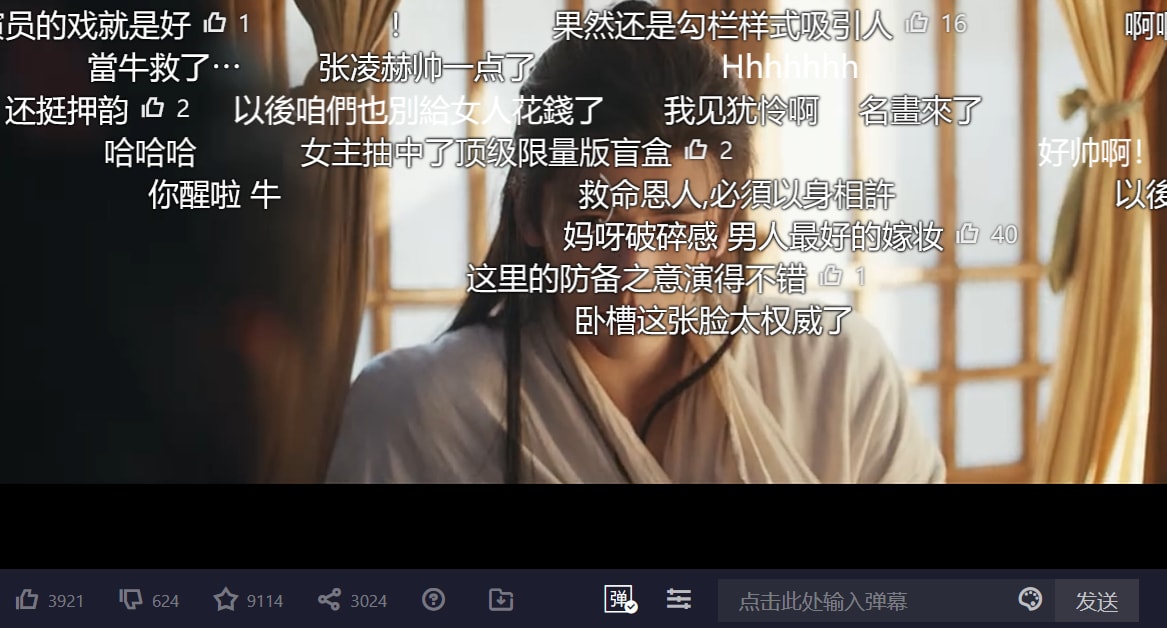
Another striking feature of Chinese media is the ever-presence of audience reactions and the surrounding cultural conversation. Here is what I see if I pull up the first episode of idol drama “Pursuit of Jade” with 弹幕 (bullet comments) on by default:
Here’s the first chapter of a randomly-selected popular novel on Qidian (the largest site for Chinese webnovels):
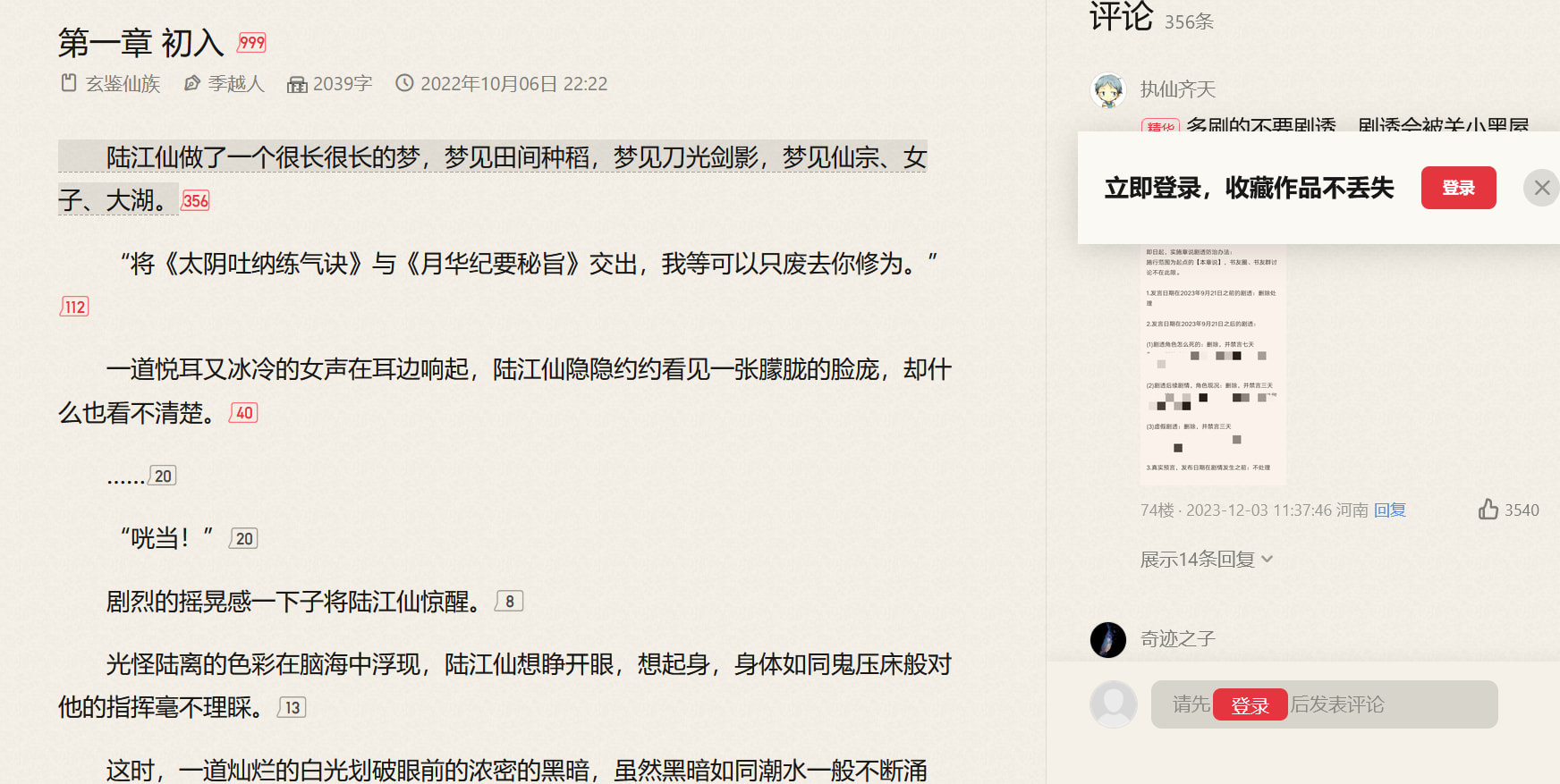
See for yourself: Qidian chapter.
Every sentence is annotated with reader comments – so interacting with the reactions of other netizens is now part of the reading experience. Often these comments are filled with memes and in-jokes (梗) which take years of internet immersion to understand. And thus reading a novel, something I classify as one of the most private experiences, is embedded into the cultural conversation.
There is a lot more I could say: writing is filled with “clickbait” attention-grabbers; astroturfing and doxxing are entrenched industries; and it is typical for important events in slop novels to be padded by pages of fictional “social media reactions” showcasing in-universe virality. The basic message is: how others react to something is as important as the thing itself.
The Primacy of Social Reality
Here is the first verse of a popular children’s song:
小嘛小儿郎
背着那书包上学堂
不怕太阳晒
也不怕那风雨狂
只怕先生骂我懒哪
没有学问啰无颜见爹娘
朗里格朗里呀朗格里格朗
没有学问啰无颜见爹娘I'm a small student.
I carry my backpack to school
I’m not afraid of the sun.
I’m also not afraid of the wind or the rain.
I'm only afraid that my teacher would scold me for being lazy
I'd lose face before my parents without the knowledge of school
Lan lee eh lan lan lee eh lan lan lee eh lan
I'd lose face before my parents without the knowledge of school.
This basic message is inculcated throughout Chinese upbringing: push through and ignore physical discomfort, but attend to and be subject to social censure. It’s okay to be buffeted by the elements, but if your grades are bad, you’ll be too ashamed to face your parents.
China lives inside an intricate and cynical theory of social reality. I wish I had some good writeups of this to point to; something that comes close is 48 Laws of Power, which cries out “this writer is sourcing from Chinese philosophy” but goes too far in the nuance-less sociopath manifesto direction.
To give some examples, the phrase 社死, “social death,” which means being so embarrassed that one might as well be dead socially, has gained a lot of popularity. I think there is a genuine sense in which people (everywhere, but more so in China) are more viscerally afraid of humiliation than death. (Again, there exists a nuanced dialectic about this phrase, and it is now used mostly ironically to joke about minor embarrassment. Further, many fictional protagonists are written as bold iconoclasts who do what is right despite social censure. I think this example still points to a culture preoccupied with social grace.)
Another example, as depicted in media, is a complex of subtle and entrenched rules “潜规则” (lit. “unspoken rules” or “underwater rules”) about social/corporate power that serve to enforce dominance hierarchies. The most salient such rule is “sleep with your boss to get ahead,” but more broadly, it points to dynamics like bribery and nepotism. Depending on status dynamics, being late is either a faux pas or a power move. Similarly with refusing to get drunk at a work dinner.
The Dark World Frame
A lot of anti-social behavior I used to intuitively attribute to "Dark Triad" pathologies – narcissism, Machiavellianism, psychopathy – I now attribute to a cluster of cynical/self-defensive beliefs that Duncan Sabien identifies in Truth or Dare as “The Dark World frame.”
Dark World thinking is typified by Peter Thiel’s recent viral quote: “If you’re evil, at least you’re not bad.” Dark World thinking is everywhere, but in my experience there’s a particularly brazen strain in China. Key tenets of the Dark World:
No good deed goes unpunished.
It is better to be strong than good.
It is better to be evil than weak.
It is better to be honest than kind.
A chain is only as strong as its weakest link.
That which can be destroyed should be.
Kindness to others is cruelty to oneself.
A common trope in Chinese stories is what I call parenting-by-cauterization. A cruel master forces a young boy to kill his best friend: “He was your greatest weakness, kill him and you have one fewer.” Forming attachments is weakness. Breaking attachments makes you strong. (To be fair, this pattern is usually attributed to antagonists, and generally rejected as needlessly cruel by the overarching plot. My reading is that this is a real dialectic-in-progress to reject a pattern of generational trauma.)
Dark World thinking sees all virtue and kindness as pretense. Among many such tropes, a common derogatory trope is of women who act nice and innocent 白莲花 (white lotus) while being deceitful and manipulative on the inside. Chinese media creates trapped priors that people acting kind, altruistic, and pure are more likely to be evil. Similarly, the phrase 圣母 (Virgin Mary) is derogatory slang for someone who displays excessive (read: normal-to-westerners) levels of empathy. If all kindness is pretense and deceit, the only way to signal trustworthiness is cruelty. My father used to say, “Everyone will be nice to you, but only your family will be honest.”
One time I was having lunch with my wife and a Chinese friend, and the conversation meandered to why my wife entered college as a premed in her distant past life. Among the many reasons – money, respectability, parental approval – my wife brought up the motivation of “saving lives and helping people.” My friend laughed open-mouthed at that suggestion, taking it as an obvious joke. (Again, I don’t mean to say this person is representative of China. I suspect that their reaction is two-standard-deviations more Dark-World than the mode in China, and three-standard-deviations more Dark-World than the mode in the West.)
Zvi Mowshowitz once wrote a book review of The Three-Body Problem, where his thesis was “The real aliens are the Chinese people”:
Instead, the humans are written a lot stranger, to my American eyes, than the Trisolarians. Most characters are Chinese, but even those who are not continue to mostly think and act in this similarly alien style. I appreciated the opportunity to see the view of humanity from someone in a completely different culture. But it points out how ordinary the Trisolarians are that they are, at least, not obviously less like the humans I know, than are the humans in the book. How much of this is how the Chinese or some Chinese group view humans and think about the world, versus how the author does? I cannot say.
The viewpoint expressed is deeply, deeply conservative and cynical.
People, all but a handful of them, are absurdly fickle, petty, short-sighted, self-interested and self-defeating. They are obsessed with status and how they are relative to others, and on the margin wish others harm rather than well. If anyone tries to escape disaster or otherwise rise on their own, universally mankind's response is to band together to kill them.
The Three-Body Problem is a particularly extreme example of the Dark World frame, and it’s an outlier because science fiction is grim-dark by default. My guess is that half of the Dark-Worldness of The Three-Body Problem derives from the nature of science fiction, and half from Chinese culture. There’s a reason the second book is called The Dark Forest.
Chinese nationalism as collective insecurity
At some point I was watching American Ninja Warrior, and one season hosted national teams from various countries. When the interviewer came around to hear people’s stories, all the western teams were like “I’m doing this to set a good example for my wife and kids at home.” The Chinese team was like “I’m doing this to prove to the world that Chinese people can be great athletes.”
In 2025 we saw the launch of an absolutely peak FMV game “Road to Empress” about instrumental convergence a fictionalized account of China’s only official female ruler Wu Zetian. Ludwig went viral in China for streaming it on Twitch, to the extent that the creators flew him out to China to film a cameo in the sequel:

Ludwig’s cameo.
The top comment on the Bilibili playthrough, which Ludwig reacted to in this clip, went, “This game is really good-looking. It can let foreigners know that Asians are not all squinty-eyed as in the stereotype [grin] There are also many handsome men and beautiful women.” Ludwig’s response was “I'm laughing that their idea of America is that before playing this game, I thought all people in Asia were the stereotype with the squinty eyes.”
Even among strains of nationalism, Chinese nationalism seems to be particularly chip-on-your-shoulder. My impression is that this kind of insecurity is less in your face, but still present, in younger Chinese today. It is concerning how much Chinese AI models catching up in the AI race is entangled with this national insecurity.
—
The point of this post is to open for the reader my fairly narrow window into Chinese culture, and to draw attention to certain features I find alien as an American.
I suspect that if the rationalist project wants to take root in China, it has to solve problems like not being immediately branded as holier-than-thou “圣母”, and adjusting to the cutthroat attention economy of Chinese social media. HPMOR is an example of something (grimdark power-scaling quasi-isekai fantasy) that likely appeals to Chinese netizens; Peter Singer is not.
I like to say that if LessWrong is “on the spectrum” and “more autistic than normal,” where normal is set to the ambient western culture, then China lives past the right endpoint of the spectrum, at “even more allistic than normal.” My current hypothesis is that the locally optimal message to China is in the vein of “give us your autists who feel alienated by the monoculture,” but others may prefer a more conciliatory approach that directly appeals to the dominant culture.