There's an optical illusion known by names like the "lunar terminator paradox". This has much discussion and descriptions online, but none made sense in my head, so I wrote this program to figure out what was going on. The paradox:
- The moon is illuminated by the sun
- After sunset, the sun is below, so we would expect the illuminated portion of the moon to point down, towards where the sun is
- This isn't what always happens!
I was camping in the mountains with a friend recently. We were looking up at the sky, just after the sun has set. The moon was clearly pointing up.
After playing with this program, I have clarity: we're looking up at the moon from below. The most pathological case is a full moon. Let's say the moon is on the horizon: elevation=0. If we're looking at this low moon, and the moon is full, the sun is directly behind us. The moon is fully illuminated, and we see 100% of the moon disc lit up.
Now, what happens if the moon is not at the horizon, but higher up at the sky? Effectively, the sun is infinitely far away, so the same part of the moon is lit up. But we're now looking at the moon from below, and we would see some of the dark side on the bottom edge. I.e. the moon appears bright at the top, but has a dark slice missing at the bottom: it points up! Even at sunset.
This is the most clearly weird case. A half-moon has no paradoxical behavior, and the more full the moon, the more clearly we can observe the bright moon pointing up despite the sun being down.
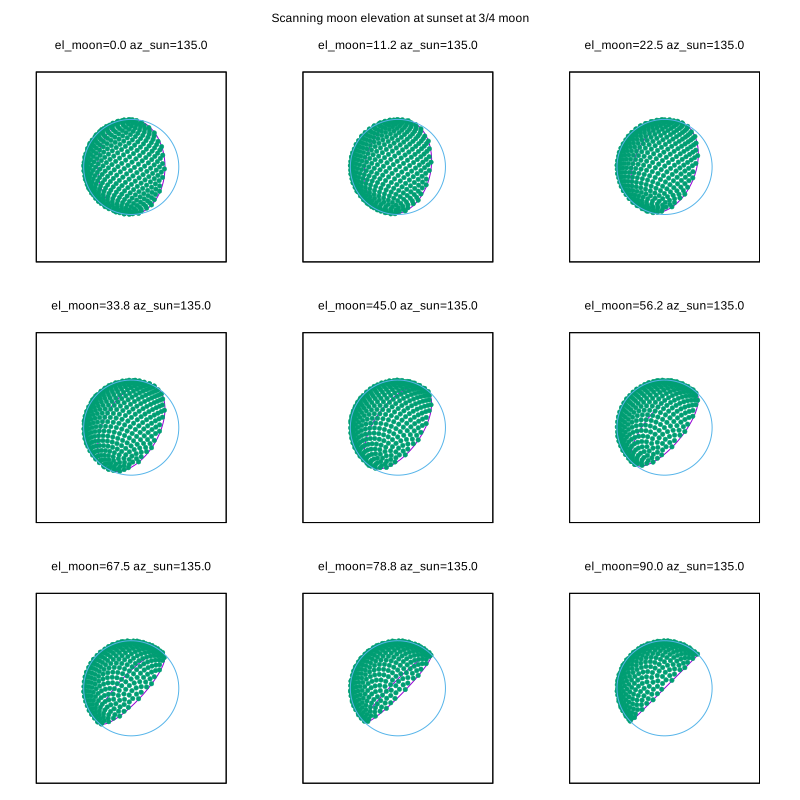
I produce two plots. At 3/4-full moon at sunset we look at the moon as it rises from the horizon all the way up to the zenith:

If the moon is at the horizon (elevation = 0), we see the expected 3/4-lit disc. As the moon rises, we see more and more of its bottom, and thus more and more dark areas show up: It clearly points up at sunset!
We can also move the sun around. Let's say the moon is 60deg up; let's move the sun from new-moon to a full-moon:

In the darkest configuration, we can still see a lit crescent on the bottom: the illumination is all on the opposite side, but we can see a slice of the illuminated back side. As the sun swings around, we see more and more of the moon. At azimuth = 90deg, we have a half-lit moon. Past that, more and more of the moon is visible, always pointing up.
This was also a super interesting study of the current state of AI tools. As I was writing this and debugging, I would talk to Claude and Gemini about how this worked and what I should be seeing. They were both completely unable to comprehend this, and would make infinite circular arguments. Clearly they read some incomplete explanations on the internet (as I have), and lack the reasoning capability necessary to distill it into something resembling "understanding". AGI is not here yet.