Is this Nefertiti’s tomb? Radar clues reignite debate over hidden chambers
原始链接: https://www.nature.com/articles/d41586-026-02621-2
研究人员提供了新的证据,表明在埃及帝王谷图坦卡蒙墓(KV62)内可能存在隐藏的密室,其中或许安葬着奈菲尔提蒂王后。 由考古学家马姆杜·艾尔达马蒂(Mamdouh Eldamaty)带领的团队,利用探地雷达和微重力测量等先进的地球物理技术对墓穴周边进行了分析。数据表明,墓内存在一组此前未被勘探的走廊和房间,其历史早于图坦卡蒙的下葬时期。这些发现发表在《阿玛纳皇家墓葬项目不定期报告》中,支持了埃及古物学家尼古拉斯·里夫斯(Nicholas Reeves)于2015年提出的理论,即图坦卡蒙墓规模较小,说明它最初可能是一座更大的建筑,后来才被改造成这位年轻法老的陵墓。 尽管结果令人信服,但一些专家仍持审慎态度,呼吁提供进一步的证据。研究人员目前正在等待埃及最高文物委员会批准进行非侵入式钻探。如果成功,该项目可能成为现代考古史上最重大的发现之一,并有望揭开一处未被扰动的皇家陵墓。

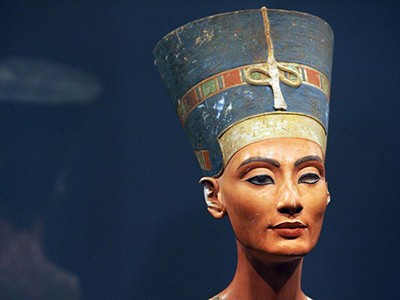
Ancient Egyptian queen Nefertiti, thought to have ruled as Pharaoh, might be buried near Tutankhamun. Credit: Filo/Getty
Tutankhamun’s tomb in Egypt’s Valley of the Kings has long puzzled archaeologists. Might hidden chambers — suspected to hold the remains of Nefertiti — lie beyond its walls? Now, researchers say they have found new evidence pointing to this controversial conclusion.
The decision of whether to peek into the supposed chambers, a few metres from the existing tomb, is in the hands of Egypt’s Supreme Council of Antiquities. If approved, careful drilling to deploy miniature tractors equipped with cameras could start in November, co-author of the study George Ballard told Nature.
The researchers conducted a range of geophysical surveys, including the first use of gravitational techniques to probe the density of ground around the site, as well as ground-penetrating radar (GPR) from inside the tomb. Taken together with studies of the tomb structure, the ground around it and wall paintings, the data strongly suggest that there is a “hidden complex” of corridors and rooms that pre-dates the entombment of Tutankhamun, says lead researcher Mamdouh Eldamaty, an archaeologist at Ain Shams University in Cairo and former antiquities minister of the Egyptian government.
Is this Nefertiti’s tomb? Radar clues reignite debate over hidden chambers
If confirmed, this could “rank among the most transformative archaeological discoveries of the modern era”, he adds. The team’s conclusions were published online on 17 September in the Occasional Papers of the Amarna Royal Tombs Project1.
The study is the latest in a string of attempts to picture what lies behind the walls of the tomb, known as KV62, since co-author Nicholas Reeves, an independent British Egyptologist who has worked extensively in the Valley of the Kings, suggested in 2015 that it could be hiding the resting place of Tutankhamun’s predecessor, Nefertiti. Many Egyptologists think she briefly ruled as a Pharaoh.
The tomb, which was built in the fourteenth century bc and discovered in 1922, is perplexing because it is unexpectedly small for a royal burial. On the basis of lines and cracks in the north wall of the burial chamber, as well as ancient alterations to the room’s paintings, Reeves suggested that the structure was a false wall, of a type often used by ancient Egyptian tomb builders to hide further chambers2.
Reeves proposed that KV62 was originally a much larger royal tomb: when young Tutankhamun died unexpectedly, the entranceway was enlarged and modified for his burial, and the deeper sections were blocked off. But geophysical analyses aiming to test his theory have so far yielded mixed results. Some researchers concluded that chambers were indeed present; others found that the data revealed nothing.
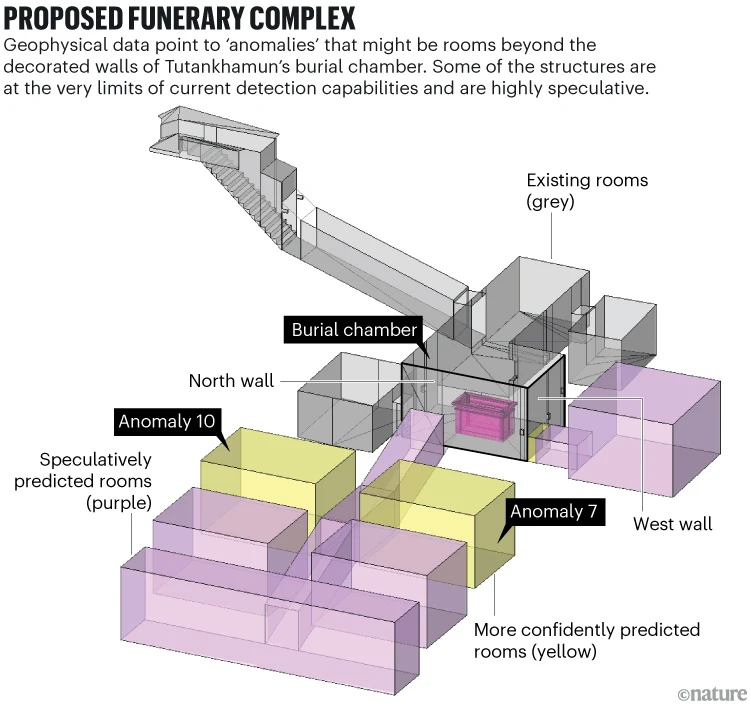
Now, Eldamaty and his colleagues at Egypt’s National Research Institute of Astronomy and Geophysics have once more used GPR to probe the interior walls of the tomb. Ballard, a structural engineer and president of the GBG Group, an international geophysics consultancy, analysed the results, as well as all available data from the previous surveys. Ballard is confident that they show a 2-metre-wide corridor, densely packed with rubble, leading away from the burial chamber. He argues that previous teams missed it because they were looking instead for a large void immediately behind the wall.
GPR, conducted through the walls from inside the tomb, has a limited range, so the team also turned to a microgravity survey — a non-invasive technique that measures density through tiny variations in Earth’s gravitational field — to investigate the area over and around the tomb. Ballard says that the data, from more than 1,200 readings across a 35-square-metre area, show what could be artificial chambers: “structures with right angles, of low density — and those structures are interestingly parallel on their axes to the north wall”. Data collected in 20173 by electrical-resistivity tomography, a technique that maps sub-surface structures, show anomalies in similar locations, although these were dismissed at the time as not being related to KV62.
Ballard highlights one feature, ‘anomaly 7’, as particularly intriguing: a mostly low-density zone hosting a roughly square, high-density area within it. This feature might be a chamber filled with objects, he suggests — although he admits that he is “looking at the very limits of detection”. The proposed chambers do not seem to link to any other entrances, suggesting that — if they exist — they have not been entered since ancient times. A further possible room lies immediately to the west of the burial chamber, although Ballard says the signal here is complicated by the gravitational effect of another tomb that lies nearby.
Other geophysicists are intrigued but cautious. Christopher Gaffney, an archaeologist and GPR specialist at the University of Bradford, UK, describes the report as “fascinating” but says that it doesn’t provide enough information to draw definitive conclusions. “I’m feeling pretty ambivalent,” he says.
From the microgravity data, the presence of chambers “looks plausible”, says Peter Styles, a geophysicist at Keele University, UK. But he, too, would like to see more details. Ballard says he doesn’t yet have permission from the Egyptian authorities to release all of the data.