It sure seems that a bunch of companies are trying to ship a git product of some kind as of late. Wonder why that is.
Either way, I’m building a Git server backed by object storage as an open-source project. It sounded simple enough to start: Git looks like a filesystem, so let’s use a filesystem as a translation layer on top of object storage to make Git speak object storage. This model worked… ok, I guess? But it didn’t work for real-world size repositories, so I needed a different approach. Git stores everything in Objects, so why not store those as objects in Tigris?
Turns out Git packfiles and how they intersected with my (admittedly somewhat terrible) filesystem shim were the main reason why it was slow. I ended up having to invent my own packfile format with a columnar store that’s object storage native. This is the fruit of all of my performance analysis, metrics annotations, and more Texas-style distributed systems work than you can make your k8s cluster shake sticks at.
This approach worked surprisingly well for production-sized repositories, so I’m sticking with this new Packfile format for now. It seems the least obtrusive change to make Git Objects feel like object storage Objects, without any client side changes.
When you make a commit, Git stores the changes you make as objects inside the
.git (I’ll call this “dotgit” so I don’t have to write as many backticks)
folder.
Imagine Git as two things: a sea of objects and named references to individual objects. Each object is a content-addressed and compressed file. Here’s an example from a tiny git repository:
$ mkdir ~/tmp/gitexample
$ git init && git branch -m main
$ echo "Hello, blog!" >> hello.txt
$ git add .
$ git commit -sm "chore: initial commit"
This produces several objects on the disk like this:
.git/objects/ refs/heads/main
│
├── 1c/7a26a901..ec7966 ─────▶ commit 1c7a26a
│ │
├── 8e/67afbb2e..857bd3 ─────▶ tree 8e67afb
│ │ hello.txt
└── 9c/c9867337..09fe26 ─────▶ blob 9cc9867
"Hello, blog!"
the filename is the sha1 of the bytes in the file, so the same
content is always, everywhere, the very same object
If you want to read the contents of an object, it’s compressed, so you have to use a fairly evil looking python oneliner to scoop out the tasty innards:
$ file .git/objects/**/* | grep -v directory
.git/objects/1c/7a26a901724b4ce766655ac387413fb9ec7966: zlib compressed data
.git/objects/8e/67afbb2ee6bdcbb79061dfdfb93febce857bd3: zlib compressed data
.git/objects/9c/c9867337c2ebae85ba2350f901e0bcc209fe26: zlib compressed data
$ python3 -c "import sys, zlib; sys.stdout.buffer.write(zlib.decompress(sys.stdin.buffer.read()))" < .git/objects/9c/c9867337c2ebae85ba2350f901e0bcc209fe26
blob 13Hello, blog!
As you can see, the objects are just bare files. Let’s look at a Git repository of the Linux kernel and try to extract out an arbitrary commit. Everything should just be a billionty bare object files, right? It should be easy to find a single commit just by looking for the ID on the disk, right?
If only reality were so simple:
$ cd ~/Code/linux.git/
$ tree objects
objects
├── info
└── pack
    ├── pack-45986f41063f286029742ec12e2c2882b88c5786.idx
    ├── pack-45986f41063f286029742ec12e2c2882b88c5786.pack
    └── pack-45986f41063f286029742ec12e2c2882b88c5786.rev
3 directories, 3 files
Yeah, as I’m sure you guessed just putting everything into their own files won’t
scale to something like the Linux kernel. I’m pretty sure you’d run into inode
limits like everyone did in the era of
fractal node_modules folders.
If you’ve used Node for long enough to remember that, please go get a colonoscopy. Colon cancer is a real concern that too many people overlook for too long and takes too many lives too early.
Git works around this by putting objects into packfiles, compressed bundles of objects that store them all in the same file. Here's an example of the packfile efficiency in my checkout of objgit:
$ git count-objects -v
count: 756
size: 3500
in-pack: 448
packs: 1
size-pack: 321
prune-packable: 0
garbage: 0
size-garbage: 0
If you ever need to “force” git to put bare objects into a packfile, you can run
git gc:
$ git gc
[omitted for brevity]
$ git count-objects -v
count: 0
size: 0
in-pack: 1203
packs: 2
size-pack: 848
prune-packable: 0
garbage: 0
size-garbage: 0
One of the beautiful things about implementing Git on top of object storage like I am is that I’m using a platform where the object data is a sea of objects with named references to points in that sea stored in FoundationDB. This is a kind of divine recursion that I don’t really know how to describe the beauty of. As above, so below.
Yo dawg, herd you like objects
Here's the object count for a copy of the Linux kernel:
xe@zohar:~/Code/linux.git$ git count-objects -v
count: 0
size: 0
in-pack: 11827138
packs: 1
size-pack: 3876775
prune-packable: 0
garbage: 0
size-garbage: 0
This is eleven million objects, which at a very generous assumption of 10ms per GetObject call means that fetching each of them takes over an hour to fetch them all. The truth is there really aren’t 11M objects as individual files on the disk, they’re bundled into one big happy 3.4Gi packfile. Your typical git repo ends up accumulating them as it makes sense to break them up. My local copy of the Tigris blog has 4 packfiles and 290-ish bare objects.
So you’d be thinking, “Oh, if git has packfiles, then why is the rest of this post a thing?”
Well, like many things in distributed systems it’s complicated. Packfiles are difficult because they’re designed with local storage and/or mmap in mind. Git constantly writes packfiles to disk and then re-reads them. Filesystem reads in that case are 10 nanoseconds at most (the filesystem cache helps so much here) but doing any network roundtrip is 10 milliseconds at minimum. It’s at least a million times slower because of how reality works.
One of the things that /usr/bin/git does that makes integrating it into object
storage difficult is the unix-y idiom of writing to a file and then immediately
reading back from that file to calculate the hash. In object storage you can’t
GetObject something that hasn’t finished a PutObject call. I worked around this
previously by writing to the disk and then doing it that way, but the experience
kinda sucked in practice.
Messin' with Packfiles
Each packfile has an index that describes what’s in it. Here’s a view of the index of the packfile made out of that trivial Git repo from earlier uppost:
$ git gc # force objects into a packfile
$ git verify-pack -v .git/objects/pack/pack-3971f5085c23c38be00e517ed0c64ca7df19b746.idx
1c7a26a901724b4ce766655ac387413fb9ec7966 commit 526 366 12
9cc9867337c2ebae85ba2350f901e0bcc209fe26 blob   13 22 378
8e67afbb2ee6bdcbb79061dfdfb93febce857bd3 tree   37 48 400
non delta: 3 objects
.git/objects/pack/pack-3971f5085c23c38be00e517ed0c64ca7df19b746.pack: ok
The commit points to the tree whose file “hello.txt” points to the blob and, blob’s your uncle, you have a repo. Git uses these binary indices to let it know where to look and how far it needs to seek into the packfile to know where to go to get things.
$ git count-objects -v .git/objects/pack/
count: 0 └── pack-45986f41..c5786.pack 3.7 GiB
in-pack: 11827138
packs: 1 eleven million loose files would be
size-pack: 3876775 eleven million inodes. so: one file.
.idx .pack
┌───────────────────────┐ ┌──────────────────────────────────────┐
│ 0002ff4c.. 0x0000c │ │███ ██ ████ █ ███████ ██ █ ████ ██████│
│ 0031ab90.. 0x0a13f │ └──────────────────────────────────────┘
│ 1c7a26a9.. 0x1f3a4 │
│ ... │
└───────────────────────┘
each row's colour is the run of bytes its offset points at, so a
read is a seek to an offset inside one very big file
ALL/03three rows, three offsets, three runs of bytes
The great part is that this works really well when everything is in a filesystem. Git mmaps the packfiles so that the kernel treats disk contents as memory pages, meaning that trying to read past what’s “in memory” makes the kernel load it instead of userspace. This is faster than loading it from the disk directly. It’s a shame this design doesn’t work in object storage.
If only you could construct Range requests from packfiles
At some level this sounds pretty great for object storage, right? You have offsets into the packfiles and then you can “just” grab out a single object from a packfile with an HTTP Range request right? Objects are placed randomly within packfiles and other attempts at storing Git in object storage end up having problems here. Tigris is really good at random access scans, so most of the hard part is figuring out how to grab the right data out of the bucket.
HTTP Range requests let a client download part of a file. The main usecase they're built for is back in the day of dial-up internet you weren't online all the time. Your main path to the Internet was the same way you send and received phone calls. As such, if someone called you while you were online, all your downloads got interrupted. Range requests let Internet Explorer resume downloads where they got cut off instead of having to start all the way over.
They've been maintained into the modern era but don't really get much use outside of galaxy brain format abuse like what I'm doing and online video streaming.
Well, it’s complicated. The example I gave shows all of the index entries one after the other, but in the real world processing the index entries one after the other you know the decompressed size of a single object in the packfile, but not the compressed size. This means you don’t have enough information to construct a HTTP Range request.
packs/019a7f3c..bin
┌────────────────────────────────────────────────┐
│ ██ │
└───────────────────────────────────▲────────────┘
0 │ 128 MiB
└── 366 bytes, right here
you know where it starts and how long it is, so ask for
exactly that span and nothing else:
GET /packs/019a7f3c..bin
Range: bytes=100663296-100663661
and that is all the bucket sends back:
206 Partial Content
Content-Range: bytes 100663296-100663661/134217728
┌────┐
│████│ 366 B on the wire, not 128 MiB
└────┘
This core problem is half the reason why I ended up needing to make my own object-storage native Git packfile format.
SEND CUE SHEET
Way back in the days of physical media, one of the most common formats was the CD-ROM (Compact Disc Read-Only-Memory, or CD). A CD is a 700Mi container that stores data in sessions that each contain up to 99 tracks of either audio or data. CDs were originally invented to store song audio in so that you could listen to an hour or so of music at a higher quality than analogue cassette tapes. CDs also let the player skip from track to track so you can go directly to the song or movement of a larger work that you like.
This is also why you see guides telling you to put legal backups of CD and DVD
media into lossless .iso files. An .iso file contains one recording session
that may contain data or audio.
CD AUDIO DISC OBJGIT PACKFILE
────────────────────────────────────────── ──────────────────────────────────────────
U0008_0000002_0000147.WAV one big file objects.bin one big file
┌──────────┬─────────────┬─────────────────┐ ┌──────────┬─────────────┬─────────────────┐
│ track 01 │ track 02 │ ... │ │ blob A │ tree B │ ... │
└──────────┴─────────────┴─────────────────┘ └──────────┴─────────────┴─────────────────┘
▲ ▲ ▲ ▲
│ 00:00 │ 00:13 │ @0 │ @142
FILE.cue plain text, parsed top-down objects.cue packed records, fixed width
┌──────────────────────────────────────────┐ ┌──────────────────────────────────────────┐
│ FILE "U0008_0000002_0000147.WAV" WAVE │ │ HEADER 16 B │
│ │ │ magic version rec_size record_count │
│ TRACK 01 AUDIO │ ├──────────────────────────────────────────┤
│ INDEX 01 00:00 │ │ RECORD 0 58 B │
│ TITLE "U0008_0000002_0000147_0001" │ │ hash 3a7f…c21 type blob │
│ │ │ comp zstd size 311 │
│ TRACK 02 AUDIO │ │ bin_offset 0 bin_length 142 │
│ INDEX 01 00:13 │ │ delta_base 0000…0000 │
│ TITLE "U0008_0000002_0000147_0002" │ ├──────────────────────────────────────────┤
└──────────────────────────────────────────┘ │ RECORD 1 58 B │
└──────────────────────────────────────────┘
to reach track 2 a player parses every
line above it. it already has the disc. record N sits at 16 + N*58. one seek,
then one ranged GET into objects.bin.
However there’s one catch that kinda ruins this easy way to back up CDs: they can store multiple recording sessions on the same disc. Most of the time this wasn’t used outside of making piracy on certain late 90’s/early 00’s game consoles more annoying, but there was that one Ricoh Encryptease product that combined a user-recordable area with a factory printed area so that you could encrypt files on CDs you share with the decryption software shipping alongside it. This is about as cursed as it sounds.
The trick of using multiple sessions is how Dreamcast games play as audio CDs telling you to put it into a Dreamcast or how Xbox 360 games play as DVDs telling you to put it into an Xbox 360. As an added bonus it means that when you stick it into a computer it thinks that it’s an audio CD or DVD, which means that lazy pirates can’t easily scoop out all the game files to their hard drives.
As a result, there needed to be a way to properly handle this for archival
purposes. The eventual result was creating
cue sheets to store
alongside the binary blob of data. The .cue sheet stores information that the
decoder uses to be able to seek to arbitrary points in the .bin file. This
lets you easily extract things like songs or bits of data without having to read
the entire CD image. As an added bonus it handles multiple recording sessions
for you.
Packfiles v2: object storage boogaloo
This got me thinking, how would we take all of these lessons into heart and build a new git packfile format optimized for object storage?
Wait, I know what you’re thinking. You’re thinking that I’m about to make a Chesterton’s Fence violation. Just “rolling my own” format for something as dear and precious as storing the revision history of a company’s code repositories is probably one of the worst decisions you can make, right?
Normally, yes, it’s a bad idea to do this. However Git is a distributed version control system. When you clone a repository, you clone all of the changes ever made to it on every branch at the same time. This also means that everyone has a copy of the entire history of that repository, meaning that if the worst does in fact come to pass and my handrolled format ends up sucking it’s trivial to recreate all the data. Just push it again.
So what would this format look like?
Well for one the format needs to be Range-request native. You should be able to scoop any one object out of a packfile without having to download or process anything but the object you want. Again, Tigris is good at this, so we should design the format with that usecase directly in mind. The format should also take advantage of modern compression libraries like zstd which are faster and more data-efficient than zlib. Finally delta objects should be stored as their own object in the packfile instead of slapped onto the end of the object it’s a delta of so that you don’t have to read the object and its deltas to read the object in the first place.
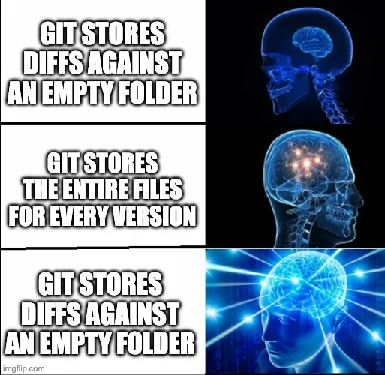
I skipped over this earlier to save time, but Git stores both file revisions (the entire copy of a file at any given point in time) and the difference between them as an optimization to make it easier to uncompute the changes made in commits. At some level this meme is both accurate and wrong:

Objgit's packfile format that probably needs a name
The format I came up with is pretty directly inspired from the .bin and .cue
format of CD backup. Objects are stored one after the other in a .bin file
that’s normally up to 128Mi (the oddly specific number was chosen because it
looked round to me) and the metadata of what objects are in there are stored
separately in a binary-encoded .cue sheet. Together this makes Git repository
storage in Tigris a columnar store.
objects.cue HEADER 16 bytes, once at the top of the file
┌──────────────┬─────────┬──────────┬────────────────────┐
│ magic "OGCU" │ version │ rec_size │ record_count │
│ 4 B │ u16 2 B │ u16 2 B │ u64 8 B │
└──────────────┴─────────┴──────────┴────────────────────┘
0 4 6 8 16
objects.cue RECORD 58 bytes, repeated record_count times
┌──────────────┬──────┬──────┬────────────┬────────────┬────────┬──────────────┐
│ hash │ type │ comp │ bin_offset │ bin_length │ size │ delta_base │
│ sha1 20 B │ u8 1B│ u8 1B│ u64 8 B │ u32 4 B │ u32 4B │ sha1 20 B │
└──────────────┴──────┴──────┴────────────┴────────────┴────────┴──────────────┘
0 20 21 22 30 34 38 58
identity hash, delta_base location bin_offset, bin_length decode type, comp, size
The big thing I did was store the sizes for both the compressed and uncompressed forms of objects alongside the offset into the packfile. This means that you can trivially construct the right HTTP Range requests to scoop individual objects out of Tigris while the packfile is downloading in the background.
As an optimization for latency, whenever the Git library requests any object from a packfile, the entire packfile is downloaded from object storage to a temporary folder. Anything on the “far end” of the packfile is Range-requested from Tigris until the downloaded packfile “catches up”. In practice this ends up meaning that packfiles get downloaded just in time for them to be useful to read from and there’s overall fairly little latency beyond what’s unavoidable with the Git library I’m using. If the “scooping objects out of the far end” problem ends up being an issue in practice I’ll just have it start fetching the most recent packfiles for a given repository in the background when you start pushing or pulling.
git wants four objects out of packs/019a7f3c..bin
A B C D
▼ ▼ ▼ ▼
┌────────────────────────────────────────────────┐
container │░░░░░░█████░░░░█████░░░░░░░░░█████░░░░░░█████░░░│
└────────────────────────────────────────────────┘
five requests go out at once:
A 16 MiB │ ░░░░░ │ in flight
B 40 MiB │ ░░░░░ │ in flight
C 77 MiB │ ░░░░░ │ in flight
D 107 MiB │ ░░░░░ │ in flight
whole file │░░░░░░░░░░░░░░