For more than a century, commercial shipping steadily moved away from sails. Now they are coming back.
Across the global fleet, shipowners are installing towering rotor sails, rigid wings and suction-based systems on everything from bulk carriers and tankers to containerships. LNG carriers could be next.
The idea is not to turn modern cargo ships back into sailing vessels. Instead, these systems are designed to work alongside conventional engines, using the wind to reduce fuel consumption whenever conditions allow.
What was once a niche experiment is beginning to look more like a real segment of commercial shipping.
The International Windship Association says more than 100 large merchant ships are now equipped with modern wind propulsion systems, representing more than 5 million deadweight tons of carrying capacity.
That is still a tiny share of the world fleet, but the ships are getting bigger, the owners more familiar and the projects more ambitious.
And 2026 has brought several signs that wind-assisted propulsion is moving beyond the demonstration stage.
One of the biggest came this month from Maersk. The company plans to install a 35-meter rotor sail on one of its 8,700-TEU containerships, with testing expected to begin in 2027 on regular Atlantic services.
The project is expected to mark the first rotor sail installation on a containership.
Rotor sails look more like giant vertical cylinders than traditional sails. They spin as wind passes around them, creating aerodynamic lift through the Magnus effect and generating thrust that reduces the load on the ship’s engines.
The concept is more than a century old, but modern controls and materials are making it practical on ships of a scale that would once have been difficult to imagine.
Vale’s 400,000-dwt Sohar Max, one of the largest ore carriers in the world, is already fitted with five 35-meter rotor sails. The system was expected to cut fuel consumption by as much as 6%. Vale is also planning to use rotor sails on future ethanol-powered very large ore carriers.
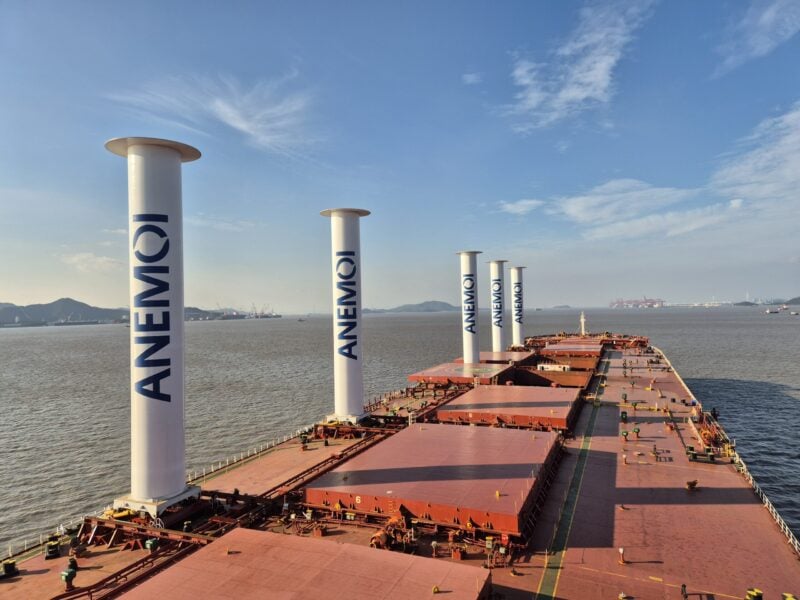
Oil tankers are next.
Two VLCCs being built for Japan’s Idemitsu Tanker are scheduled to receive Norsepower rotor sails when they enter service in 2028, bringing wind-assisted propulsion to some of the largest ships afloat.
LNG shipping may not be far behind. Korean Register, HD Hyundai Heavy Industries, BAR Technologies and the Liberian Registry recently announced plans to study a 174,000-cubic-meter LNG carrier fitted with BAR Technologies’ WindWings.
The design moves the ship’s accommodation block forward, creating space for large rigid sails on deck. The project will examine the technical, safety and regulatory challenges of applying the system to LNG carriers.
That is significant because LNG carriers are among the most sophisticated and tightly scheduled ships in commercial service.
If wind propulsion can work there, it would further strengthen the case that the technology is moving into the mainstream.
Not every project is designed simply to assist an engine.
France’s Neoliner Origin, delivered in 2025, uses two 76-meter carbon-fiber masts carrying about 3,000 square meters of sail area, with wind intended to provide the ship’s primary propulsion across the Atlantic. The 136-meter ro-ro vessel can carry cars, containers and other cargo between Europe and North America.

Airbus is taking a similar approach with a new generation of ro-ro ships designed to carry aircraft components across the Atlantic using a combination of wind propulsion, alternative fuels and optimized routing.
The result is a strange mix of old and new: some of the world’s most advanced supply chains are beginning to rely once again on one of shipping’s oldest sources of propulsion.
The sails themselves are also changing quickly.
Some systems use spinning cylinders. Others resemble aircraft wings mounted vertically on deck. Bound4blue’s eSAIL uses suction to increase aerodynamic lift, while other developers are working with rigid foils, automated wings and soft-sail systems.
Maersk Tankers has been rolling out eSAIL systems across a group of MR tankers, while the juice carrier Atlantic Orchard has been fitted with four 26-meter suction sails.
In most cases, crews are not standing on deck trimming sails by hand. The systems are heavily automated, adjusting themselves based on wind speed, direction, vessel speed and heading. Weather-routing software can also help ships alter course slightly to capture more wind without significantly disrupting schedules.
That integration is becoming increasingly important. Norway recently launched the WINTEGRATE program, bringing together companies including Kongsberg Maritime, DNV, Odfjell, Norsepower and bound4blue.
The idea is to stop treating wind propulsion as a standalone piece of equipment bolted onto a ship and instead integrate it with engines, batteries, power-management systems and voyage planning.
That shift may be critical to the technology’s future.
The physics behind wind propulsion have not changed. The economics have.
Shipowners are under growing pressure to reduce fuel consumption and emissions, while many low-carbon fuels remain expensive, scarce or unavailable at scale.
Wind, by comparison, is free.
It also offers something relatively unusual in shipping’s decarbonization push: a technology that can often be retrofitted to ships already in service.
Savings depend heavily on the vessel, route and weather.
Industry estimates generally put fuel savings for retrofit projects somewhere in the single digits to low double digits, while purpose-built ships designed around wind propulsion can potentially achieve much more.
That may not sound revolutionary.
But on a large oceangoing vessel burning thousands of tons of fuel each year, even modest savings can add up quickly.
There are still plenty of limitations.
Wind is unpredictable. Sails take up deck space. Systems need to withstand heavy weather, corrosion and cargo operations. Bridges, cranes and terminals can restrict how tall or where equipment can be installed.
Some routes are also far better suited to wind propulsion than others.
Regulation is still catching up as well.
The International Maritime Organization has begun work on interim safety guidelines for wind propulsion and wind-assisted systems, with the first guidelines expected later this decade.
But the industry now has something it lacked only a few years ago: real operating experience.
Tankers, bulkers, ro-ros and general cargo ships are accumulating commercial sea time with these systems. Shipyards are learning how to install them. Classification societies are writing rules around them. Manufacturers are scaling up production.
That does not mean commercial shipping is heading back to the age of sail.
Engines will remain essential for schedules, maneuvering, adverse weather and port operations. Many ships will also rely on alternative fuels, batteries and other efficiency technologies.
Wind will simply become another part of the propulsion mix.
And that may be the most important change.
After spending more than a century trying to escape its dependence on the wind, shipping is starting to realize there is little reason to ignore free energy when it is blowing in the right direction.

Sign up for gCaptain’s newsletter and never miss an update