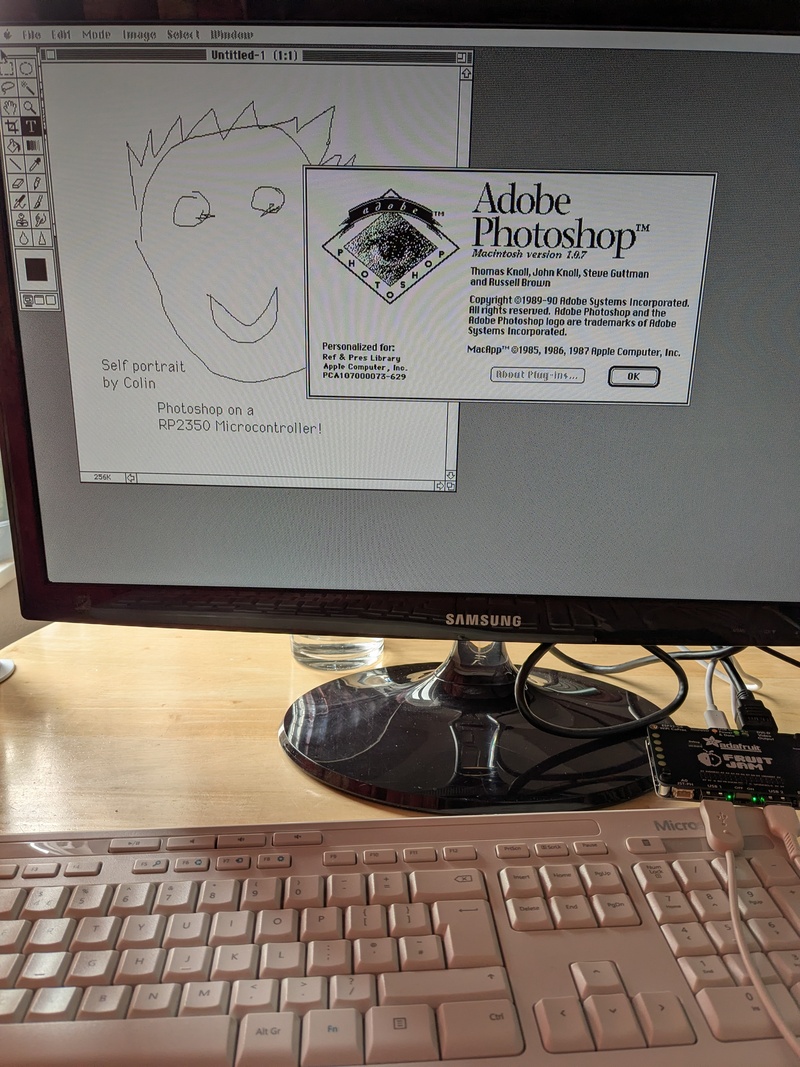
I've always had a fascination with simpler and low power computing. This lead me to run Photoshop on a 60 pence computer chip and it amazes me that this is possible.
 Photo: A monochrome screen showing Adobe photoshop with a simple drawing running on an emulated Apple Macintosh
OK; this is hardly editing a full colour, highly detailed photograph but at least my "self portrait" will obviously set the illustration world on fire.
This was done by emulating an old Apple Mac on a Raspberry Pi RP2350 chip, which can be purchased for around 60p. Add the various extra parts needed and say roughly that a mid 1990s equivalent computer can be built today for a few pounds in one-off quantities. Call it the price of coffee and a cake in a European café today.
Adjusted for inflation, a roughly equivalent Macintosh SE to the one being emulated would cost £9554 today. (I found the pricing from a review in this 1989 Personal Computer World magazine online and used the Bank of England inflation calculator to convert the £3495 selling price.)
Whichever way you estimate: Computers are vastly cheaper nowadays and this computer is much cheaper than a modern PC.
The same emulated Mac can run other software - e.g. the WordPerfect word processor which was popular at the time. I found this surprisingly pleasant to type and concentrate with: It had an uncluttered interface and was distraction free when compared to my modern Macbook with its notifications and busy displays.
 Photo: WordPerfect 1.0 on an emulated Apple Macintosh
Sometimes experimenting with things can spark my imagination and create new ideas. Simple and low power computers appeal to me, so it's interesting to ask "what is the minimal viable modern computer". A 60p chip is definitely not the cheapest possible, but it is certainly has an impressive "computing power to price" ratio.
Assume this is equivalent to a mid 1990s computer (it has two 150MHz processors, and easily adds 4Mb RAM and gigabytes of storage) . This was time when people made presentations, wrote documents, ran spreadsheets, sent emails and browsed (an admittedly simpler) web - not dissimilar to a lot of our computer use today.
This provokes questions: How to provide computing for those who need to or want to spend their resources elsewhere? What could a super thin, super lightweight laptop look like? Perhaps it could have an e-paper screen to be calm on the eyes. Could it be solar powered? Could it have a calmer, less cluttered and less distracting interface than modern operating systems but still provide similar functionality? Could it be long lasting with reliable software and not have to be thrown into landfill every few years? Does this have enough processing power and quality to become part of a personal music playing or streaming system? Can this help reduce the addictiveness of modern devices and stop "doom-scrolling"?
The relative simplicity of this chip compared to more powerful ones (and the software limitations this would imply) means that the whole computer is (with effort by the right people) relatively understandable, and everything is documented, and the power consumption is lower.
If I had this computer as my phone or laptop what would I miss? If I could read web pages and write and listen to music I think this would do a lot of what I want. I'd want some kind of messaging and probably maps. I think this can probably play music. It could display maps but maybe in a simpler "A to Z atlas" style of flipping between pages. But maybe this trade-off vs power use could be useful in remote places with no smartphone charging. Maybe cycle tourists would appreciate such a thing.
It could (slowly) take and view grainy pictures, but videos and good pictures would be difficult. Saving videos to watch later on a display at home is probably a healthier way of consuming them than distracting myself with them, and maybe carrying a separate digital camera wouldn't be a sacrifice.
The modern web is sadly too complex to be viewable on such a device, but a bridging solution would be to have conversion software running on larger computers. A browser for something like Gemini would be possible. We could still have a WiFi chip on this, but the complexity of modern 4G and 5G mobile networks could be a challenge. Adafruit has An IRC messaging client demonstration running on this chip.
Maybe I'm being naive and nostalgic for a past that never existed. But I think it is important to think of the trade-offs we make with modern computers and maybe playing with some of these things can help us make computers which are kinder, as discussed by James in this blog post after our discussion. There is overlap here with some of the Solarpunk and Permacomputing communities. Having privacy respecting solar powered computers that people can tinker and mold to their own needs feels to me like an exciting, positive future.
It's interesting to imagine an alternative world where these modern chips had arrived much earlier in time, bringing un-imaginable (for then) amounts of computing power and memory for little money. How would computers have evolved and what would they look like today?