This is a story about data and certainty. It began in century-old genealogy, and ends with contemporary misinformation.
Last week I went through a small pile of my grandmother’s papers, specifically those dealing with her attempts, some 90 years ago, at building out her family tree. She was born in 1889, and seems to have been working from some notes that her father wrote about his forebears sometime around 1910. Those jottings touched 1792.
Early on, I found out that grandma had a half-sister seven years her senior, from a father whose disappearance went unexplained. I don’t believe this had ever been mentioned to me. The stepsister was adopted by my great-grandfather, but doesn’t seem to have lived with the family. She later married and lived in St. Louis, but when she died aged 22 she was buried in the family’s graveyard in Kansas. If you’re anything like me, you’re already noodling on how all these mysterious fragments might hang together. Who was this person, and what sort of life did she have?
There were letters from my grandmother’s cousins, people I’d never heard of, who told stories of unknown uncles who’d fought for years in the Civil War, accepted victory garlands in Washington, and died of consumption on the march home. One of grandma’s uncles was named Commodore Perry Bebee, in honor of the Admiral who opened Japan to the U.S. in 1853, the year of his birth. He wrote back to Kansas from Santa Monica, expressing his loneliness following the strange death of his wife in 1934. He had also been unknown to me until then, but his pain was vivid.
Every time I found out something about someone, I wrote up their story in my head. Imagining their experiences enriched my sense of my own life. I found myself seizing on the smallest bit of data (a father and son who died two months apart) to build a story (in 1863! They must have both been killed in the Civil War!), complete with twists (they came from Appalachian Missouri! - which side did they fight for?) When I found out that the fragment about them was wrong (they’re not Missouri Babcocks, they’re Kansas Bebees!), I rewrote their story.
Days of doing this made me realize that, whoever you are, you’re not many steps from confusion about how you got here, particularly as more data continues to show up. For the most part, few of us admit the uncertainty of our stories, whether in parsing our roots or ourselves. In our daily lives we ignore most of our ever-branching considerations, so our hindsight has straighter lines, something closer to a linear narrative we can own. Psychology teaches that we often misremember things, rewriting them so they cohere to current needs. Do a little genealogy, and you do that in real time, with distant relations.
Data demands a story, and the more we relate to the data, the more urgent the story becomes. Relatives multiple removes from me were genetically as closely related to me as strangers I’d pass in the street. They became interesting because my grandmother collected their stories as part of my family history. So I built on that story, more than I would have if the anecdotes arrived from an unfamiliar source.
This experience of data scraps and stories reminded me of something I wrote last December:
Then there is the technology that rotted…There is much evidence, like the remains of deep water fish bones found in East Timor, that homo sapiens repeatedly took to the water 42,000 years ago. The aboriginal settlement of Australia seems to have involved some 1,000 people, almost certainly traveling in multiple vessels over hundreds of miles of open water, some 40,000 years ago. Then they stopped sailing. This technology story is mostly lost to time because ships are made of perishable materials. Stone axes endure.
In other words, the data we find is the data that dictates the story. Technology that was hewn, moulded, or woven rotted. Stone tools endured, and so we say our forebears lived in the Stone Age.
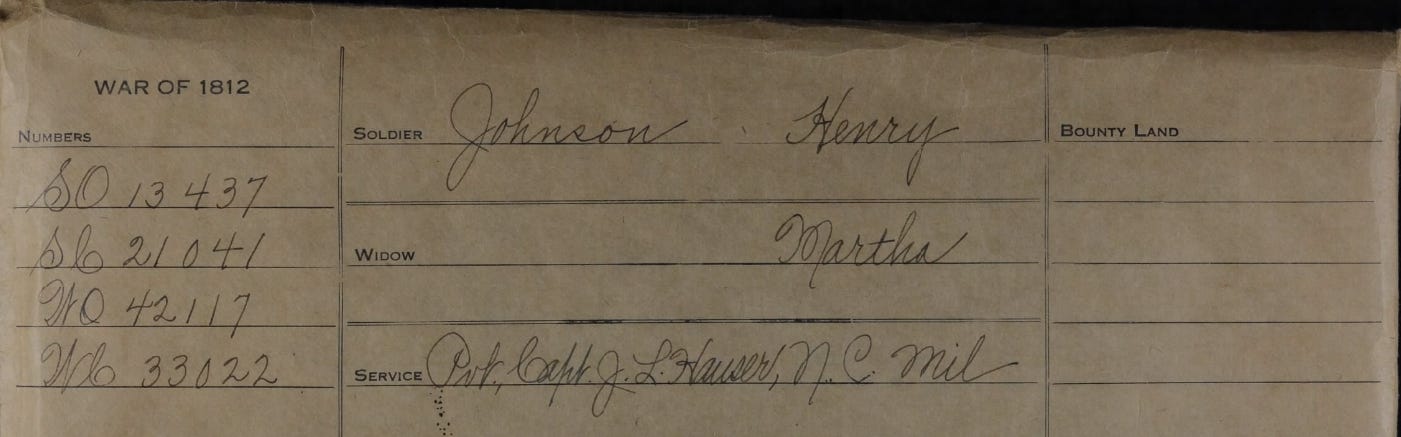
At first glance, we have the opposite problem today. I sorted my grandmother’s genealogy efforts with the aid of Family Search, a capacious genealogy service run by the Mormon Church, an outfit that believes families are united in the afterlife, and offers members the option to include the long dead in contemporary ceremonies. They have uploaded a truly astonishing number of documents, including my great-grandmother’s presence in the 1870 census, a 17 year-old in a boarding house with no reference to her parents, or my great-great-great grandfather’s application for a pension for doing his bit in the War of 1812:
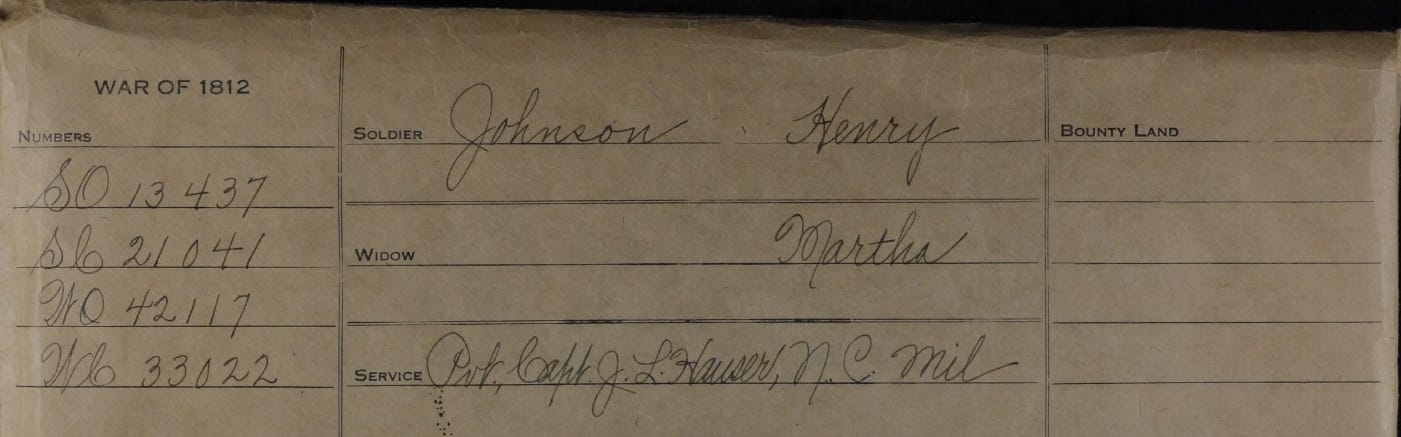
This is very impressive data. It’s also the smallest eyelash on a hairy gorilla, when compared with the abundance of data now collected on everyone, every day. If you include your online behavior, the stuff in your phone, what traffic cameras catch, or the potential DNA you leave all over the place, you’re still probably only scratching the surface of what various sources capture today (doorcams! satellites!)
And of course, we’re just at the start of what may be collected in the future, when you consider the vision touted by AI companies: A disembodied robot will accompany you throughout your journey from your first air to your final clay, diligently taking notes and chiming in to help you along.
Will we make better sense of ourselves with all this machine data and machine interpretation? Certainly that’s how the founding brains of the Information Age saw things. In his 1945 essay, As We May Think, Vannevar Bush, who’d just coordinated 6000 scientists to create new tools of war, posited a new machine, called the Memex, in which individuals would store all their books, records, and communications. This device would enable them to retrieve not only information, but the paths by which they came to think something. Between 1998 and 2007 Gordon Bell, who developed the first personal computer, updated this idea with MyLifeBits. He not only digitized his writings, audio, and video, but he wore a camera around his neck to record most of his interactions (incredibly, at the time few of us minded this.) He gave it up after the iPhone came along, correctly determining that he’d been lapped, in terms of continual recording.
More recent history, however, has shown several problems with the idea that amassing data will lead to certainty. People in the worlds of Vannevar Bush and Gordon Bell, largely elite scientists and researchers, assumed good will on the part of the people using these machines, and a motivation to determine impartial truth.
Today, however, we have videos of Maga rioters beating up the police to protest the verification of a free and fair presidential election, while the president declares it a day of love and peace. At the other end of the political spectrum, I was in graduate school with people who excused the Khmer Rouge, and called accurate reporting of Cambodian atrocities a right-wing effort to discredit a people’s revolution. There’s a general bias to have one’s worldview be true.
Whether in political alignment or personal history, emotional recollection often trumps rational recall. Changing one’s mind is stressful, and there’s little movement in the culture to change that. Since current AI chatbots are engineered to be agreeable to an irritating extent, it’s unlikely our future robot companions will spend their days telling us we’re not remembering something correctly, or that ancestor so-and-so actually died, not of consumption, but when they got drunk and fell off their mule. Their job is to soothe, not to challenge.
Even setting aside the anxiety of revision phenomenon, today’s abundance of data is increasingly encountering an abundance of fakes. Consider AI-generated fake obituaries, including obituaries of Joe Biden that were loaded on to Family Search (since removed.)
The well-known ones are easy to pull, but it may well be that many more obituaries of obscure people are getting through, generated by people who want to fake out the Mormons, or grieve on some genealogy-loving relative. Just one of many, many data sources, ripe for shit-posting the past.
In the future, the past will be abundant. That doesn’t mean it will be any easier to make sense of.