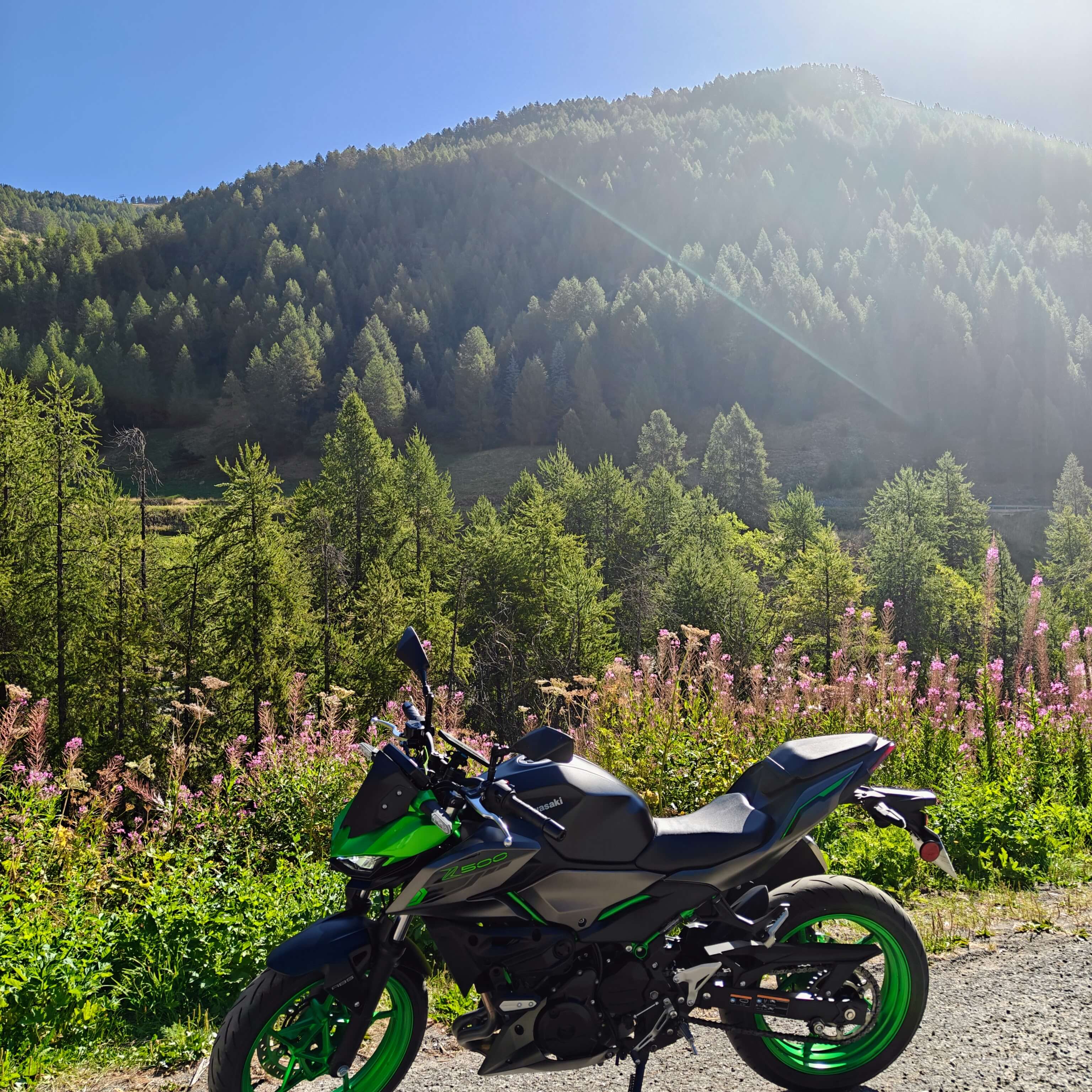
Most cars on French roads carry exactly one person. The average occupancy for commuting trips in France is 1.08 passengers per vehicle 0. 16 million people driving alone, twice a day, in machines built to seat five. I ride a Kawasaki that weighs 185kg. It carries one person too, but at least it’s honest about it.
Fuel, materials, space
My fuel consumption sits around 3L/100km (73.5 MPG) in mixed riding. A comparable compact car doing the same coastal routes between Antibes and Nice burns 6 to 8 liters. That’s roughly half the fuel, half the CO2, for the same commute. On highway stretches where the engine stays in a narrow RPM band, consumption drops further.
The material gap is just as wide. A motorcycle uses a fraction of the steel, plastic, rubber, and electronics of a car. Less battery, fewer components, less waste at end of life. When an occupancy rate of 1.08 means almost nobody is using the other four seats, those seats are just mass you’re accelerating and braking for no reason.
Road space matters in this part of France. In Nice or Cannes during summer tourist season, three motorcycles fit in one car parking spot. Motorcycles cause less wear on road surfaces too. I think about this every time I watch someone in an SUV do their third lap around Place Garibaldi looking for a spot.
Where the ecological argument actually holds
The per-trip emissions math is straightforward, so I won’t belabor it. The part that surprised me is how owning a motorcycle changed my habits around driving in general.
I plan routes more carefully now. I’m more aware of weather and road conditions. I don’t make lazy 2km drives to grab groceries because suiting up in full gear for a 2km errand feels absurd, so I walk. The motorcycle has made me more intentional about when I use a motor vehicle at all. I can’t prove this is true for all riders, but I’ve seen it in the ones I know.
Motorcycles are also mechanically simpler than modern cars, with fewer systems to fail and fewer electronics to become obsolete. My Kawasaki will remain serviceable for decades with basic maintenance. Meanwhile the infotainment screen in a 2024 car will stop getting updates by 2029.
Electric
Electric motorcycles are on the way too, though the range isn’t there for my riding patterns yet. A small battery pack charged from French nuclear grid electricity would eventually make the per-kilometer carbon math very hard to beat.
Unfortunately, I don’t have access to a charging station where I currently rent, but as soon as that changes, I’m looking into electric/hybrid.
The risk
Motorcycling is dangerous. I’m not going to bury this in a disclaimer at the bottom or soften it with statistics about how safe modern bikes have become.
You are exposed. There is no crumple zone, no airbag, no metal cage. A pothole that a car driver doesn’t notice can put you on the ground. A driver checking their phone who drifts into your lane has a fender bender with another car but a serious crash with you. Rain changes the grip equation entirely, and the Côte d’Azur has a specific problem: it rains so infrequently that when it does, the roads are coated in months of accumulated oil.
I wear full gear every ride, even in August when it’s 35°C and the leather feels punitive. Helmet, gloves, jacket with armor, reinforced pants, boots. I took the progressive French licensing route (A2 then A) which includes long hours of mandatory training on handling, emergency braking, and low-speed maneuvers. I ride defensively, assume every car hasn’t seen me, and I still have close calls a few times a year.
Motorcycling forces you to ride differently, you have to pay attention, anticipate and be reactive. I have never “zoned out” on a motorcycle, I can’t say the same for cars.
The fatality rate per kilometer traveled is higher on a motorcycle than in a car. The numbers vary by country and source, but the gap is real everywhere. You have to accept that and adjust your behavior, or you shouldn’t ride.
Why it works
Nobody buys a motorcycle for the CO2 numbers. They buy it because riding is practical and most importantly enjoyable in a way that driving stopped being sometime around the introduction of lane-keeping assist.
On a motorcycle, you’re in the environment instead of sealed off from it. Lavender above Grasse in June, a 5-degree temperature drop when the road cuts through a forest, leaning into corners with your whole body. After 45 minutes through the hills behind Antibes, I arrive somewhere more awake than when I left. I’ve never once felt that way stepping out of a car.

The best ecological choice is the one people will actually make consistently. For me, that’s a motorcycle. I accept the risk because the tradeoff is worth it. Your math might come out differently.