How does that actually work?
Illustrated science features for curious readers — real mechanisms, real researchers, and experiments you can run at home.

Technology
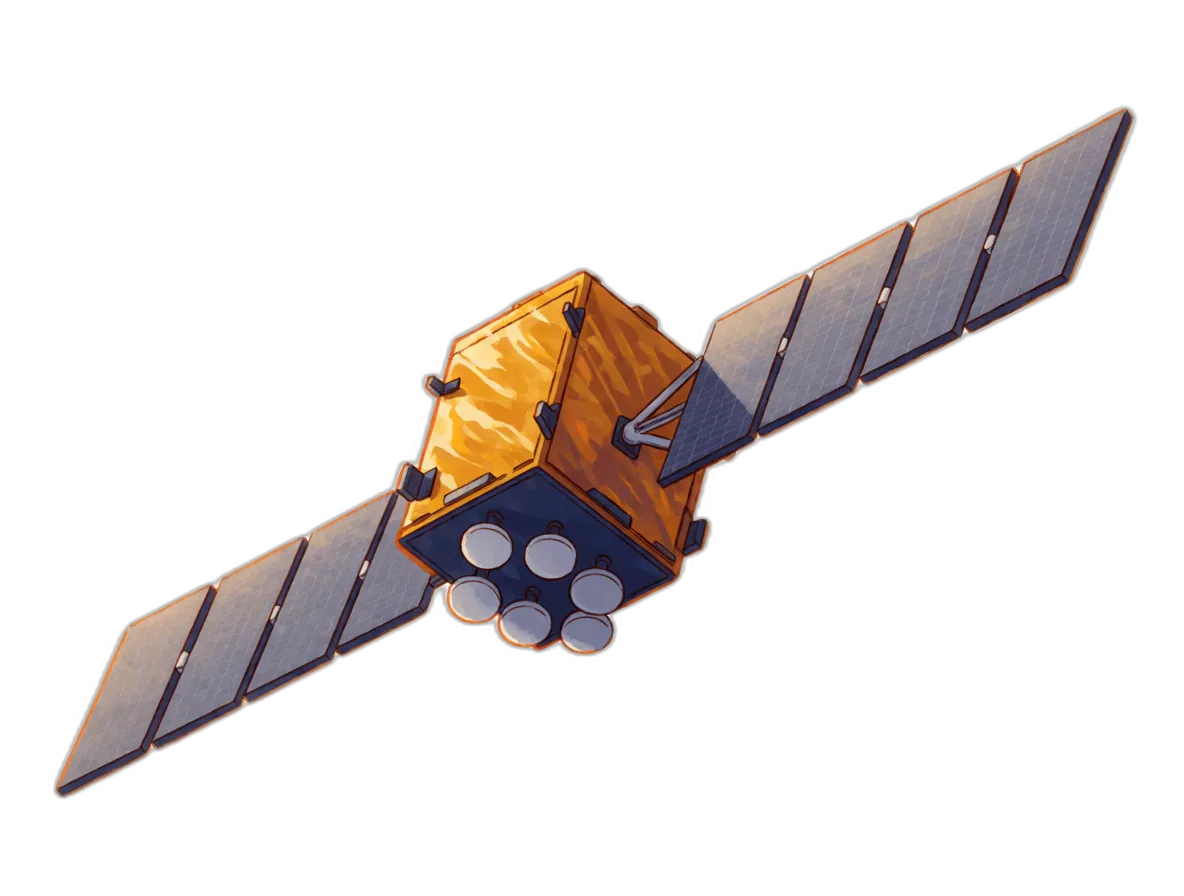
How does your phone know where it is?
Open a map in a town you have never visited and a blue dot lands on you within seconds. Nobody told the phone anything, and nothing up there answered it.

Biology
Why does a cut apple turn brown?
A whole apple sits in the fruit bowl all week and looks the same on Sunday as it did on Monday. Cut one at breakfast and it is the color of weak tea by lunchtime. Nothing was added to it.

Physics
Why does a desert get so cold at night?
Sand that could blister a bare foot in the afternoon can be chilly enough for a coat by midnight. All that heat goes somewhere, and where it goes is not where most people guess.

Physics
Why doesn’t a spinning top fall over?
Set a top going and it leans at an angle that would flatten anything else on the table, then stays there, drifting round in a slow circle. Nothing is propping it up, and gravity has certainly not let go of it.

Biology
Why do your fingers wrinkle in the bath?
Stay in the water long enough and your fingertips fold up like a plum left in the sun, while the back of your hand stays perfectly flat. Same bath, same skin, same half hour. So what decides?

Mathematics
Why can’t you fold a piece of paper more than seven times?
Everyone gets stuck at six or seven folds, and fetching a bigger sheet barely helps. The reason has almost nothing to do with how strong your hands are.

Chemistry
Why does rust make iron swell and crack?
The orange patch on a painted gate does not sink into the metal. It bulges, and the paint around it stands up in a blister that crackles under a fingernail.

Astronomy
Why are there two high tides a day and not one?
The Moon is only ever on one side of Earth, yet the sea climbs the beach twice a day. The second high tide arrives from the direction the Moon is not.

Astronomy
Why is Venus hotter than Mercury, when Mercury is closer to the Sun?
Mercury sits nearer the Sun than any other planet, so it ought to win. It does not, and the planet that beats it is almost twice as far out. Distance turns out to be the least interesting part of the story.

Biology
Why can’t you tickle yourself?
Run a fingertip up your own arm and nothing happens. Let a friend do exactly the same thing and you fold in half. Your skin cannot tell whose hand it is, so something further in must be doing the deciding.

Physics
Why can you hear around a corner but not see around one?
A voice from the kitchen reaches you in the hall, around the corner, without any trouble at all. Light from that same kitchen stops dead at the door frame.

Technology
How does a chip add two numbers when it cannot count?
A phone works out sums faster than you can blink, and nothing inside it can count to three. So something else has to be doing the arithmetic.

History of science
How did one doctor work out that hands were killing his patients?
Two maternity clinics stood in the same Vienna building, a few steps apart. In one of them, mothers died nine times as often. Nobody could see why, and one doctor worked it out anyway.

Technology
How does a touchscreen tell your finger from your glove?
Pull a glove on and your phone stops answering. The glass is the same and the push is the same, so something else about a bare hand is doing all the work.

Biology
How does a young sunflower follow the sun?
A sunflower has no muscles and nothing inside it that moves. A young one still swings its head halfway across the sky each day — and swings back overnight, in the dark.

Biology
How does a tree lift water to its highest leaf?
The tallest tree alive is taller than a thirty-story building, and the leaves at the very top stay wet all day. No pump ever built can raise water a tenth of that far.

Astronomy
How do we know what the stars are made of?
Nobody has ever been to a star, and nobody has brought a piece of one home. Yet astronomers will tell you what any star contains, in order, with amounts. The answer is hiding in the parts of a rainbow that are missing.

Physics
How do noise-canceling headphones erase a sound?
Press one button on a plane and the engine roar drops away, while the passenger beside you stays perfectly clear. Nothing was plugged, and nothing was switched off.

Biology
Why does a bruise turn purple, then green, then yellow?
You knock your shin, nothing bleeds, and days later a mark appears and works through three colors in a fixed order. Nothing else on your body behaves like that. So what is happening underneath?

Chemistry
Why does a cake need baking powder?
Leave it out and the cake comes out flat and heavy, and nothing else in the bowl has changed. So what is half a teaspoon of white powder doing that a pound of flour, sugar, butter and eggs cannot?

Physics
Why does a mirror swap left and right but not up and down?
Raise your right hand at the bathroom mirror and the person in the glass raises a left one. Nothing in the room has moved sideways. So where is the swap actually happening?

Chemistry
Why does ice float when almost every other solid sinks?
Drop a chip of hard candle wax into a pool of melted wax and it sinks. Almost every solid sinks in a puddle of itself. Ice does the opposite, and one feeble, fussy grip between molecules is the reason.

Biology
Why doesn’t your stomach digest itself?
Your stomach can take a chicken drumstick apart in about two hours. It is built from the same stuff as the drumstick. So why is it still there?

Mathematics
Why is every cell in a honeycomb a hexagon?
Bees buy wax with honey, so a comb is really a problem about cost. Thousands of builders working in the dark all reach the same answer, and mathematicians took two thousand years to prove they were right.

Chemistry
Why is the sea salty when the rivers filling it are not?
Almost every drop in the sea arrived down a river, and river water is not salty. Something happens where the two meet that never happens upstream.

Biology
Why do some leaves turn red before they fall?
The yellow in an autumn leaf was hiding under the green all summer long. The red was never there at all. A tree builds that color from scratch, in the last two weeks of a leaf it has already decided to drop.

Astronomy
Why can’t light climb back out of a black hole?
Light is the fastest thing there is, and nothing has ever overtaken it. Yet there are places it sets off from and never leaves. The explanation most people are given was worked out in 1783, and it is wrong.

Mathematics
Why has no shuffled deck ever come up twice?
People have been shuffling playing cards for more than six hundred years, in millions of homes, on billions of evenings. Give a deck a proper shuffle tonight and the order in your hands has almost certainly never existed before.

Chemistry
Why do onions make you cry?
A whole onion can sit in the kitchen for a month without bothering anybody. Cut it, and within seconds something invisible has crossed the room to your eyes. It was not inside the onion a moment earlier.

Biology
Why did sailors’ old wounds open up again?
A man on Anson’s ship had been shot more than fifty years earlier, and the scar had healed long ago. Months from land, it opened again, with nothing touching it.

Physics
Why does a snowflake have six sides?
The pattern that decides the number six is millions of times too small to see, and yet it lands on your sleeve where anyone can count it. Something has to be doing the enlarging.

Chemistry
Why does soap get grease off a plate when water won’t?
Hold a greasy plate under a running tap and the water slides off, leaving the grease exactly where it was. One drop of dish soap and it is gone. Nothing burned it away, and nothing melted it.

Physics
Why is the back of the fridge warm?
Reach around the back of a refrigerator and the metal is warm. The one machine in the house whose whole job is making things cold turns out to be heating your kitchen, and the reason is sealed inside a pipe.

Physics
Why is the sky blue at noon and red at sunset?
The same sun, the same air, and two completely different colors twelve hours apart. Nothing overhead has been swapped out, so something else must be doing the work.

Physics
Why does thunder rumble on and on instead of going bang?
The flash is over in a heartbeat, but the noise behind it can roll for a dozen seconds. Something is stretching one very short bang into something very long.

Chemistry
Why does toast taste different from bread?
Nothing goes into the toaster except a slice of bread, and the slice comes out lighter than it went in. So where does the smell of toast come from?

Mathematics
Why do two people in your class probably share a birthday?
Thirty children, three hundred and sixty-five days, and no obvious way for two of them to collide. Yet in a class that size a shared birthday turns up about seven times in ten.

Astronomy
Why do we only ever see one side of the Moon?
Every human being who has ever lived has looked up at the same face of the Moon. The other half stayed hidden until a camera flew behind it in 1959. Something lined the Moon up, and it is still working today.

Biology
Why do you only catch chickenpox once?
An aunt who had it thirty years ago sits in a room full of spotty children and stays perfectly well. Her skin is no different from theirs. So what is she carrying?

Biology
Why does your own voice sound wrong on a recording?
Someone plays back a video from the school concert. Every other voice on it is exactly right. Yours belongs to a stranger, and the whole room insists the stranger is you.

Biology
How can pushing on someone’s chest keep them alive?
A stranger kneels down and pushes on the middle of someone’s chest, over and over, for ten minutes. No medicine, no machine, nothing fetched. So what is moving in there?

Physics
How does sunscreen stop a sunburn?
Rub it in and you can still see your skin, still feel the sun, still get warm. Nothing looks blocked at all. So what has that invisible film actually done?

Technology
Why do sunglasses turn a screen black?
Tilt a pair of sunglasses in front of a laptop and the picture vanishes. Nothing has been switched off. The screen is doing something to its light long before it reaches your eyes.

Chemistry
Why does popcorn pop?
A pan of hard yellow beads goes quiet, then starts firing. Nothing is added to it and no kernel gains a single gram. So where does all that white come from?

Technology
Why does a lightbulb blow the moment you switch it on?
Bulbs almost never quit while they are quietly glowing. They wait for the flick of a switch, then go with a flash and a small tink. Something about that first instant is rougher on the wire than a whole evening of burning.

Physics
Why won’t a wheel full of weights turn forever?
Hang weights around a rim so that one side is always the heavy side, and the wheel should keep falling over itself and never stop. Engineers have drawn that wheel for eight hundred years. Not one has ever run.
For grown-ups
What this is, and who it's for
Every feature is written for a reader of about ten who reads well above their age — the vocabulary can stretch, the life experience can't. Articles name the researchers, give the real numbers, and say plainly where the evidence comes from. Measurements are metric first, with US customary alongside.
Free to read · No ads · No trackers · No sign-in
How these articles are made