Every few months, and especially this week, the AI space gets criticized for circular financing and customer relationships. OpenAI raises money from Microsoft, spending it on Microsoft servers; Nvidia backstops CoreWeave debt, and CoreWeave buys Nvidia GPUs. “The bubble is about to burst!” analysts scream.
Analysts point to dot-com deals with circular investments in 1999, arguing that this is all bound to happen again[1][2]. They are wrong.
Circular deals are more interesting than “good” or “bad.” They show the AI industry isn't just maturing, but modifying the idea of “AI” to something that is less a technology product, and more a commodity. Imagine that—intelligence available like electricity, and the underlying financial system structured accordingly.
The evolution of circular deals points to the commodification of AI, where compute capacity is moving from a business model where you buy a product (e.g., the hardware, or space in a data center) to something so fungible that you buy it the way you buy electricity, copper, natural gas, or other commodities.
We'll explore why circular deals are particularly important in commodity industries and what this implies for understanding the trajectory of AI. First we'll cover how major investments in traditional commodities markets work to ground our analogy more clearly. Next, we'll cover the investments that mimic this process in AI, showing how such investments can be healthy. Finally, we'll explore a few examples where circular deals do not abide by this analogy and how these deals are introducing risks that could one day turn into awful surprises for the companies themselves, their investors, or the entire sector.
Buying and Selling Commodities: A Circularity Primer
Complex commodity infrastructure like mines, refineries, and ports comes with such large development costs that a bank lending a development company money can potentially risk its own solvency in doing so. Circular deals with multiple customers or beneficiaries, and potentially even governments, are often the only solution that gets shovels in dirt or ships in the water.
Let's look at a simplified example of such a deal. Imagine you want to develop your region's economy with several wells and a pipeline, and you can't afford it. You partner with a commodity trading firm who agrees to make your company attractive to banks or bond buyers by guaranteeing they will buy all your oil at a certain price. This means you are guaranteed revenue for the foreseeable future, and the banks know they can trust you'll repay their loans. The trading firm might even take an equity stake in your company for good measure—potentially to encourage better governance or oversight.
With such a relationship between you and the oil trader, you've got oil, a large bank loan, and a guaranteed customer… you've got yourself a circular commodities deal!
This is not a contrived example; it's a common strategy developed and evolved since the 1960s. Japanese commodities traders and development banks financed infrastructure to enable commodity development, committing to future purchases and equity deals[3]. Jamaica did so in the 1980s[4].
More recently, the US government began facilitating circular deal making to stimulate the critical minerals sector in its bid for supply chain resilience. Last year, MP Materials, a relative newcomer to magnet manufacturing and critical minerals, announced a 10-year relationship with the Department of War, where the latter committed to buying all neodymium-praseodymium (i.e., magnets) from the company for at least $110/kg[5]. Since then, such off-take agreements have been announced between MP Materials and General Motors[6], and are in fact quite common in the electric vehicle space[7]. These direct relationships also incentivize equity ownership in the commodities producers and even underlying mines because it's very clear that these producers and mines will have revenue in the coming years.
Fungible commodities with large global markets are particularly well suited to such deals because the counterparty guaranteeing to be a customer (i.e., the oil trading firm in our example above) knows there is a large market they can tap into. They likely have a history of successfully making such sales, otherwise they wouldn't have billions of dollars and a pristine reputation they can leverage.
AI is Fungible and Expensive to Develop
The frontier generative AI industry—be it model development or inference—is very much dependent on Nvidia. GPUs are effectively a fungible commodity thanks to Nvidia's development of the underlying infrastructure and standardization across all firms in the space. Three forces are enabling AI chips and associated data centers to act like a fungible commodity:
- The majority of compute today comes from Nvidia GPUs, so two data centers using similar chips are almost the same for the purposes of hyperscalers, model builders, and those needing inference.
- Model development and inference at scale requires massive data centers sometimes costing well over $10 billion. These data centers can't be developed unless it's via a creative financing deal or via a company with access to immense wealth (i.e., the hyperscalers).
- Aside from GPUs, memory and other hardware, electricity is the other bottleneck. You can't build an 11-figure data center without access to large amounts of reliable electricity.
As a result, GPUs, electricity, and data centers are all effectively fungible, with large order backlogs and pent-up demand. If you build a data center and can't leverage it for your own business, there's a good chance you can sell it to someone who can—they might even pay a premium for availability in the short term.
SpaceX and Meta, despite trying to build top-tier foundation models, are profitably leasing their own data centers to others—these data centers are working today and ready for frontier lab workloads. Well-capitalized labs are willing to pay a huge premium for the privilege. SpaceX leases its Colossus 1 and 2 data centers for over $2 billion per month[8], at a significant markup over other smaller clouds and data centers[9].
Let's now return to the aspiring startup or neocloud. You are starting up and, like our oil example earlier, have proven yourself on a small scale but now need your own data center or access to thousands of GPUs. What can you do?
Enter Nvidia and the circular deal—much like the oil deal.
Nvidia provides the capital and product access to your startup, prioritizing your access to its GPUs so you can get the hardware you need. Nvidia has a $1 trillion order backlog[10] and knows it can resell your hardware or make better use of it if you fail, so it goes a step further: it becomes the guaranteed buyer of your compute if you can't take advantage of it… much like SpaceX and Meta above. This is not theoretical—SemiAnalysis provides estimates for Nvidia compute off-take agreements and pricing[11]. As with our oil example, Nvidia might want some equity as well—and you will want them to have it, should you need to call in any favors later.
This is, of course, one type of circular deal, and a relatively simple one at that. It's been used in CoreWeave's $6.3 billion deal with Nvidia[12], alongside smaller data center operators like Firmus ($505 million[13]).
This helps explain why we see so many interconnecting and circular relationships—OpenAI cancels its deal with Oracle, so Meta swoops in[14]; SpaceX leases servers to Google, Google invests in Anthropic; and so on.
Wall Street gets circular deals, and humanity gets artificial general intelligence… purportedly.
When Circular Deals Go Ugly
Nvidia argues it is supporting a global AI ecosystem. Unfortunately, this doesn't preclude it from overextending itself. A $6.3 billion deal with CoreWeave is one thing, but committing up to $750 billion[2] is another.
The success of this approach for startups and neoclouds also assumes that AI and data centers continue to be fungible and “resellable”. Should standards or chipsets change, or should technologies make it easier to run local models or models on small clusters, then the business models might fail and the off-take agreements Nvidia has might not help the ecosystem much.
… and When They Go Bad
Circularity becomes particularly nefarious when it is used to hide the effects of the investments, debts, or other obligations from investors.

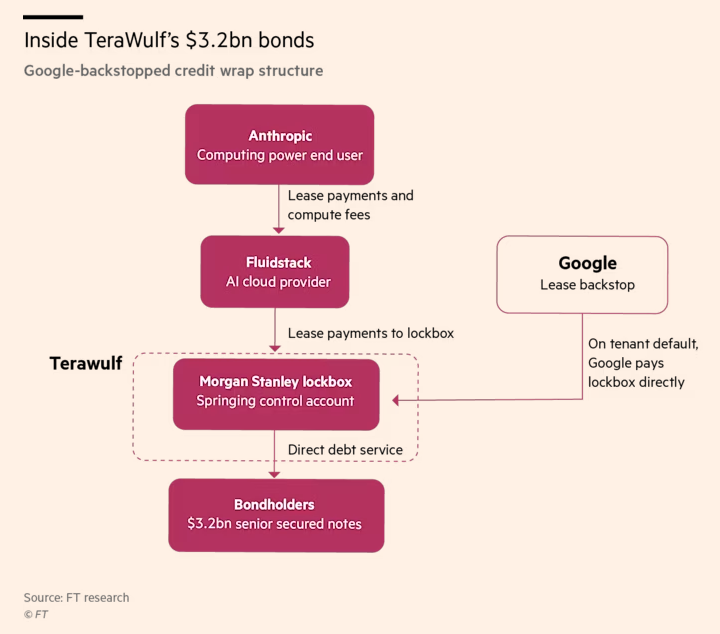
Figure 1 shows the FT's[15] breakdown of a recent TeraWulf bond deal. In this case, TeraWulf can obtain financing given Google's backstop of any lease failures, should Fluidstack not be able to pay TeraWulf, or Anthropic unable to pay Fluidstack[16]. Google is skipping the entire reselling process and simply committing to cover any delinquencies. This gives TeraWulf the benefits of Google acting as a guarantor of the loan without the loan appearing on Google's balance sheet.
Similarly, Meta's $27.3 billion Hyperion data center bond sale is an off-balance sheet one[17], as is its more recent $12.3 billion deal marketed by BlackRock[18].
Many finance professionals argue that these bonds are ultimately guaranteed by the impressive and continually growing revenues and profits from the hyperscalers, so there is nothing to worry about. The reason these bonds find so many customers, despite the circularity label, is that the final guarantors (i.e., the hyperscalers) generate billions of dollars of profit every year and can easily cover these costs, should it come down to that.
… but this is today, and it's with the current bond deals. Will tomorrow's bond deals be supported by the hyperscalers in the same way? And what happens if hyperscaler revenue trends change? What if the banks begin expanding the backstop agreements from hyperscalers to “generally pretty decent” companies? What if the backstop fails to be enforced? Will we see hyperscaler-backstop-backed-bonds grouped together, collateralized, and resold the way Mortgage Backed Securities were in 2007?[19]
Implications and Conclusion
Circular deals are not bad. In fact, they are critical in the development of the AI ecosystem much like such deals are used in critical minerals, oil, electric vehicles, and other capital intensive industries with incredibly high startup costs.
The circularity helps illustrate the commodification of AI today, and how the technology might one day be more like electricity or an internet connection, rather than a product one buys or subscribes to.
When circular deals are supported by overextended lenders, or when overextended lenders try to move such deals off their balance sheets, they become ugly and bad—in other words, incredibly risky. This industry is likely to grow much more in the coming years, so it is important to watch for the lowering of standards or aggregation of risk. As SemiAnalysis writes[11]:
AI Debt Financing will become a multi-trillion-dollar credit market, with over $7T of debt outstanding by 2029 driven both by AI IT Capex and AI Datacenter Capex needs [...] This will make it the second largest asset backed debt market after the US mortgage-backed financing market at just over $13T.
In this evolution, there might be a few bad deals along the way. It's important to keep your eyes open.