
 |
|
|
|
they also aren't very hot and wont work in northern cities, but people will install them there anyway. "boiler" - is that jargon for multiple kinds of heating units or actually just boilers?
|
|
|
So, i have a house in Haliburton Ontario. Historically we drop a cool $3k a year on propane. Last year we installed a Mitsubishi hyper heat ductless system. We used zero gas this year. Read it again, zero. It’s lakefront, very remote, and the largest electricity bill i got was around $450 for a month and then they dropped back to something more like $250. The savings are huge, I’m no longer stressed about running out of gas…and the heat pump performed well beyond its advertised specifications. We had a few -25C days and it was humming hard, but the house stayed a comfortable 20C inside. The house is around 3000sqft and we didn’t even get the largest unit, i can’t stress enough that they actually operate better than advertised. We would run a fire from time to time but we did that with propane too, it’s mostly ornamental. https://photos.app.goo.gl/FCwLJQAtoG67g9y86 https://photos.app.goo.gl/TwiMaSAj9hGxYqby6 |
|
|
You might be surprised at how well cast iron rads can provide comfort at low outside air temps and low flow temps. (I'm in neighboring Cambridge in an old, poorly/non-insulated house.) https://news.ycombinator.com/item?id=39144329 has a bit of details on the experiment I ran back in 2022 to prove 135°F flow would work for us. (If you have a condensing boiler, you can run this experiment safely; if you have a non-condensing boiler, you can run it, but not for very long as you'll be damaging the flue and boiler with condensation at these lower temps.) My outdoor reset curve (sadly, on a gas combi boiler because of the "pretty unusual product" factors) is now set to 105°F at 55°F OAT and 154°F at 0°F OAT (which is lower than the design temperature here, but it gave me more resolution to tweak the line to fit the loss just right; it's spot-on on the lower end, with the system running 22-24 hours per day when it's cold out and stays that way up until around freezing, where the utilization falls off). Matching the gain to the loss quite closely has resulted in a house that's the most comfortable since we moved in in 2007 and gas bills with the combi went down about 46% (versus a 1990s oil-to-gas conversion of a 1950s boiler, so not a realistic comparison for anything that wasn't built by General Motors [not a typo]). |
|
|
We have one loop with cast iron radiators, but the other two loops are modern baseboard. When we installed a condensing boiler in 2015 I needed to adjust the outdoor reset curve up so the loop that serves the first floor wouldn't leave it under temp on cold days. Even our cast iron radiators are smaller than you might expect for the age of the house, because they were designed for water above its normal boiling point (using mercury pressure: https://www.jefftk.com/p/mercury-spill). |
|
|
I also have one loop of modern baseboard. Fortunately, it's in the attic conversion where they did insulate the rafters while doing the conversion, so it works even at that lower temp. I did do something slightly unconventional in plumbing that zone in a primary/secondary and it gets the water from the boiler "first" and returns it to the primary loop ahead of the main zone which is all cast iron rads. That means the baseboard gets the hottest water possible and the full potential flow from the boiler if it "needs" it. In practice, that zone tends to only run 4-5 hours per day while the main zone is running 22-24 hours, so either what I did works really well and/or I didn't need to do it in the first place. But, you've already discovered your reset curve with modern equipment, so you know the right answer for your place. Thanks for the story on mercury pressurization! Fascinating. I learned a lot about our old house (originally gravity circulated as well, but near as I can tell, pressurized only to the typical 12-15 psi and with an in-ceiling green steel expansion tank: https://structuretech.com/wp-content/uploads/2020/03/Old-sch... ) (And of course, sorry to hear about your contamination inconvenience and expense!) |
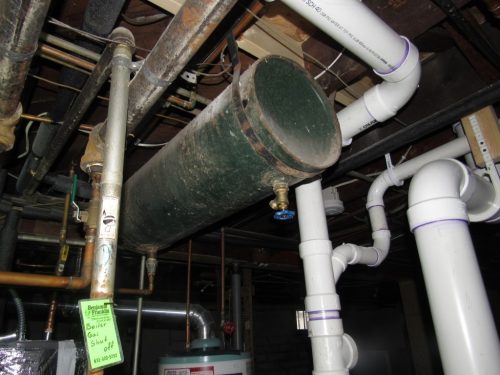
|
|
Most heat pumps fall back to electric heating when it's too cold. So, on these few days you will need the same amount of electricity a typical electric heating will need.
|
|
|
That’s correct, air handlers for ducted systems can absolutely have heat strips. That’s actually pretty standard. I have never seen one for a mini split though — can you share a link?
|
|
|
https://ces.mitsubishielectric.com/wp-content/themes/melco/a... documents the SVZ indoor unit's ability to have electric resistance heat and be connected to Hyper Heat SUZ outdoor units. Whether you call that mini-split or not is up to you, but it's definitely a heat pump system that is Hyper Heat and supplemental electric heat capable, and getting down to one-ton units seems "mini" to me. Mini-split means "smaller than conventional system ["mini"], condensor and evaporator are connected by long refrigerant lines ["split"]". It doesn't necessarily mean "wall/floor/ceiling indoor unit that has no ducts", though a "ductless mini-split" is the most common configuration of mini-split (because of the cheapness and ease of installation). https://zeroenergyproject.com/2022/03/09/what-is-a-mini-spli... |
|
|
In nearly all places extreme code means dark! Sure there are less clouds, but the latitude is high and so there are not only few hours of daylight, the earth's angle is also working against solar.
|
|
|
I absolutely agree this kind of nontrivial work can be done in a way that is woefully inefficient/impractical. My EWI, approx 85m2 of graphite polystyrene with an embedded CO2[1] of ~15kg/m2 is equivalent to approximately 1.5 years of CO2 emissions (combined electricity & gas), or ~9 months of CO2 emissions before I replaced windows and old kerosene boiler that came with the house. Actual installation and other materials excluded (adhesives, mesh, silicone render, 450 hot beverages, getting the neighbour's car repaired after the scaffolders hit it, etc.) excluded. I don't have a full year of data yet, but all in it's looking like CO2 emissions are going to come in at well under 40%. This is in line with the independent assessment I needed to clear a grant for some of the costs[2]. It seems to me "carbon ROI" is about 1/4 the financial ROI (est 8+ years). Now if it was PU instead of EPS that would be a different cost (10x the CO2 of polystyrene). Sadly I also ended up with some PU (PIR) in a small area of low-pitched roof void, I don't know if there were better choices there. There's also a hidden cost in living in a cold, damp building - now there are winter days when I don't even turn the heat on at all. [1] https://www.greenspec.co.uk/building-design/embodied-carbon-... [2] https://www.seai.ie/publications/Your-Guide-to-Building-Ener... |
|
|
It's not just an environmental consideration - efficient houses are much more pleasant to live in, particularly if they are designed holistically with proper ventilation systems and few cold spots.
|
|
|
No one will pay more for a house with a higher R-value. If this were a determining factor, it would be part of real estate listings. It's a secondary or even tertiary concern for most people.
|
|
|
PEB grade systematically increases the value of a house less than 20% of the house value. That's far too low to justify the huge sums involved in energy renovations. |
|
|
From a practical standpoint, they have valued their energy savings closer to what the true cost of carbon emissions are (remember, most carbon emitters are in no way paying the true cost of their emissions [1]; this externality dumping continues with wild abandon). You're arguing systems and scale. This person is simply early in the adoption curve. Consider what will happen when this happens more broadly. As the climate situation becomes more dire [2], the price of carbon emissions per ton will rise and the willingness to prioritize energy savings and carbon emission reductions should increase regardless of fiat return. Physical system outcomes are distinct from magic number in database goes up. But sure, if you're already poor and have nothing [3], this won't matter to you and your life trajectory is already mostly locked in today. As nullstyle mentions, we need to compound in the positive outcome direction, and those decisions are being made today. [1] https://www.nature.com/articles/s41586-022-05224-9 [2] https://www.npr.org/2024/04/09/1243595924/march-world-hottes... |
|
|
Uhmm...I see a problem for countries where you have wall to wall connected urban environments...If all 60 connected houses on a street, install external heat pumps, it will add up.
|
|
|
Have you ever monitored the air quality levels in various rooms? Curious if getting rid of those drafts may be unknowingly affecting your health in other areas. |
|
|
I see tables, I am exited. But I can't make sense of what anything is? I know COP, but what is Training, what is Source? MID seems to be a kind of sensor? Some of the table headers have a tool tip explaining things, but are the ones that aren't the most needed. Also, some about page about what the table aggregates and how it gets there? Seems to be some kind of aggregator for information gathered from an appliances called "emonHub" which is a rPi that gathers data from an assortment of other devices. There are some jargon that you have to parse, ("supply" means the electric cables that "supply" your heat pump) to understand what's going on. The best guide I could find is buried all the way down of the documentation https://docs.openenergymonitor.org/applications/heatpump.htm... That's it. |
|
|
it's funny actually, i've been binging their videos the past few weeks, since i'm looking into buying a home in need of renovation, and was happy to see their logos as part of one of the default columns. they claim also to be mainly motivated by the climate crisis and are even, now, developing an open source water heater, which... you don't often hear about in industries such as home appliances or heating: https://www.youtube.com/watch?v=uFBbArwAXS8 i'd love to install an air-to-water heatpump myself, but i'm untrained and i guess i'm feeling a bit of the dunning–kruger effect while learning from the heat geek videos. |
|
|
I have this outdoor unit https://cooperandhunter.us/product/ch-hyp36lcuo. This past winter the temperature dipped into -20C (-11F), had no issues maintaining temperature in the low 70s in the house. I was running them in heat pump only mode (resistive strips were not used). In the summer our temperature regularly reaches into 90s (above 30C) and the house is very comfortable on those days as well with the same heat pumps |
|
|
No they don't and it's kind of like agile everyone tells you it's not done the right way otherwise it would work. But when is sold it's sold as is it's great.. Very deceiving for customers
|
|
|
If you are in North America, I highly recommend to check out https://ashp.neep.org/#!/ to compare heat pumps. It has efficiency and technical data on almost all models easy to compare without the marketing bullsh*t of manufacturers. The tests are conducted independently and instead of one COP you get the COP depending on the outside temperature which very important in cold climates like Canada.
|
|
|
> If I save 60% on energy for heating every year but then require all the energy needed to build a new heat pump every 5-10 what am I really doing? Activism. |
|
|
Which is why mini splits are not very popular here. The install ends up costing so much. Labor is not cheap in US/Canada, and install is a lot of labor. Still seems like it should be cheaper though.
|
|
|
I paid 15k CAD for 2 Daikin units two years ago, the pricing is kinda stupid but it depends on the quality of the model. Chinese models are way cheaper than Japanese models.
|
|
|
I love my ground-source heatpump. I did the entire install myself, submerging the loop in the pond by my house. We get a COP of approx 3.0 in the middle of winter when its -25C air temp outside :)
|
So i'm slightly mystified that we basically don't hear anything about fitting drainwater heat recovery [1], in which the lukewarm drain water from your shower is used to pre-warm the incoming cold water. It's extremely simple, pretty cheap, simple to fit, and can recover ~50% of the waste heat, of something which is tens of percent of the energy consumption of a household.
By all means, get a heat pump. But get a heat exchanger on your shower first!
[1] https://www.energy.gov/energysaver/drain-water-heat-recovery