Two months ago, we launched our Chrome extension to help combat the rising slop problem on social media. It lets users scan posts on social media as they scroll, flagging AI-generated content so they can make informed decisions about how they spend their attention.
Pangram is a research-first company, not just for our industry-leading AI detection algorithms, but for tracking the risk and prevalence of AI-generated content. Social media is one of the hardest domains to study here — much harder than, say, news articles, research papers, or Amazon reviews. But it's also one of the most crucial, because it's potentially the highest-volume source of AI-generated content we face.
We believe it's important to understand this problem so that we can better combat it. That's why we included an opt-in setting in our Chrome extension, to allow users to aid our research by anonymously sharing their scan statistics with us. We've compiled the first few months of this data into the report below.
Key findings:
- One in four longform posts on social media flagged as fully AI-generated
- Of all posts we flagged as AI-generated, two-thirds came from LinkedIn
- Nearly half of X/Twitter articles contained AI writing
AI-generated content is hitting longform the hardest
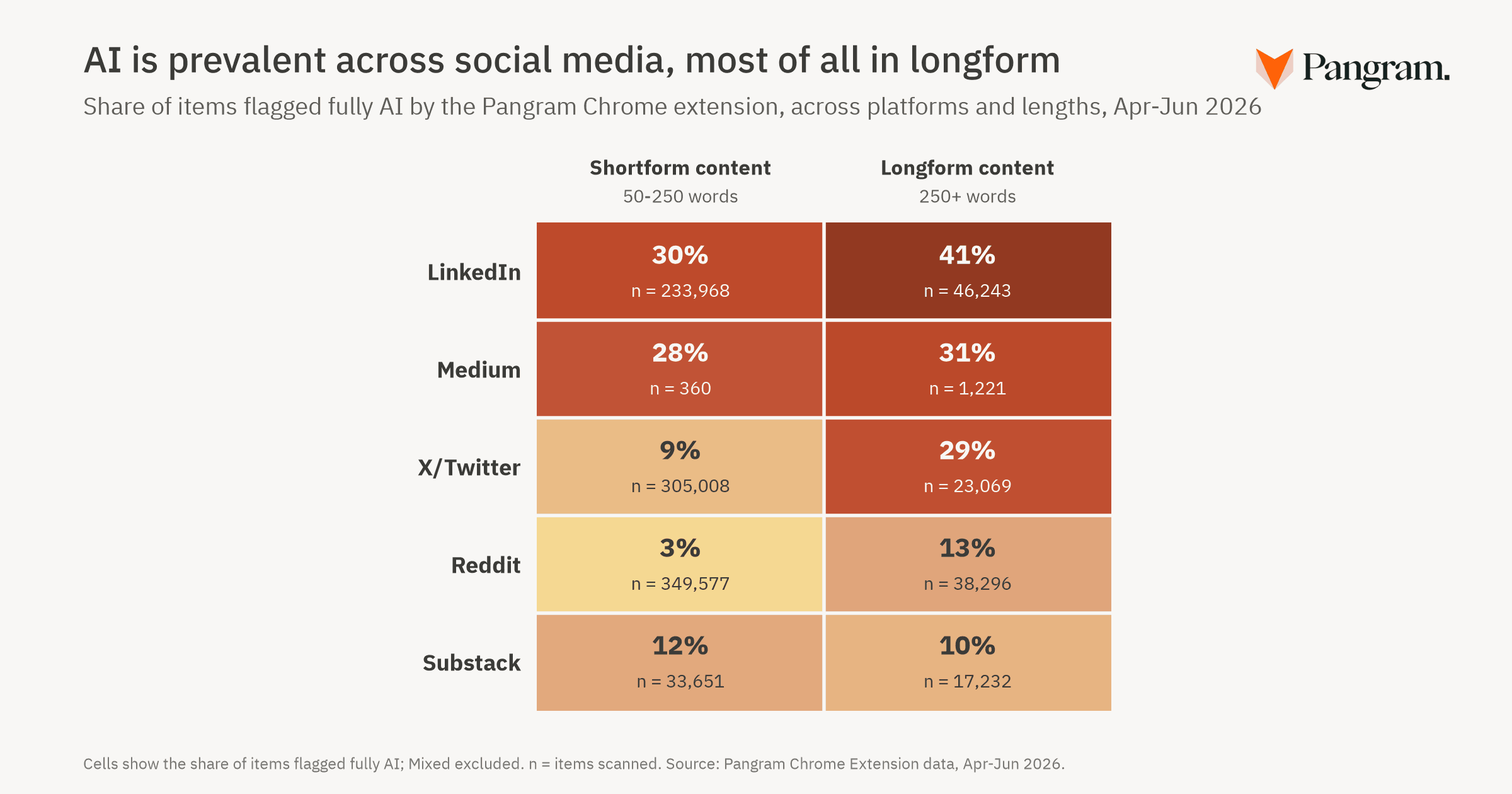
AI-generated content appeared across all social media platforms in our data set. The average AI rate across all scanned items was 13.8%, but specific rates varied by platform and item length. On four out of five platforms, longer content was more likely to be AI-generated than shortform content. Across all platforms, one in four longform items (25.72% of items over 250 words) were fully AI-generated.

Substack was an exception; there, the rate of fully AI-generated content remained fairly flat, and longer, more substantial posts were actually slightly less likely to be AI-generated compared to shorter ones.
LinkedIn was the most AI-saturated platform, where more than 40% of longform posts flagged as fully AI-generated. However, if we included mixed AI and human content, X/Twitter was the worst off: almost half of X articles were either fully AI-generated (23.9%) or AI-assisted/mixed (22.9%), with only 53.2% of X articles flagging as fully human-authored.

Our data shows that AI-generated content is a problem across all platforms, and it is hitting longform content especially hard. Even Substack, which was the longform platform with the lowest combined AI rate, still saw more than a fifth of its posts (21.9%) flag as AI-generated or AI-assisted. This is consistent with the rise of AI-generated content we're seeing in writing elsewhere, such as in newspaper opinion pieces.
AI slop is flooding LinkedIn
LinkedIn had the highest AI share of any platform across the board. LinkedIn posts made up a third of scanned items, yet it accounted for nearly two-thirds (62%) of all AI content we flagged. Contrary to what one might expect, people are overwhelmingly willing to use AI to speak on their behalf in professional settings that are associated with their real identity, and less likely to use it on casual and anonymous platforms.

LinkedIn also encourages AI use on its platform in several ways, including a built-in "Write with AI" button (now rebranded "Enhance post," but still offering AI writing assistance). People are noticing LinkedIn's growing reputation for slop – perhaps to combat it, an executive at LinkedIn recently announced that the platform would be detecting and downranking AI-generated posts using an in-house algorithm; ironically, the announcement was itself AI-generated. Whether or not the company is attempting to modulate AI in their feed, our users are still seeing a lot of AI writing on LinkedIn.
Top-level posts were more AI-generated than replies
In our data, Reddit had the highest scan volume of any platform, making up 36.7% of items that we scanned. Yet at just 4.4%, Reddit had one of the lowest combined AI shares of any platform. This is due to a composition effect: replies on Reddit were overwhelmingly human-authored (98.1%) and replies altogether made up 72% of Reddit items that we scanned. Top-level posts on Reddit were much more likely to be AI-written, at 11.6% of posts, in line with X/Twitter's 10.0% AI-saturation. The same pattern held on LinkedIn, albeit to a lesser extent: a top-level LinkedIn post was 1.35x more likely to be AI-generated than a comment.

Although LinkedIn replies were less likely to be AI-generated than posts, the effect reverses when controlling for length: LinkedIn comments were actually slightly more likely to be AI compared to top-level posts. For Reddit, the difference in AI rate was independent of post format – when controlling for length, top-level Reddit posts still had a 5.25x greater chance of being AI-generated.
Reddit's AI-free replies point to a blind spot of many anti-botting strategies. While Reddit's spam policy effectively eliminates accounts that use AI to automatically generate spam replies, this approach only catches the lowest-effort spam content on the platform. Top-level Reddit posts only make up a quarter of all Reddit items, but they have far more audience impact, and their lower volume allows AI-authored posts to slip past volume-based moderation like rate-limiting.
Method and data collection
Collectively, since the Chrome Extension's launch on April 24th 2026, users who opted into sharing their data for research helped us create a dataset of 1,002,627 posts across several of the largest social media platforms on the internet: LinkedIn, Medium, Substack, X/Twitter, and Reddit. Each post in our dataset is counted only once, and we only scan items that are longer than 50 words. Every post was analyzed with Pangram 3.3, our latest AI detection model, which achieves a 0.01% false positive rate. This dataset allows us a direct window into what AI-generated content people are seeing on their feeds at this point in time.
Conclusion
AI writing is now a problem everywhere on social media. This is concerning, but it's in line with what we're seeing elsewhere online: researchers estimated that 35% of newly published websites on the open internet were AI-generated or AI-assisted. An internet that is completely flooded with undisclosed AI content is bleak, but we don't believe it's inevitable. We hope that by providing transparency to AI-generated content online, we can give internet users back some control of how they spend their attention.