
Authored by Jijo Malayil via Interesting Engineering,
While China dominates humanoid robotics headlines, a Korean firm showcased a humanoid learning complex motions through an open-source AI framework.
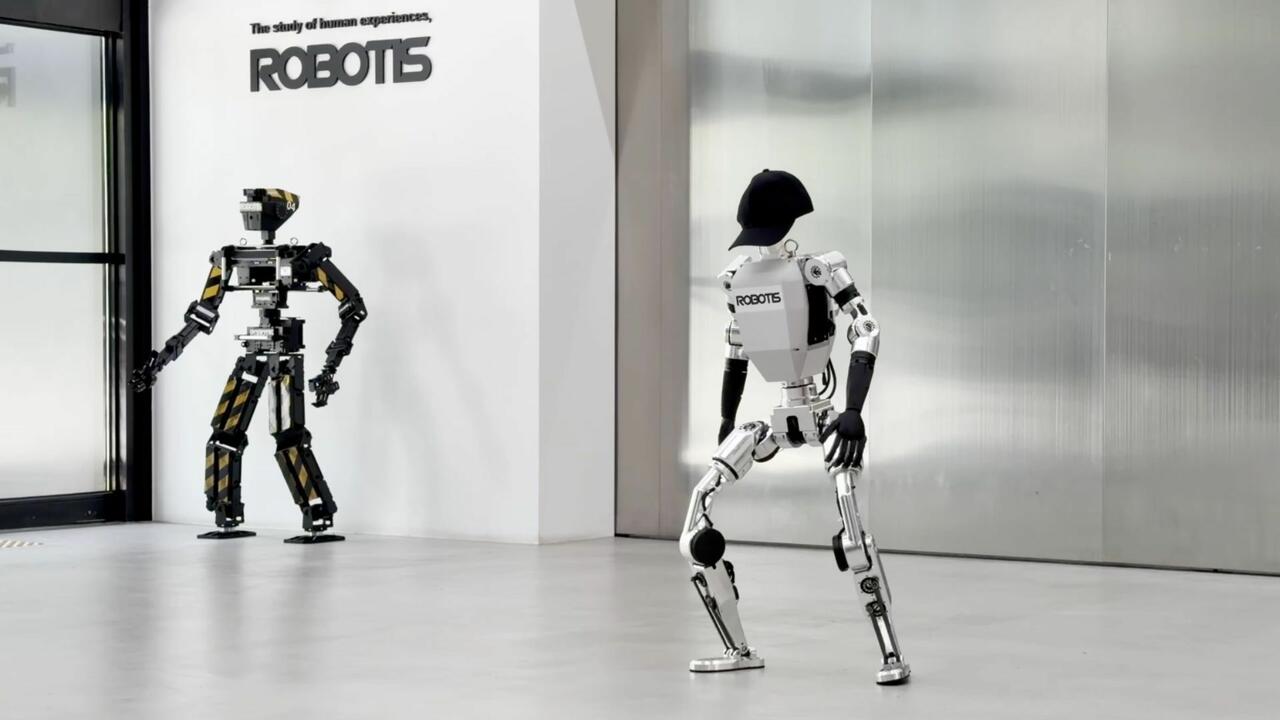
In a recent demonstration, ROBOTIS' AI Sapiens learned the famous CORTIS REDRED Challenge motion using only smartphone video, eliminating the need for professional motion-capture systems.
The process combined video-based motion capture, motion retargeting, simulation-based reinforcement learning, and Sim2Real transfer.
According to the firm, the demonstration highlights how open-source tools can simplify humanoid robot training, enabling users to generate, learn, and execute full-body motions more easily.
Humanoid Learns Motion
ROBOTIS has demonstrated the capabilities of its AI Sapiens humanoid robot, an open-source platform for physical AI powered by DYNAMIXEL-Q actuators. The project is designed to make humanoid robot motion learning more accessible by using widely available hardware and open-source software tools.
In the demonstration, AI Sapiens learns and performs a complex full-body motion known as the CORTIS REDRED Challenge. Instead of relying on expensive professional motion-capture systems, the robot learns the movement from video recorded using a standard smartphone camera. This significantly reduces the cost and complexity of collecting training data for humanoid robots.
The motion-learning process begins with video-based motion capture. Human movements recorded on a smartphone are converted into digital motion data that can be processed by software. The captured motions are then passed through a motion retargeting stage, where the human movements are adapted to match the physical structure and joint limitations of the humanoid robot.
After retargeting, the robot is trained in a simulation environment using reinforcement learning. During this stage, the AI repeatedly practices the motion in a virtual world, allowing it to improve balance, coordination, and movement accuracy without risking damage to physical hardware. Simulation training also enables rapid testing and optimization before deploying the motion to the real robot.
Once training is complete, the learned behavior is transferred from simulation to the physical AI Sapiens robot through a Sim2Real pipeline. This process helps ensure that motions developed in the virtual environment can be executed successfully in the real world, despite differences between the simulation and the physical hardware.
Accessible AI Robotics
ROBOTIS plans to release the motion generation and learning pipeline as open-source software, giving researchers, developers, educators, and hobbyists access to the tools used in the demonstration. The goal is to lower barriers to humanoid robotics development and enable a wider community to experiment with motion learning and physical AI systems.
According to ROBOTIS, AI Sapiens is a fully open-source humanoid robot platform designed for physical AI research and development. Standing 1.3 meters tall and weighing 34 kilograms, the robot features 23 degrees of freedom across its body, enabling a wide range of human-like movements.
The platform is powered by 23 next-generation DYNAMIXEL-Q quasi-direct-drive (QDD) actuators, including 14 QM-060 units and 9 QM-080 units. These actuators combine low gear reduction ratios, high-torque motors, and integrated control electronics to deliver high backdrivability, low impedance, and precise torque control, making them suitable for dynamic and compliant humanoid motion.
AI Sapiens is powered by an NVIDIA Jetson Orin NX 16GB computer, delivering up to 100 TOPS of AI performance for advanced robotics tasks. It supports Wi-Fi 5, Bluetooth 5.0, dual Ethernet ports, USB connectivity, and 24V/12V power outputs for connecting additional hardware.
The robot is powered by a 46.8V, 9000mAh battery. It is supported by a fully open-source ecosystem that includes hardware bills of materials, CAD files, source code, simulation assets, and development tutorials, enabling researchers and developers to customize and expand the platform.