Someone recently introduced me a weird and wonderful little board game that has become my latest obsession.
It's a game for 2-12 players where horses race on a track. Except that the players don't control the horses directly. Nor do they choose when and how to bet on said horses. Nor do they have any input whatsoever regarding how the game unfolds (though the proceedings are not deterministic – merely luck-based, like a casino game). The game basically amounts to a skill-free gambling machine. It wouldn't require much effort to turn it into a zero-player affair.
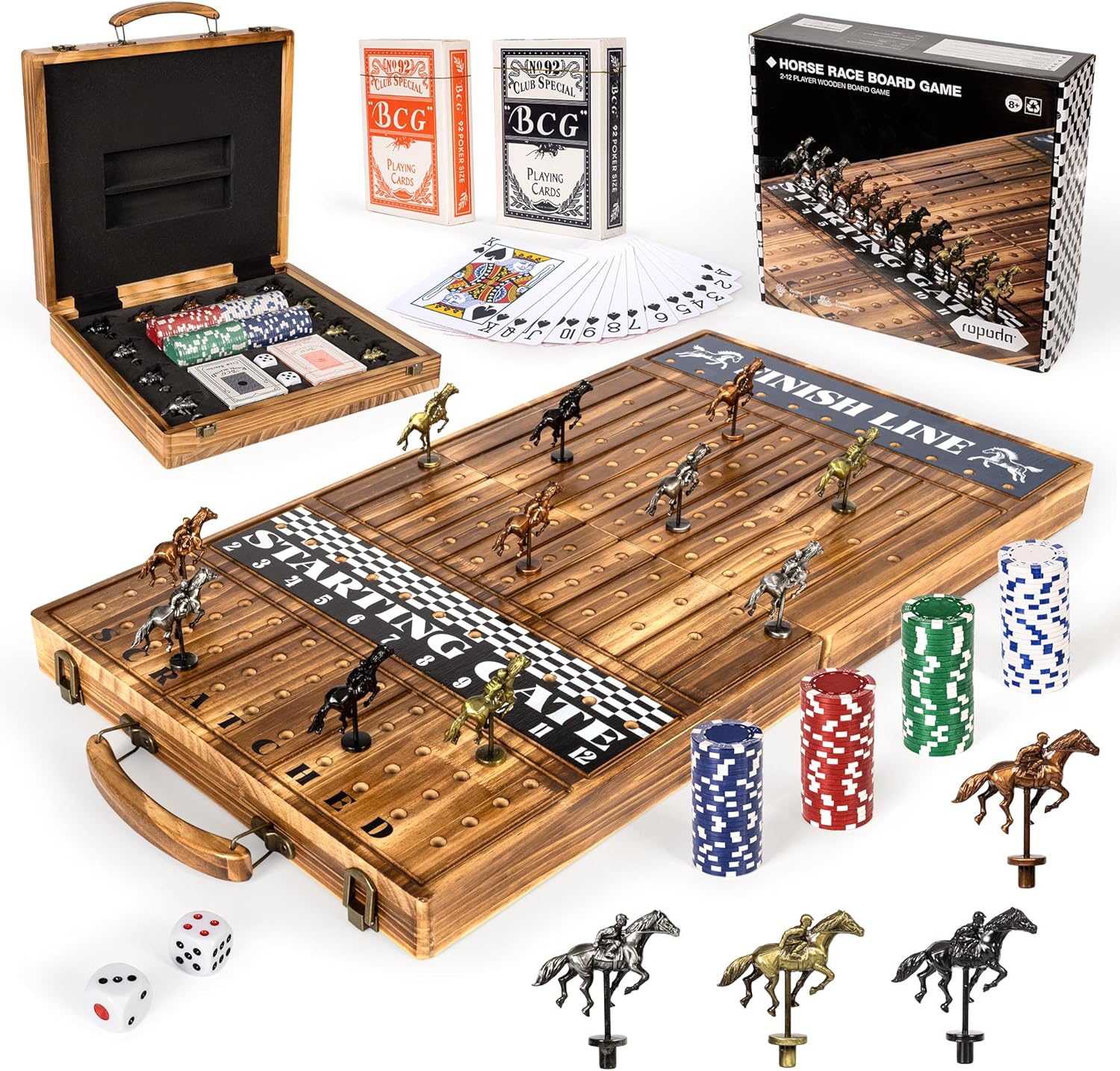
Oh, and did I mention that the game has no consistent title? As far as I've found, it has been (re)released many times under several different names, including:
Perhaps it's one of those ancient folk games that seem to have come to us fully-formed from deep in the past? Or else it's in the public domain, such that anyone is free to run with it? I have no idea. The mystery is part of the appeal – what on earth is this non-game, where did it come from, and why does it keep being repackaged?
I have no answers. All I know is that it's strange, and entertaining, and I love it. I'll probably try to code my own variation of it at some point.
In the interest of making more people aware of this strange and delightful game, I've compiled its rules and variations in this post:
- Classic Mode is the aforementioned input-free variation. It's strangely enjoyable!
- Advanced Mode adds a few wrinkles that introduce player inputs and a modicum of strategy.
- Other House Rules are a handful of minor changes that I've found elsewhere on the internet. They add minor variations that increase the amount of player agency in the game.
A game for 2 to 12 players.
This rule set is adapted from Horse Race Board Game, published by Ropoda.
Components
- Game board
- 2 six-sided dice
- 2 decks of cards
- 11 horse tokens
The Board
The board consists of:
- A starting gate where horses initially begin (containing one slot per lane).
- A scratch zone (containing four slots per lane).
- 11 numbered lanes (each containing a variable number of slots).
- A finish line (containing one slot per lane).
        Starting Gate                     Finish Line
             |                                 |
             |                                 |
--------------------------------------------------
| 0 0 0 0 |  2 | 0                         0 | 0 | 	(2 slots)
| 0 0 0 0 |  3 | 0     0      0      0     0 | 0 | 	(5 slots)
| 0 0 0 0 |  4 | 0   0   0    0    0   0   0 | 0 | 	(7 slots)
| 0 0 0 0 |  5 | 0  0  0  0  0 0  0  0  0  0 | 0 | 	(10 slots)
| 0 0 0 0 |  6 | 0 0 0 0 0 0  0  0 0 0 0 0 0 | 0 | 	(13 slots)
| 0 0 0 0 |  7 | 0 0 0 0 0 0 0 0 0 0 0 0 0 0 | 0 | 	(14 slots)
| 0 0 0 0 |  8 | 0 0 0 0 0 0  0  0 0 0 0 0 0 | 0 | 	(13 slots)
| 0 0 0 0 |  9 | 0  0  0  0  0 0  0  0  0  0 | 0 | 	(10 slots)
| 0 0 0 0 | 10 | 0   0   0    0    0   0   0 | 0 | 	(7 slots)
| 0 0 0 0 | 11 | 0     0      0      0     0 | 0 | 	(5 slots)
| 0 0 0 0 | 12 | 0                         0 | 0 | 	(2 slots)
--------------------------------------------------
     |                        |
     |                        |
 Scratched                Race Track
Classic Mode
For 2-12 players.
Classic mode is played for 8 (or more) rounds, decided by the players at the game's outset.
Whichever player has the greatest number of chips at the end of all the rounds is the winner.
Setup
- Prepare the deck(s):
- Use one deck of cards with four or fewer players. Use two decks with more than four players.
- Remove all aces (A), kings (K), and jokers from the decks.
- Shuffle all remaining cards into a single deck.
- Deal an equal number of cards to each player until the deck is depleted.
- Place all horse tokens on the starting line.
- Continue to the Scratch Phase.
Scratch Phase
- Scratch the first horse:
- The player to the dealer's left rolls the dice.
- Add the numbers of the dice roll to determine the horse to scratch.
- Move the corresponding horse to the first scratch line.
- Any player holding a card with a number matching the horse must:
- Discard the matching card. (Note: Jacks match "11" and queens match "12.")
- Contribute 1 chip to the pot for each card discarded.
- Scratch the second horse:
- Pass the dice to the player to the left.
- The player rolls the dice.
- Add the numbers of the dice roll to determine the horse to scratch.
- Move the corresponding horse to the second scratch line.
- Any player holding a card with a number matching the horse must:
- Discard the matching card.
- Contribute 2 chips to the pot for each card discarded.
- Scratch the third horse:
- Pass the dice to the player to the left.
- The player rolls the dice.
- Add the numbers of the dice roll to determine the horse to scratch.
- Move the corresponding horse to the third scratch line.
- Any player holding a card with a number matching the horse must:
- Discard the matching card.
- Contribute 3 chips to the pot for each card discarded.
- Scratch the fourth horse:
- Pass the dice to the player to the left.
- The player rolls the dice.
- Add the numbers of the dice roll to determine the horse to scratch.
- Move the corresponding horse to the fourth scratch line.
- Any player holding a card with a number matching the horse must:
- Discard the matching card.
- Contribute 4 chips to the pot for each card discarded.
- Continue to the Race Phase.
If a scratch number is repeated:
- Move the matching horse to the corresponding scratch line.
- Players who held matching cards must contribute a number of chips to the pot equal to the current scratch line.
Example
- The third horse's roll is 4, but Horse #4 was the first horse scratched.
- Horse #4 moves to the third scratch line.
- Player 2 held two 4s when the horse was originally scratched. Player 2 now contributes 6 chips to the pot.
If a player is unable to contribute a specified amount to the pot, they must contribute all the chips they can. If the player has no chips to contribute, they contribute nothing.
Race Phase
- The next player going clockwise rolls the dice:
- If the dice total matches a non-scratched horse, move that horse forward one space.
- If the dice total matches a scratched horse, the player contributes a number of chips to the pot equal to the horse's scratch line, if able.
- Repeat Step 1 until a horse reaches the finish line.
- When a horse reaches the finish line, continue to the Payout Phase.
Payout Phase
- Players receive a share of the pot depending on whether they hold cards matching the winner's number:
- If using one deck of cards, players receive 1/4 of the pot (rounded down) for each matching card.
- If using two decks of cards, players receive 1/8 of the pot (rounded down) for each matching card.
- Leftover chips remain in the pot.
- Continue to the Reset Phase.
Reset Phase
- All players pass their remaining cards to the player on their left.
- Shuffle all the discarded cards, then deal an equal number to each player.
- Move all horse tokens to the starting line.
- Continue to the Scratch Phase.
Advanced Mode
For 4-12 players.
Advanced Mode retains the same core gameplay and objectives as Classic Mode, but includes the following variations.
Deck Composition
Aces and kings are now included in the base deck.
| Players | Deck Composition | Cards Per Player | Remaining Cards |
|---|---|---|---|
| 4 | Two suits + 1 joker | 6 | 3 |
| 5 | Two suits + 2 jokers | 5 | 3 |
| 6 | Three suits + 2 jokers | 6 | 5 |
| 7 | Three suits + 2 jokers | 5 | 6 |
| 8 | Full deck + 2 jokers | 6 | 6 |
| 9 | Full deck + 2 jokers | 6 | 0 |
| 10 | Full deck + 2 jokers | 5 | 4 |
| 11 | Full deck + one extra suit + 2 jokers | 6 | 1 |
| 12 | Full deck + one extra suit + 2 jokers | 5 | 7 |
Card Abilities
| Card | Ability |
|---|---|
| King (K) | Transfer a scratch penalty during the Scratch or Race Phase to the player on your left or right. Each King played in response to another King doubles the penalty. |
| Ace (A) | Cancel and ignore a scratch penalty during the Scratch or Race Phase. |
| Joker | After dice resolution, move any horse forward or backward one space. |
Note
2-10 / J / Q retain their standard functions.
Dealing and Card Drafting
- Designate a dealer to shuffle the deck and deal an equal number of cards to each player.
- Draft the cards:
- Each player examines their hand and keeps one card, placing it face down in front of them.
- Players pass their remaining cards clockwise to the next player.
- Repeat Steps 2.1-2.2 until all cards are drafted.
- Each player's kept cards form their starting hand.
Pots and Antes
Advanced Mode adds antes to the game, and uses a two-pot system:
- Main Pot: Players pay an agreed-upon ante into this pot each round in addition to the usual scratch penalties. This pot is divided as normal among the holders of cards matching the winning horse.
- Jockey Pot: Players pay double the Main Pot ante into this pot each round. The entire pot is awarded to the player who moves the winning horse across the finish line.
Chain Penalty Scratch Mode
This feature is recommended for multi-race sessions.
- The player to the left of the dealer rolls to scratch the first horse, following the same procedure as Classic Mode.
- The player passes the dice clockwise to the next player.
- When this player rolls:
- If a new horse is scratched, all players discard their cards that match the horse, paying a penalty of (Scratch Position x Round Ante) into the Main Pot.
- If an already-scratched horse is rolled, only the current player pays a penalty of (Scratch Position x Round Ante) into the Main Pot.
- Repeat 2-3 until a horse is moved to the fourth scratch position.
- Continue to the Race Phase like in Classic Mode, except that the player who made the final scratch makes the first roll.
Settlement Phase
Once a horse crosses the finish line during the Race Phase, do the following:
- Assess penalties to players who hold the following cards:
- King (K): Pay 2x the base ante into the Main Pot.
- Ace (A): Pay 3x the base ante into the Main Pot.
- Joker: Pay 4x the base ante into the Main Pot.
- Award payouts from the pots:
- Distribute the Main Pot:
- Players show any cards they hold that match the number of the winning horse.
- Divide the Main Pot into a number of portions matching the shown cards. Round down any decimal amounts.
- Place any leftover payouts in the Jockey Pot.
- Give all of the Jockey Pot to the player who moved the winning horse across the finish line.
- Distribute the Main Pot:
- Reset the board and deck:
- Collect all cards and shuffle them into the deck.
- The player to the left of the current dealer becomes the new dealer.
- Move all horses to the starting line.
- Begin the next round.
Other House Rules
This section collects interesting house rules from various corners of the internet.
Jesse Schellenberg's Variant
Suitable for Classic Mode.
"This allows for folders remorse situations that are mostly hilarious for the majority at the table. It also allows a player to specialize or diversify in the cards they think will end up snagging a portion of the winnings."
- Deal an extra hand at the beginning of the game. (I.e., in a 6-player game, deal a 7th hand.)
- Once all scratched cards are discarded, the extra hand of cards are placed face up near the board.
- After dice rolls are resolved on a player's turn, cards from the extra hand can be purchased at a cost of the highest scratch value.
- Once you purchase a card, you must replace it with one from your hand.
George Husted's Variant
Suitable for Classic Mode.
- Keep the face cards, jokers, and aces in the deck.
- Cards are dealt and held without being displayed.
- After the initial card draw, starting with the first player (highest dice roll), all players:
- May place a wager, meet a wager, or raise a wager.
- May then discard up to 2 cards and be dealt 2 replacement cards. Discards are placed face up.
- All players are free to place another wager. Each wager or raise is limited to twice the ante. All wagers totaled are limited to five times the ante.
- Each player must meet a wager or raise to stay in the race.
Face cards, aces, and jokers held in your hand may be played if you roll a "scratched" horse and have to pay into the pot:
- Jacks: Retreat a horse of your choice one space.
- Queens: Place one chip under a horse of your choice. When that horse's number is rolled, do not advance it. Remove the chip and place it in the kitty. Once the chip is gone, any subsequent rolls will move the horse.
- Kings: Place two chips under a horse of your choice. When that horse's number is rolled, do not advance it. Remove one chip and place it in the kitty. Continue this until there are no chips left under the horse, and then any subsequent rolls will move the horse.
Marcus Perry's Variant
Suitable for Classic Mode and Advanced Mode.
At the game's outset, players may choose to implement a one-minute round of card trading from among the following options:
- Before the scratch phase.
- After each scratch.
- At the end of the scratch phase.
Any trade is permissible as long as both trading partners consent to it.
Sample Trades
- Giving two 6s for one 7.
- Giving three 2s for one 8.
Matt Robertson's Variant
Suitable for Classic Mode and Advanced Mode.
After the scratch phase:
- The current player rolls 4 six-sided dice.
- The current player chooses how to pair the resulting rolls. (For example, rolls of 1, 4, 5, and 6 could be 5-11, 6-10, or 7-9.)
- The two horses matching the chosen pairs move forward one space.