"This is not science fiction; it's science eventuality." - Steven Spielberg.
"You decide you'll control nature, and from that moment on you're in deep trouble, because you can't do it.You can make a boat, but you can't make the ocean. You can make an airplane, but you can't make the air.Your powers are much less than your dreams would have you believe." - Michael Crichton.
As production began on Jurassic Park, the following story appeared over the wires of the Associated Press:
San Francisco (ap)A team of California scientists has cloned a fragment of genetic material from an extinct stingless bee that has been preserved in amber more than 25 million years. The researchers, who extracted some of the insect's DNA and determined its exact molecular sequence, are attempting the new procedure on other amber-trapped ancient animals such as lizards, weevils and a biting midge that may have eaten dinosaur blood. If the midge consumed dinosaur blood, the researchers said they may be able to unlock the secrets of the mysterious extinct reptiles and their evolution. The report on the first stage of the scientists' work is being published in the current issue of the British journal Medical Science Research by Raul J. Cano, a molecular biologist at California Polytechnic State University in San Luis Obispo, Calif, and entomologist George O. Poinar Jr. of the University of California's College of Natural Resources in Berkeley. While the research seems to echo Jurassic Park, the novel about scientists who bring dinosaurs back to life by cloning their DNA, Poinar said the real purpose of the experiment is to prove that it is possible to extract viable DNA from extinct animals and to seek firm new lines of evidence for an "evolutionary clock" that shows the pace of evolution over geologic time.
In the report published this week, the researchers describe how they were able to extract bits of muscle tissue from the wings of four of the bees whose bodies were preserved virtually intact in the resinous sap of an extinct tree. The sap became amber as it solidified over hundreds of years. Poinar has collected insects and the fur of animals found in a mine in the Dominican Republic, where the trees lived 25 million to 40 million years ago. Poinar's son Hendrik, a Cal Poly graduate student, and David W. Roubik, a Smithsonian Institution bee expert from Panama, are also part of the team. The bee used in the experiment was a member of the species Propledia dominicana, an extinct ancestor of tropical stingless bees that bite rather than sting and that are widespread throughout the world today. The sequencing of the ancient DNA shows that about 7 percent of the bee's original genetic material has changed in contemporary bees a valuable clue to the rate at which evolution of the bees has progressed, Cano and Poinar said.

Jurassic Park
Imagine that you are one of the first visitors to Jurassic Parka melding of scientific discovery and visual imagination. You arrive as a child would, free of preconceptions and ready for anything. Your adventure is about to begin. Entering the gates of the park, your senses are overwhelmed by the world that surrounds you; the sounds, the smells, even the feel of the earth is curiously different. Somewhere in the distance, you hear the movement of huge animalsthe ground shakes with their passing. You are a stranger in an alien world. You look into the night sky, at stars whose light was born long before humans ever existed; born when a different race of beings walked the planetpowerful animals, rulers of the earth for 160 million years. Like those ancient stars, the Jurassic has left only faint traces of itselfin fossils, footprints, relics of blood cells encased in amber. A time capsule that has remained closed for countless millennia. Now the time capsule has been opened, and man and dinosaurs, the two rulers of the earth, will meet for the first time. All scientific resources had been dedicated to bringing Jurassic Park to reality; a childhood fantasy made real, a place where wonders come to life. It was created to be the ultimate amusement. But someone forgot to tell the dinosaurs. Meeting them in their environment, we realize they are not monsters, but animals far more agile, far more intelligent and far more dangerous than we guessed. We can give birth to the dinosaurs, but nothing can prepare us for what will happen when the egg hatches.
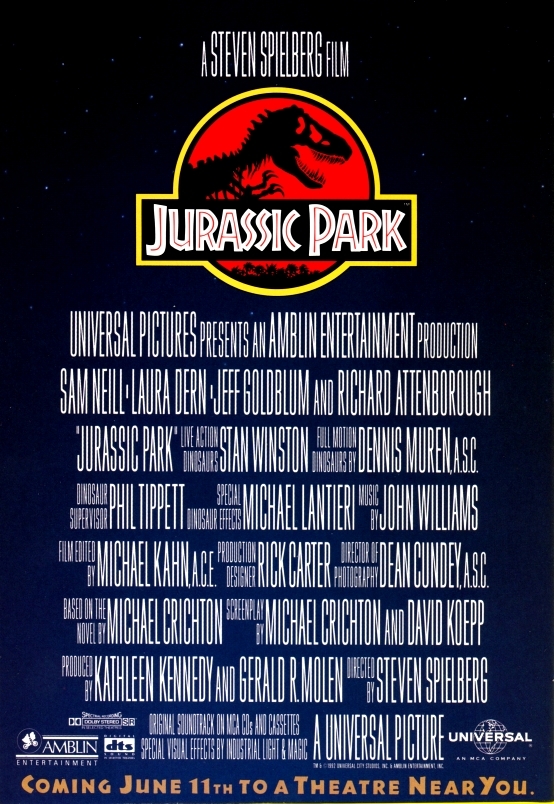
Jurassic Park is the place where science ends and the unpredictable begins. Directed by Steven Spielberg from the best-selling book by Michael Crichton, Jurassic Park stars Sam Neill as Dr. Alan Grant, a renowned paleontologist who is asked to inspect a spectacular amusement park; Laura Dern as his colleague, Dr. Ellie Sattler; Jeff Goldblum as a brilliant but eccentric mathematician whose Chaos Theory explains the dangers inherent in the project; and Sir Richard Attenborough as John Hammond, the park's ambitious developer. Ariana Richards and Joseph Mazzello are Hammond's young grandchildren. Also starring are Bob Peck, Martin Ferrero, B.D. Wong, Samuel L. Jackson and Wayne Knight. Kathleen Kennedy and Gerald R. Molen produced the Amblin Entertainment Production for Universal Pictures. Lata Ryan was associate producer.
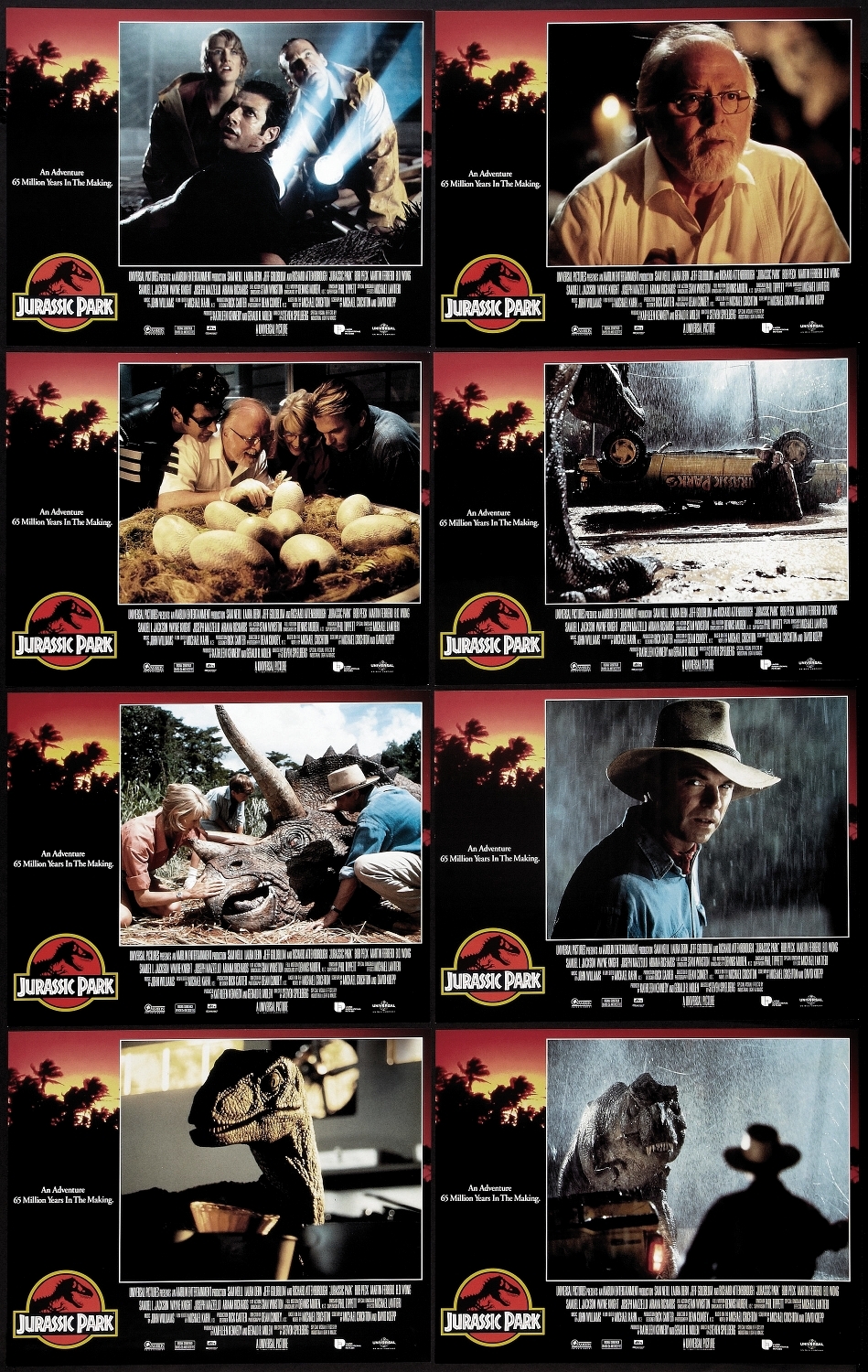
Michael Crichton and David Koepp wrote the screenplay. Behind the cameras, the creative team included cinematographer Dean Cundey, production designer Rick Carter and editor Michael Kahn. In addition to the talented cast of actors Jurassic Park features stars of a different magnitude. For more than 18 months before filming began, an award-winning design team had been conceiving and creating the live action dinosaurs who would inhabit the unique park. From the huge Tyrannosaurus rex to the vicious Velociraptor, Jurassic Park features a level of realism and technical innovations that had never before captured on film. The talented design team included the highly acclaimed Stan Winston, Live Action Dinosaurs; ILM's Dennis Muren, Full Motion Dinosaurs; Phil Tippett, Dinosaur Supervisor; Michael Lantieri, Special Dinosaur Effects and Special Visual Effects by Industrial Light & Magic. Their achievements, individually and collectively have included box office successes, from Star Wars to Terminator 2.
Production
In May of 1990, Universal obtained the galleys of best-selling author Michael Crichton's upcoming book Jurassic Park, and within a matter of hours, the studio was intently negotiating to purchase the book on behalf of Steven Spielberg. "It was one of those projects that was so obviously a Spielberg film," said producer Kathleen Kennedy, who had closely collaborated with the filmmaker for 14 years. "If you look at the body of Steven's work, he very often is interested in the theme of extraordinary things happening to ordinary people." "What's interesting to me about this particular project is there is as much science as there is adventure and thrills," said Spielberg to the Washington Post. Jurassic Park is a cross between a zoo and a theme park. It's about the idea that man has been able to bring dinosaurs back to earth millions and millions of years later, and what happens when we come together. Author Michael Crichton, who spent two years writing the book, witnessed a flurry of bids and negotiations from four major studio contenders, but was pleased to learn of Spielberg's interest in directing the film. In less than a week, Universal announced that Jurassic Park would be directed by the filmmaker who had so successfully blended art and science in the making of such films as Close Encounters of the 3rd Kind and E.T..

Crichton's remarkable background as a graduate of Harvard Medical School, novelist, screenwriter and film director had led to his distinct flair for techno-thrillers such as "The Andromeda Strain" and "The Terminal Man." The story that had been percolating about a theme park for genetically engineered dinosaurs grew out of his concern for the rise of "scientism." "I believe that science is a wonderfully powerful, but distinctly limited tool," said Crichton. Envisioning the park's billionaire-developer, John Hammond, as a sort of "dark Walt Disney," Crichton's story ventured into an area of growing controversybiogenetics for the sake of profit. "There's a big moral question in this story," said Spielberg. "DNA cloning may be viable but is it acceptable? Is it right for man to do this, or did dinosaurs have their shot a million years ago?"
A self-professed dinosaur fan since childhood, Spielberg recalled, "The first big words I ever learned were different dinosaur species, and when my son Max was two vears old, he could not only identify but pronounce 'Iguanadon.' I think one of the things that interests kids is that they're so mysterious----there's a quote from a Harvard psychologist who was asked why kids love dinosaurs so much. He said, 'That's easy. They're big, they're f fierce and they're dead." "But now they're back," said Spielberg. Both Crichton and Spielberg viewed paleontology as detective work, a Sherlock-Holmes-like deductive existence. "When I first saw a dinosaur dig, it looked just like the scene of a crime," recalled Spielberg. "It had ribbons around it, with people working as if they were forensic scientists brushing for fingerprints. I'd love to spend a summer in Montana doing that."
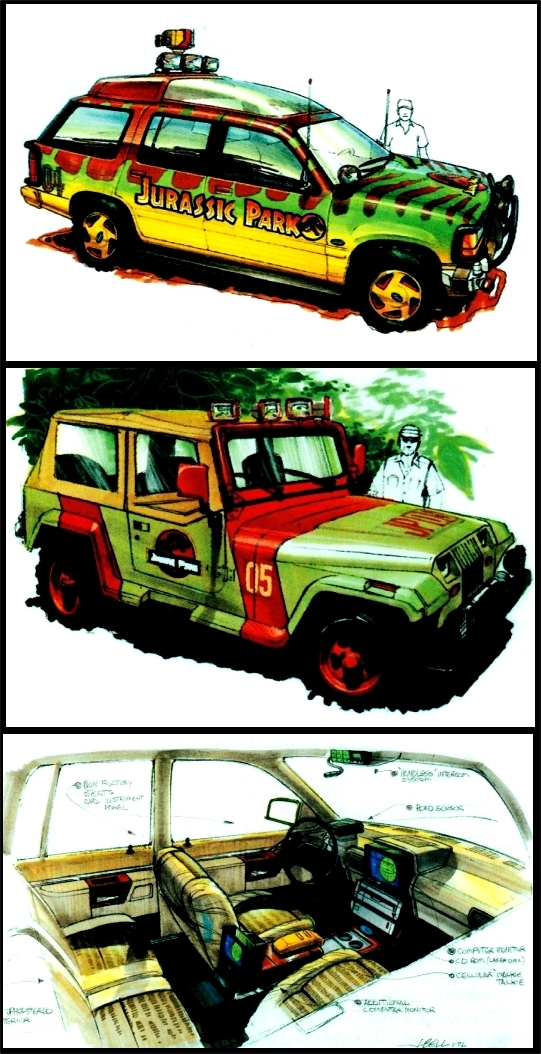
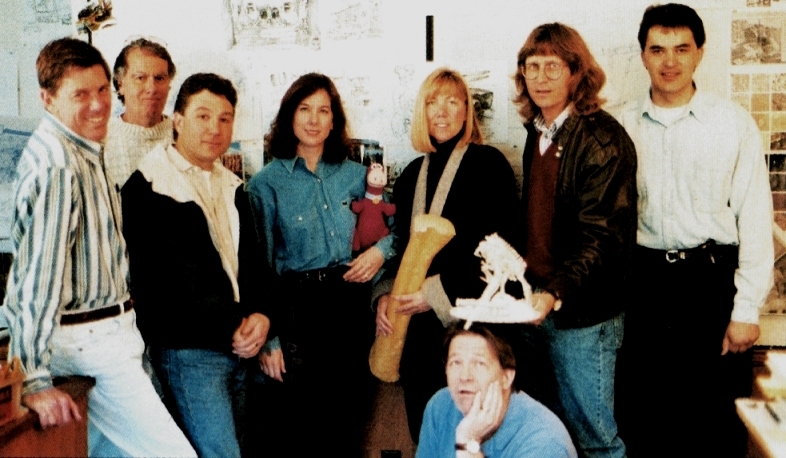
It was the summer of 1990 that Kennedy and Spielberg first began to recruit the "dream team" that would lay the creative foundation for Jurassic Park. First on board was talented production designer Rick Carter, who did "Back to the Future Part II" and "III." His first association with Amblin began when he designed 42 episodes of "Amazing Stories." As Michael Crichton began adapting his complex book into a feature-length screenplay, Carter started work with a group of illustrators and storyboard artists who could help translate Crichton's words into cinematic images. Carter's goal was to find a convincing blend of science, fantasy and Reality that he likened to "Close Encounters of a Prehistoric Kind."
One of the movie's challenges would be narrowing Crichton's 15 dinosaur species down to a more practical six. Next, there was research to be done as to how the dinosaurs would move on film. Associate producer Lata Ryan joined the company in September of 1990 with the challenge of helping to build an all-star effects team that would bring the dinosaurs to life. In the months ahead, Ryan became a choreographer whose formidable task was to serve as a source of communication and clarification for the four separate effects units. Historically, the action of larqe creatures had been best achieved with old fashioned stop-motion photography, but Spielberg had hopes of pushing the effects envelope and developing technologies that had not been used before. After a thorough interview process with every effects shop in town, the producers selected a top group of effects people who were literally challenged to go where no man had gone before.

Kennedy recalled, "It was a dream come true to land Stan Winston, Phil Tippett, Dennis Muren artd Michael Lantieri all on one movie." Stan Winston Studio was asked to create the live action dinosaurs; full-size animals who would be both quick and mobile. A miracle worker in both make-up and creature effects who had been acclaimed for his work on such notable films as The Terminator, "Aliens" and Terminator 2, Winston broke the project into three phases: research, design and construction. Dedicated to making dramatic characters who are both spectacular and majestic, Winston and his team spent a full year in the research phase. Consulting with paleontologists, museums and hundreds of texts, Winston's artists prepared detailed sketches and renderings that would later lead to fifth-scale sculptures, and finally, to such enormous creations as a 20 foot Tyrannosaurus rex.
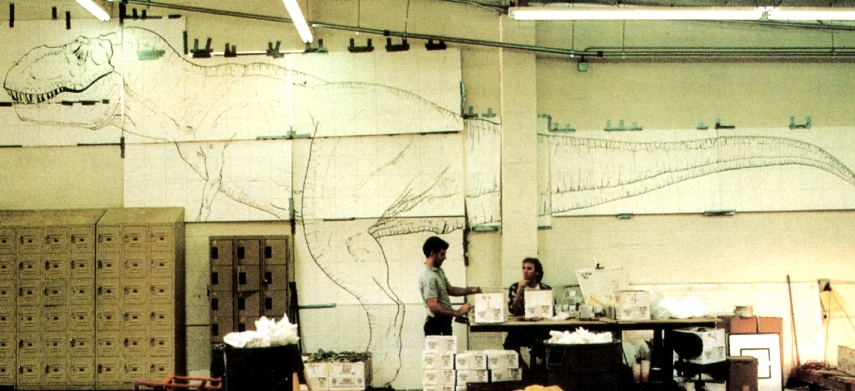
In order to tackle the scope and breadth of the project ahead, Winston designated a group of teams that included both artists and engineers. To give you an idea of each team's complex responsibilities, meet "Team rex," which consisted of 12 operators performing widely varying functions. Constructed from a frame of fiberglass and 3000 pounds of clay, the 20 foot tall T-rex was covered with a durable yet delicate latex skin and then painted by a team of artists who blended a rich palette of colors to bring his body to life. The T-rex was then mounted on a "dino-simulator," an imaginative mechanism inspired by hydraulic technology and based on a traditional six-axis flight simulator used by the military. On this motion-based foundation, "both the platform and the T-rex could be actuated through a computer control board.
Meanwhile, a fifth-scale version of the T-rex, resembling an elaborate erector set, had been built so that the identical motion of the scaled down creature could be generated manually by four puppeteers. Once the small T-rex (called a Waldo) had rehearsed the moves and actions required in a specific scene, a computer recorded the movement and programmed the big T-rex to repeat the action exactly. While the Waldo's puppeteers operated the animal's head, torso, tail and arms, additional puppeteers crouched nearby to simultaneously operate the T-rex's eyes, mouth, jaw and claws. The Stan Winston Studio, which employed more than 60 artists, engineers and puppeteers in the making of Jurassic Park also created life-sized articulated versions of a 20 foot Tyrannosaurus rex, a 6 foot tall Velociraptor, the long-necked Brachiosaurus, a sick Triperatops, a Gallimimus, the unusual Dilophosaurus (aka "the Spitter") and a baby Raptor hatchling. With the challenge of creating "live" dinosaurs solved by Stan Winston, Spielberg turned his attentions to the necessity of miniature photography for the wide angle or full length shots. He took his thoughts to Phil Tippett, an Academy Award winning animator and effects wizard who devised the Go-Motion System (a much refined version of stop-motion) while working on the film "Dragonslayer." Tippett, who formerly worked for ILM, was based in Berkeley, California and eagerly began recruiting a team that would supply more than 50 Go-Motion shots.

In addition to choreographing the movements of the dinosaurs on film, Tippett was also relied on to provide a series of "animatics," as a means of helping the filmmakers to prepare and rehearse the highly complex scenes with T-rex and the Velociraptors. Early in the process, Spielberg had also consulted with Industrial Light and Magic, the effects house founded by George Lucas which had collaborated with him on many films. ILM's effects supervisor Dennis Muren, a six-time Academy Award winner, was anxious to participate in Jurassic Park, but since Steven hoped to use full scale dinosaurs and Go-Motion, he was unclear about ILM's role in the project. But a year later, when Spielberg was working closely with ILM as the director ofHook, a new conversation began.
As the industry leaders in the area of computer graphics for film, ILM had only recently devised groundbreaking computer generated imagery and astonishing morphing techniques in the making of Terminator 2. Members of the ILM computer graphics team quietly experimented with an idea for Jurassic Parkthey built the bones and skeleton of a dinosaur in a computer, and from that, they created a walk cycle for the T-rex. Impressed with the test results, Amblin Entertainment, soon gave the greenlight to take on several additional shots, including a stampede and several wide-angle scenes that illustrate a herd of dinosaurs against a sweeping vista. When Muren next returned to Amblin, he astounded the filmmakers with a computer-generated sequence of the T-rex walking in daylight. It appeared that with the advent of computer-generated images, Go-Motion might soon be extinct.
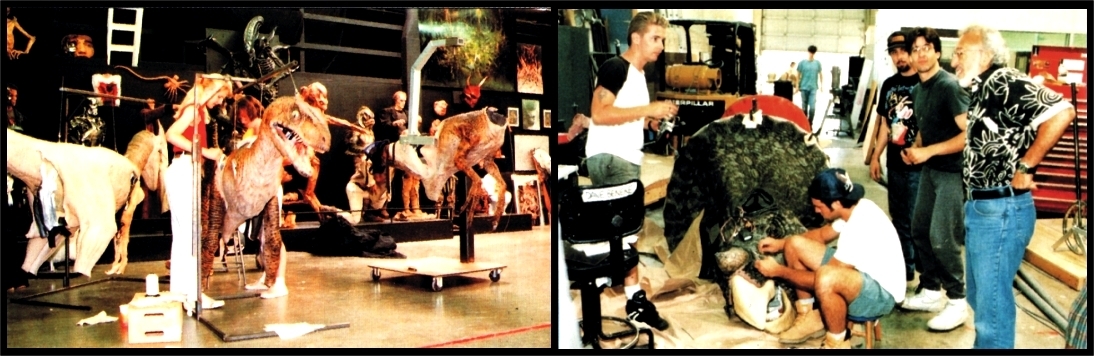
Although Tippett's work was ultimately reassigned to ILM, Phil became a valuable member of the "transition team" and set up training sessions with ILM's graphic designers to teach them as much as possible about character movement throughout the production. Michael Lantieri, who headed the fourth effects unit, had a long association with Amblin projects; he had worked with Robert Zemeckis on "Who Framed Roger Rabbit?" and "Back to the Future Part II" and "III," and had collaborated with Spielberg on "Indiana Jones and the Last Crusade" and Hook. His team would be responsible for a myriad of mechanical challenges including the construction of exterior cranes and large scale hydraulics that would move the enormous dinosaurs around. Lantieri's group was also responsible for a number of imaginative camera riggings that were customized to move fluidly with Stan Winston's creations. During the two years of pre-production on Jurassic Park, there wasn't an idle moment for Spielberg, Kennedy or producer Jerry Molen, who simultaneously undertook the making of Hook, an imaginative dramatic adventure based on the story of Peter Pan. Meanwhile, work continued on the screenplay, beginning with Michael Crichton's first draft. Later, David Koepp, the young screenwriter who had co-written the black comedy "Death Becomes Her," was brought on to the project, and he shares the screen credit with Crichton.
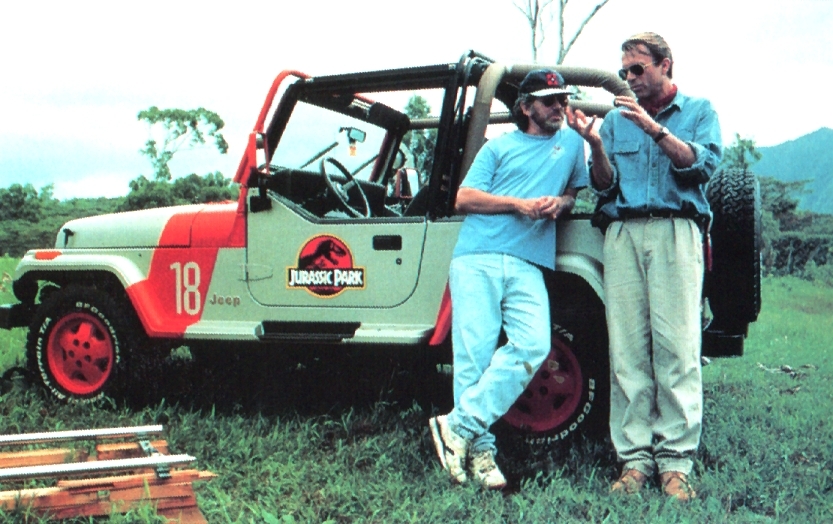
Construction was now underway in Hollywood on two of Universal's largest sound stages, and would later expand to three others on the lot, as well as an enormous sound stage at Warner Bros. Studios. Casting was a relatively short process, capped by the signing of Sir Richard Attenborough, whose acclaimed work as a film director had distracted him from acting roles since 1979. "I think Steven is a genius," sayid Attenborough, who had recently completed directing "Chaplin." "And he has asked me on a number of occasions in the past to work for him. After I read the book, I thought if any man in the world can make a movie of this, it's Steven Spielberg." When Jurassic Park began principal photography on the island of Kauai on August 24, 1992, it had been exactly two years and one month since the start of preproduction.
The lush green resort-land near Lihue was an ideal setting for the Jurassic Park exteriors, but after three weeks of filming under the tropical sun, a real-life drama overshadowed the movie. Hurricane Iniki was fast approaching Kauai, and the crew was asked by the hotel to pack their suitcases and fill their bathtubs with water in case of future power and water shortages. Next, they were instructed to pack a day bag and meet in the ballroom of the hotel on the basement level. By 9:00 a.m. the storm was headed straight for the island. Kathy Kennedy recalled, "We started pulling all our supplies into the ballroom, and the camera crew was quickly packing their things in the trucks. But if you're going to be stranded with anyone, be stranded with a movie crew," says Kennedy. "We had generators for lights, and plenty of food and water. We were self-sustaining because we moved around on location all the time."

Camped out in rows of chaise lounges on the ballroom floor, the cast and crew heard the winds pick up at about 4:00 p.m. and blow by at almost 120 mph. "It sounded like a freight train roaring past the building," recalled the producer. When water seeped into one end of the ballroom, the crew huddled on the other side of the room. But at 7:30 p.m., Kennedy and Gary Hymes, the stunt coordinator, stepped outside into silence. "It was the eeriest thing I had ever seen," recalls Kennedy. "Here we were that morning on a beautiful tree-lined street adjacent to a golf course, and now virtually every single tree had been flattened." Although the company had scheduled one more day of filming, the sheer force of Iniki literally struck all the sets. There was no power or working phones on the island, so at dawn the next morning, Kennedy jogged two miles to the airport to explore their options. "The destruction in the airport was unbelievable," she recalled. "All the windows were blown out in the terminals, and the buildings were full of palms, trees, sand and water. Every single helicopter had been tipped on its side." Thanks to her relentless efforts among airport and military personnel in Lihue, Kennedy was able to hitch a ride to Honolulu on a Salvation Army plane and began organizing from a pay phone. Over the next 24 hours, she not only coordinated the safe return of the company, but also arranged for more than 20,000 pounds of relief supplies to be transported from Honolulu and Los Angeles into Kauai.
Upon its return to Los Angeles, Jurassic Park resumed production at Universal Studios. Stage 24 had become the industrial-size kitchen for Jurassic Park's Visitors Center and it was being visited by two predatory Velociraptors. While Winston's team manipulated every moving part of,the full size raptor from head to tail, actors Ariana Richards and Joseph Mazzello cowered in the corner as two young children who were trapped in their worst nightmare. From there, the company packed up and moved to Red Rock Canyon State Park, at the west end of the Mojave Desert. Chosen for its similarities to a Montana dinosaur dig site, Red Rock played host to actors Laura Dern and Sam Neill, both of whom were coached by one of the country's premier paleontologists, Jack Horner. As a professor at the University of Montana and curator of paleontology at the Museum of the Rockies in Bozeman, Horner was a valued member of the crew and the official paleontology consultant. Returning to Stage 27, the Company began a complicated sequence following a confrontation with the mighty T-rex, who had effortlessly picked up a Ford Explorer and hung it on the branches of the tree. Rigged by Michael Lantieri's team and suspended on steel cables, the car slowly slips from branch to branch until it falls to the ground with a reverberating crash. By the end of the shoot, the tropical jungle on Stage 27 had been're-dressed for three additional scenes: an early morning visit from a Brachiosaurus, a surprise attack on Muldoon (Bob Peck) and Dennis Nedry's (Wayne Knight) encounter with a Spitter.
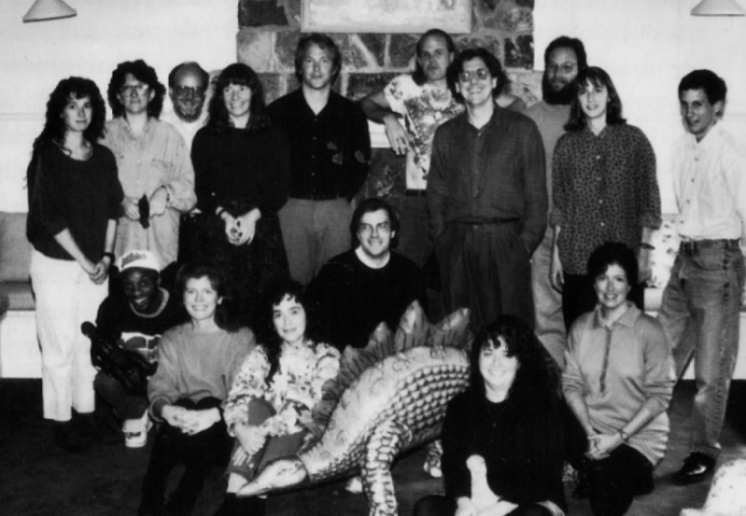
Stage 28 housed the heart of Jurassic Park; a computer control room and dinosaur hatchery. Headed up by Michael Backes, computer effects designer, the Control Room was headquarters for almost a million dollars in high-end equipment, on loan from such industry leaders as Silicon Graphics, SuperMac, Apple and Thinking Machines. When Nedry's sabotage results in Control Room chaos, the audience will simply watch the display screens in order to understand the problems that face the park visitors who are on the royal tour. By size and scope, the most memorable "Jurassic Park" set was perhaps the Visitor's Center constructed on Stage 12, but it was closely rivaled by the T-rex Pad located on one of the largest sound stages at Warner Brothers Studios. Lantieri and his crew built the riggings that mobilized the 3000 lb. dinosaur, who along with his fellow actors, worked long, hard hours in the wind, rain and mud. The film's climactic finale was filmed on Stage 12, in Jurassic Park's enormous Rotunda, which, according to the script, is still under construction. As John Hammond escorts his visitors into the main lobby, the first thing they see are two gigantic dinosaur skeletons displayed in the middle of the Rotunda. Constructed by Toronto-based Research Casting International, the museum-quality pieces are full-size recreations of a T-rex, which is approximately 40 feet long, and an Alamosaurus, which measures 45 feet long. As the cast and crew lifted their glasses in a toast on the final night of filming, a weary but enthusiastic Spielberg announced that Jurassic Park, an ambitious project which had been two years in the planning and four months before the cameras, had finished on budget and 12 days ahead of schedule.
The Cast
Sam Neill stars as Dr. Alan Grant, a renowned paleontologist who grudgingly agrees to visit Jurassic Park and then discovers that it is home to several species of living dinosaurs. Sam Neill had emerged from the New Zealand film industry to become an international leading man. He gained recognition in roles as diverse as Harry Beacham, the well-mannered young grazier in "My Brilliant Career," in which he starred opposite Judy Davis; Sidney Reilly, "the greatest spy the world has ever known" in "Reilly, Ace of Spies," for which he was named Best Actor in British Television and received a Golden Globe nomination; and as Michael Chamberlain in "A Cry In The Dark" opposite Meryl Streep, for which he was given the Australian Film Institute Award for Best Actor. Before Jurassic Park, He was seen in "Family Pictures," opposite Anjelica Huston, based on the best selling novel by Sue Miller, the author of "The Good Mother." Neill starred in the motion pictures "Dead Calm," "Memoirs of an Invisible Man," "Until the End of the World" and The Hunt for Red October. Neill was awarded an O.B.E. (Order of the British Empire) for his "Services to Acting," which honors excellence in the performing arts.

His additional film credits include "Death in Brunswick," for which he was nominated for best performance from the Australian Film Institute, "The Good Wife," and his debut film, "Sleeping Dogs," which also marked the debut of director Roger Donaldson. Neill reunited with Jmfiy Davis in the Hallmark Hall of Fame presentation, "One Against the Wind," for which he earned a Golden Globe nomination. His additional television work includes "The Sinking of the Rainbow Warrior," "Hostage," "Fever," "Amerika" and "Kane and Abel." Neill was born in Northern Ireland and grew up in New Zealand. After graduating from the University of Canterbury, Neill spent two years with the Amamus Theater Group and subsequently joined the New Zealand Film Unit, where he combined acting with directing.
Laura Dern portrays Ellie Sattler, a paleobotanist who is among the first people to tour Jurassic Park. The previous year, Dern had received both an Oscar nomination and a Golden Globe nomination for her performance as Rose in "Rambling Rose," co-starring Robert Duvall and her mother Diane Ladd. Dern starred in the HBO film "Afterburn' for which she received a Golden Globe award and an Emmy nomination. Dern's film career began at the age of seven, while visiting her mother on the set of "Alice Doesn't Live Here Anymore." Director Martin Scorsese saw her and asked to use her as an extra. At the age of 11, she made her acting debut opposite Jodie Foster in "Foxes." Dern won the Los Angeles Film Critics' Award for "Smooth Talk." She has starred in two David Lynch films: "Blue Velvet" and "Wild at Heart," winner of the Palme d'Or at the 1990 Cannes Film Festival. Her film credits also include "Mask," "Fat Man and Little Boy," "Haunted Summer" and "Teachers." She began her acting studies at the Lee Strasberg Institute and also studied at London's Royal Academy of Dramatic Arts.
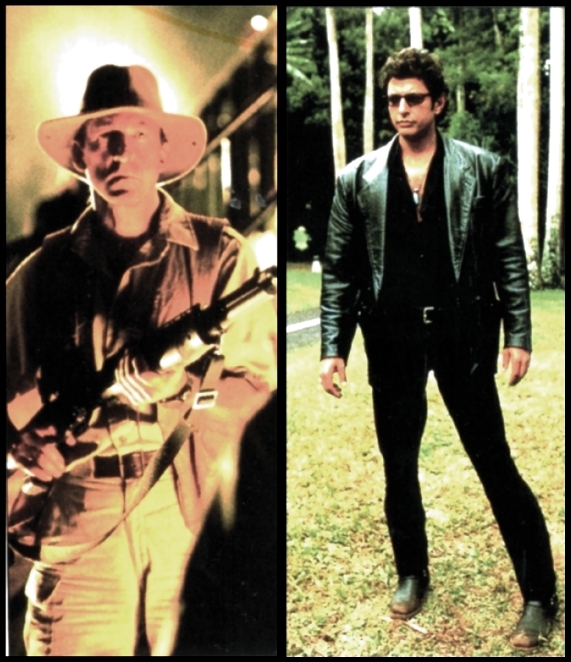
Jeff Goldblum is mathematician Ian Malcolm, who uses his "Chaos Theory" to predict disastrous results for Jurassic Park. Goldblum's film credits prior to the film included "Nashville," Invasion of the Body Snatchers, "Threshold," "The Right Stuff," "The Big Chill," "Buckaroo Banzai," "Into the Night," Silverado, The Fly, "Earth Girls Are Easy," "The Tall Guy," "Twisted Obsession," "Mr. Frost," "Fathers and Sons" and "Deep Cover."
Sir Richard Attenborough portrays John Hammond, a billionaire developer who has used his resources to create the world's most extraordinary amusement park. An award-winning producer/director who began his career as an actor and has starred in more than 60 films, Attenborough stepped in front of the cameras for the first time since 1979, when he co-starred in "The Human Factor." Born in Cambridge in 1923 as the son of a university college principal, Attenborough left his Leicester home at the age of 17 to attend the Royal Academy of Dramatic Arts in London and within a year had earned the distinguished Bancroft Silver Medal. He soon earned his first West End theater role in a production of Odet's "Awake and Sing," but rocketed to national stardom in a play called "Brighton Rock." In 1942, he made his movie debut as a cowardly seaman in a Noel Coward film, "In Which We Serve," but was soon called for service in the Royal Air Force Film Unit. Upon his return to London, he went on to star in numerous films before he set his sights on producing.
In 1959, he partnered with fellow actor Bryan Forbes in a production company called Beaver Films. Their projects included "The Angry Silence, "All Night Long," "Whistle Down the Wind," and "Seance on a Wet Afternoon," which was directed by Forbes and earned Attenborough the Best Actor Award from the British Film Academy. He won the Best Actor Award again in 1964 for his role in "Guns at Batasi." A succeesion of major film roles followed, including "Flight of the Phoenix," The Sand Pebbles, "Dr. Doolittle," "The Great Escape," "The Bliss of Mrs. Blossom," and "The Chess Players," among many others. Sir Richard made his directorial debut in 1969 on "Oh! What A Lovely War," followed by "Young Winston," A Bridge Too Far and Magic. In 1982, he achieved a lifelong dream by producing and directing the epic film "Gandhi," which won five British Academy Awards and eight American Oscars, with Attenborough receiving the prestigious Best Film and Best Director awards on both sides of the Atlantic. Since then he has directed "A Chorus Line," "Cry Freedom" and "Chaplin." He also starred in the home video version of Andrew Lloyd Webber's musical "Joseph and the Amazing Technicolor Dreamcoat." Sir Richard, a Commander of the British Empire, was Knighted in 1976. He received the Martin Luther King Jr. Peace Prize and India's Padma Bhusan in 1983. In England, he is known to many as "The Chairman of London," as he has been known to serve as president or chairman or patron of 30 or more organizations at once, including the Royal Academy of Dramatic Arts, The British Film Institute and Channel Four Television, among others.

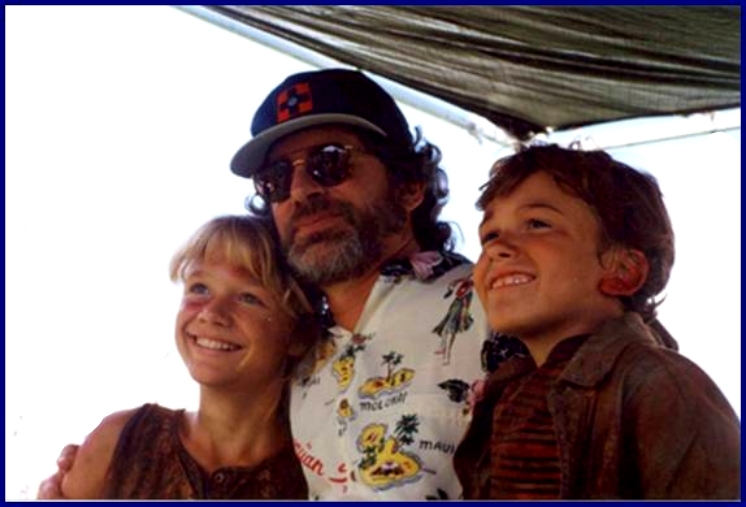
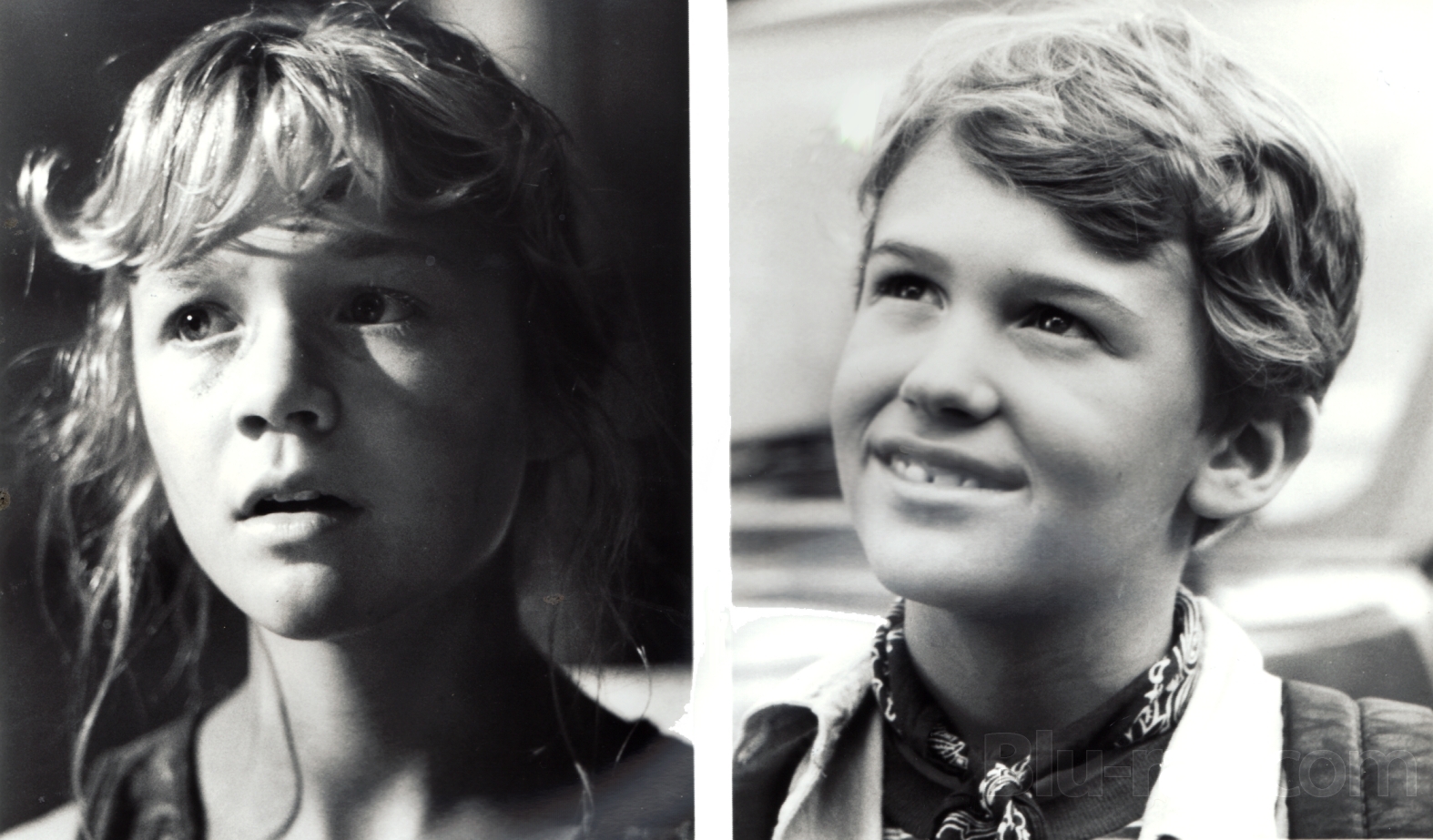
Ariana Richards portrays Alexis, aka "Lex," a precocious 12 year-old who is visiting her grandfather at Jurassic Park. In 1991, Richards won the Youth In Film Award as "Best Young Actress" starring in a TV movie, for her memorable role in the season's biggest ratings hit, "Switched at Birth." She won the same award in 1992 for her role in the CBS movie "Locked Up." Ariana made her first commercial at the age of seven and has since worked widely in television and film. Her feature film projects have included "Disaster In Time: The Grand Tour," Tremors, "Spaced Invaders," "Prancer," HBO's "Into the Homeland" and "I'm Gonna Get You Sucka." Richards' best known television work includes the Emmy-winning TV movie, "The Incident," in which she starred as Susan Blakely's daughter and Walter Matthau's granddaughter. She returned for its sequel, called "Against Her Will: Incident at Baltimore," and co-starred in the series of five. She starred opposite Richard Chamberlain in the series "Island Son" and has guest-starred on such episodic shows as "Empty Nest," "My Sister Sam" and "The Golden Girls."
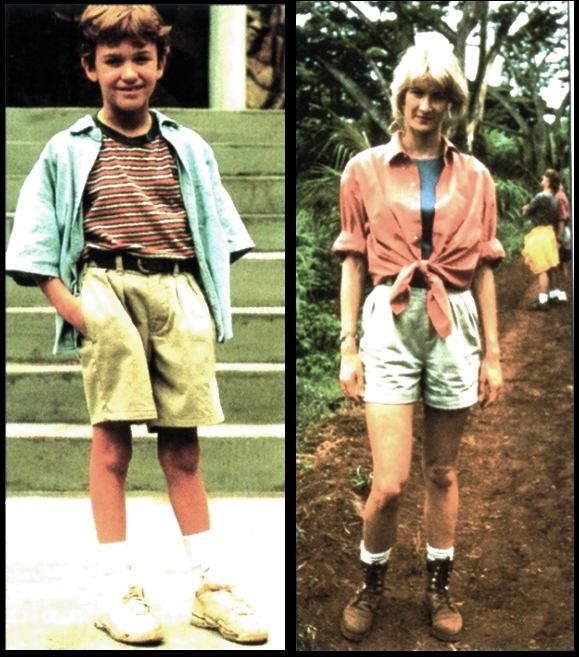
Nine-year-old Joseph Mazzello joined the cast as Tim, a dinosaur lover who is thrilled to be visiting his grandfather at Jurassic Park. The co-star of "Radio Flyer," Mazzello has also had key roles in "Presumed Innocent" and "Jersey Girls." Born in Rhinebeck, N.Y. and raised in Hyde Park, he won his first leading role at the age of five in a TV movie about child abuse called "Unspeakable Acts." He also co-starred in a movie for television called "Desperate Choices: Save My Child," which starred Joanna Kerns.
British Actor Bob Peck portrays the park's serious-minded game warden, Robert Muldoon. A longtime member of the Royal Shakespeare Company, Peck has starred in such works as "Othello," "Macbeth," "King Lear," "The Tempest," "Nicholas Nickleby" and "Richard II," among many others. Theatrically, he has also starred in such stage productions as "The Road to Mecca," directed by Athol Fugard at the National, as well as "A Chorus of Disapproval," directed by Alan Ayckbourn. He is a well-known television actor, and for the BBC his various projects include "An Ungentlemanly Act," "Natural Lies," "Children Crossing," "After Pilkington" and "Edge of Darkness," for which he won the 1985 BAFTA Award as Best Actor. Peck's feature film credits include "On the Black Hill," "The Kitchen Toto," "Slipstream" and "Ladder of Swords."
Donald Gennaro, a skeptical attorney who represents investors for Jurassic Park, is portrayed by Martin Ferrero. Perhaps best known for his recurring role as a local "snitch" on the popular TV series "Miami Vice," Ferrero co-starred in such films as "Oscar," "Stop or My Mom Will Shoot!," Plains, Trains and Automobiles, "Gung Ho" and "High Spirits." He was also featured in "Wreckless Kelly." Born and raised in San Jose, California, he earned a Bachelors degree in Social Science from San Jose State with the intention of becoming a teacher. But after his second day of graduate studies, Ferrero quit school and joined the California Actors Theater, a repertory company in nearby los Gatos. Among the plays he performed there were "Steambath," "Play It Again, Sam" and "A Midsummer Night's Dream." Ferrero moved to Los Angeles in 1979 and soon earned his first television role as a waiter on the popular sitcom "Soap." From there, he moved on to roles in numerous episodic shows including "The White Shadow," "Mork & Mindy," "M*A*S*H," "Hill St. Blues," "Cheers," "Moonlighting," "L.A. Law" and "Newhart," among others. His theatrical background includes roles in the productions of "Accidental Death of an Anarchist" at the Mark Taper Forum and "Bullshot Crummond."
B.D. Wong took on the role of Dr. Wu, a bio geneticist who discovers a procedure to clone dinosaur DNA. Best known for his 1988 Tony Award winning performance on Broadway opposite John Lithgow in "M. Butterfly," his performance was also rewarded with a Drama Desk Award and Outer Critics Award and the Clarence Derwent Award (from the Actors Equity Association). His additional theatrical credits include "See Below Middle Sea," "The Tempest," "Bondage," "Herringbone," "Peter Pan" and "Face Value." His most recent feature film before Jurassic Park was in "Father of the Bride," preceded by "Mystery Date," "The Freshman," "Family Business" and The Karate Kid Part 2, among others. Wong was a series regular on the NBC pilot "Baltimore," and had appeared as a guest star in numerous episodic series. He had also been featured in the TV movies, "Good Night, Sweet Wife; A Murder in Boston" for CBS, as well as "Crash Course," the two-hour special episode of "Shannon's Deal" and "And The Band Played On" for HBO.
Samuel L. Jackson appears as Arnold, chief computer technician in Jurassic Park's Control Room. Jackson made his indelible mark on film with his portrayal of a crack addict, Gator, in Spike Lee's "Jungle Fever." For this searing characterization, Jackson received the first Best Supporting Performance award ever given out by the judges at the Cannes Film Festival. Jackson's versatile career, which includes film, television and stage work began upon his graduation from Morehouse College in Atlanta with a degree in dramatic arts. He went on to perform in numerous stage plays such as "Home, A Soldier's Play," "Sally Prince" and "The District Line." He originated the roles in two of August Wilson's plays at Yale RepBoy Willie in "The Piano Lesson" and Wolf in "Two Trains Running." In another Wilson play, "Fences," he portrayed Lyons at the Seattle Repertory Theater. From the New York Shakespeare Festival, Jackson appeared in "Mother Courage and Her Children," "Spell #7" and "The Mighty Gents." Other stage credits included "Ohio Tip-Off" and "Native Speech" at the Baltimore Center Stage. While still a student at Morehouse, Jackson made" his film debut in "Together For Days," which starred Clifton Davis and Lois Chiles. His film credits prior to Jurassic Park included "Ragtime," "Sea of Love," Coming to America, "Raw," "Do The Right Thing," "School Daze," "Mo' Better Blues," GoodFellas, "Strictly Business," "White Sands" and Patriot Games. Other credits include "Jumpin' at the Boneyard," "Fathers and Sons" and "Juice." His television credits include the ABC movie-of-the-week "Dead and Alive" with Tony Danza and several guest appearances in episodic television. Jackson was recently seen in "National Lampoon's Loaded Weapon 1," opposite Emilio Estevez and "Amos & Andrew," with Nicholas Cage.
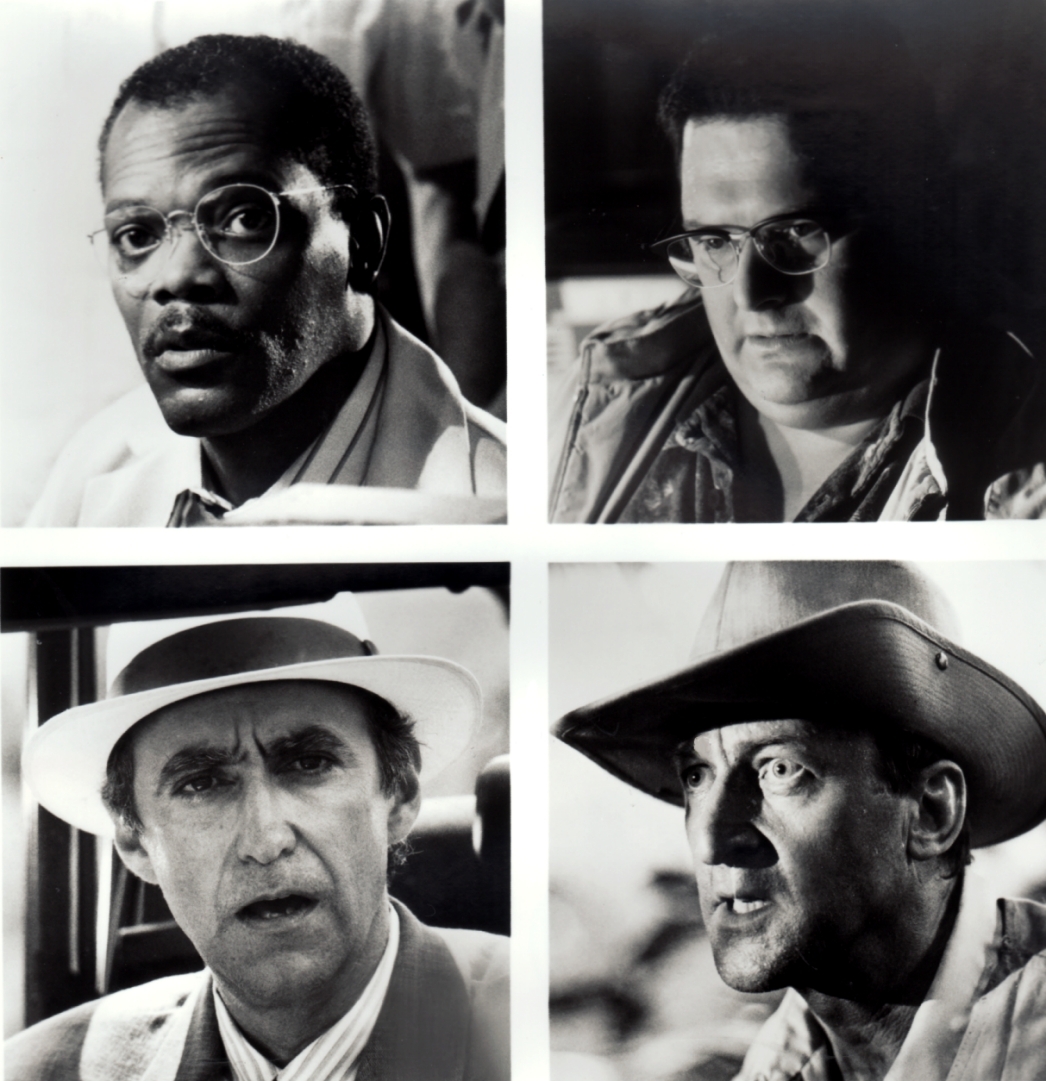
Wayne Knight portrays Dennis Nedry, a computer genius whose greed and ambition lead to chaos in Jurassic Park. A popular film and television actor who worked successfully in both, Knight was, during filming Jurassic Park, a series regular in Fox TV's sketch comedy, "The Edge," and had the recurring role of Newman on the NBC's "Seinfeld." His film credits included "Basic Instinct," JFK , "Dead Again" and Born on the Forth of July. A theater major at the University of Georgia, Knight studied with Aleksander Bardini of the State Theater of Poland and Anne Gullestad of Norway's Bergen Theater. He went on to train in New York in improvisational comedy under The Ace Trucking Company's Sandy Holt. His comedy work included a stint with his own comedy group. Knight's theatrical background includes over a 1000 performances in Albert Innaurato's long running Broadway hit, "Gemini," and appearances in such plays as "Measure for Measure" at Lincoln Center and "One of the Guys" at the Public Theater. Additional TV work included two seasons as a regular on the television series "Assaulted Nuts" for Britain's Channel Four and Cinemax, as well as work in films for television such as this past season's "Double Edge" and MTBone and Weasel." Other feature film credits include "V.I. Warshawski," Dirty Dancing, Ishtar and "The Wanderers."
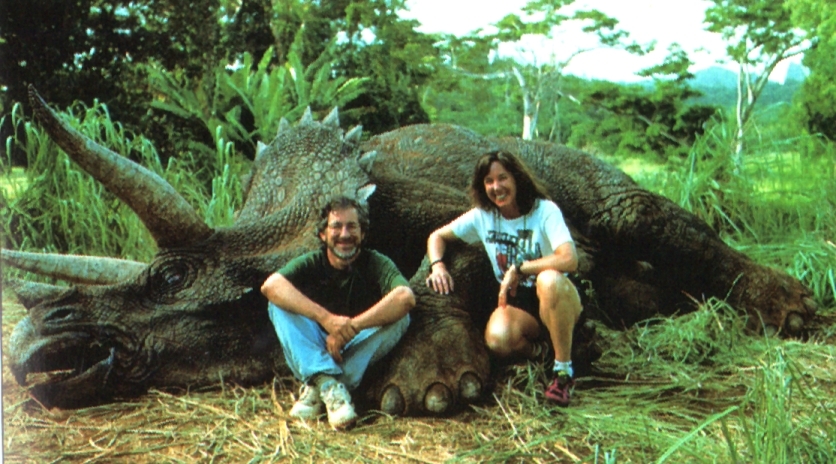
Steven Spielberg, Director
Director Steven Spielberg earned a reputation as one of the world's most respected and successful talents. He directed and/or produced six of the top 20 films of all time by the time Jurassic Park was released. E.T. directed by Spielberg, and produced by Kathleen Kennedy, was still the biggest grossing film in the history of motion pictures. In recognition of his consistent excellence in filmmaking, he received the prestigious Irving G. Thalberg Award at the 1987 Academy Award ceremonies. He earned the coveted Directors Guild of America Award in 1986 for his direction of "The Color Purple," which also received 11 Academy Award nominations. Spielberg had been nominated by the DGA for the following five films: "Empire of the Sun," Jaws., Close Encounters of the 3rd Kind, "Raiders of the Lost Ark" and E.T.. For the latter three, he was also nominated by the Academy of Motion Picture Arts and Sciences. Spielberg made his feature directing debut on "The Sugarland Express," and the two films that followed, Jaws. and Close Encounters of the 3rd Kind were phenomenal successes.

Following his WWII comedy "1941," which was his first unsuccessful film, he teamed with longtime friend George Lucas to make "Raiders of the Lost Ark," which he directed and Lucas executive produced. In 1982, he co-wrote and co-produced Poltergeist while concurrently directing E.T.. After directing a segment of Twilight Zone: The Movie, he again collaborated with George Lucas on "Indiana Jones and the Temple of Doom" and five years later on "Indiana Jones and the Last Crusade." His additional directing credits include "Always" and Hook. Spielberg formed his production company, Amblin Entertainment, in 1984 and has since served as an executive producer on dozens of films including Gremlins, "The Goonies," Back to the Future, as well as "Back to the Future Part II" and "III," "An American Tail," "Who Framed Roger Rabbit?" and "The Land Before Time." Spielberg's next directorial project, following Jurassic Park, was "Schindler's List," starring Liam Neeson and Ben Kingsley, which began filming in Poland the following year. Amblin Television, a subsidiary of Amblin Entertainment has been active in both network and syndicated series programs and television specials.

The Crew
Producer Kathleen Kennedy established a record of achievement that made her one of the most successful producers and executives in the industry today. A founding partner with Steven Spielberg and Frank Marshall of Amblin Entertainment, she was president of the company and had been at the forefront of Amblin's wide-ranging productions. The same year, she and Frank Marshall established their own production company based at Paramount Pictures. Their first project, "Alive," was produced by Kennedy and directed by Marshall. However, she continued her association with Amblin as producer of Jurassic Park, executive producer of "Schindler's list" and executive producer on "The Flintstones," among other projects. In addition to producing the biggest grossing film in the history of motion pictures, E.T., she served as producer on The Color Purple, "Empire of the Sun," "Always," Hook and "Arachnophobia." Her executive producer credits include a line-up of huge hits such as Back to the Future as well as its sequels Back to the Future Part II and III, "Who Framed Roger Rabbit?" Gremlins, "Gremlins II," "An American Tail," "The Land Before Time, "The Money Pit," "Dad," "Joe Versus the Volcano" and Cape Fear. In addition to films, she has also been deeply involved in the production of Amblin's television projects beginning with the NBC-TV anthology series "Amazing Stories." Raised in Weaverville and Redding, California, Kennedy graduated from San Diego State and worked at a local television station where she gained experience as a camera operator, video editor, floor director and talk show producer. She first worked with Spielberg as a production assistant on "1941" and soon moved through the ranks until he asked her to join him as co-producer.
Producer Gerald R. Molen also produced, along with Branko Lustig, "Schindler's List" in Poland, his fourth collaboration with Spielberg. Molen had previously co-produced Hook, and served as production manager on "The Color Purple," which was his first project with his future Amblin colleagues. His previous credits included serving as co-producer on "Rain Man" and executive producer on "Days of Thunder." Additional credits include "Bright Lights, Big City," "Batteries Not Included," "A Soldier's Story," "Tootsie," "Absence of Malice," "The Postman Always Rings Twice" and "Ordinary People."
Associate Producer Lata Ryan first worked with Steven Spielberg as the production coordinator on "1941" and has since become a valuable member of the Amblin team. Following three years at Lucasfilm Ltd. in Northern California where she worked on such projects as "Return of the Jedi," Ryan returned to Los Angeles. As a production coordinator, she has collaborated with producer Jerry Molen on The Color Purple, "Batteries Not Included" and "Rain Man." She served in the same capacity on Back to the Future Part II and III, and then became production supervisor on the Goldie Hawn film, "Crisscross." Since joining Jurassic Park, in September of 1990, Ryan had been instrumental in supervising key areas of pre-production including the design team.
After graduating from Harvard Medical School, Author and Screenwriter Michael Crichton embarked on a career in filmmaking. Called the "father of the techno thriller," his novels include The Andromeda Strain. The Great Train Robbery. Congo, Jurassic Park and Rising Sun. He also wrote four non-fiction books: Five Patients. Jasper Johns. Electronic Life and Travels. His novels have been translated into 20 languages, seven of which have been made into feature films, including Jurassic Park and "Rising Sun." Crichton also directed "Westworld," "Coma" and "The Great Train Robbery." Always interested in computers, he once ran a software company called FilmTrack and invented the computer game "Amazon." His film "Westworld" has the distinction of being the first feature film to employ digitized imagesquite a feat back in 1973. Jurassic Park was also published as an electronic book by Voyager in 1992. With the advent of the movie, Jurassic Park was once again back on the Best Seller's list for many months. In the first three months of 1993, it sold an additional 2.9 million paperback copies.
Screenwriter David Koepp met Steven Spielberg through Robert Zemeckis, who directed "Death Becomes Her," from a screenplay Koepp wrote with Martin Donovan. The black comedy starred Goldie Hawn, Meryl Streep and Bruce Willis. In 1987, he also co-wrote and produced "Apartment Zero" with Donovan, which went on to win awards at film festivals in Seattle and Taormina, Italy. In addition to his joint projects with Donovan, Koepp wrote "Bad Influence" and "Carlito's Way," which was directed by Brian De Palma for Universal. Director of Photography Dean Cundey reteamed with Spielberg after a successful alliance on Hook. His first project for Amblin was Back to the Future for director Robert Zemeckis, with whom he had worked previously on "Romancing the Stone." He completed the Back to the Future trilogy and also joined Zemeckis as cinematographer on "Who Framed Roger Rabbit?" for which he received an Academy Award nomination. The two teamed up on "Death Becomes Her." Cundey's other film projects include "Rock and Roll High School," "D.C. Cab," "Halloween" (I, II and III), "The Fog," "Escape from New York," "The Thing," "Psycho II," "Big Trouble in Little China," "Project X," "Big Business" and "Road House" and "The Flintstones."

Production designer Rick Carter began work on Jurassic Park in June of 1990 in order to meet the film's elaborate design demands. Prior to his Amblin association as production designer on Back to the Future Part II and "III," Carter had accomplished the formidable feat of designing 42 episodes of "Amazing Stories," which partnered him with a Who's Who list of directors, including Spielberg, Martin Scorsese and Peter Hyams, to name a few. Born and raised in Los Angeles, Carter attended UC Berkeley in the late '60s, worked in New York City and became a world traveler for two years before settling in Los Angeles in the art department on "Bound for Glory." He was an assistant art director oil "The China Syndrome" and "The Adventures of Buckaroo Banzai." His additional credits as a production designer included "Three Fugitives" and Robert Zemeckis' film, "Death Becomes Her."
Editor Michael Kahn is an Academy Award winner for his work on "Raiders of the Lost Ark," and has been nominated for Close Encounters of the 3rd Kind, "Empire of the Sun" and "Fatal Attraction." He won the British Academy Award for his work on "Fatal Attraction." Kahn's other films produced and/or directed by Steven Spielberg are "Indiana Jones and the Temple of Doom," "1941," Poltergeist, "Used Cars," "The Goonies," The Color Purple, "Indiana Jones and the Last Crusade," "Always," "Arachnophobia" and Hook. Among his other credits are "Return of a Man Called Horse," "Falling in Love," "The Eyes of Laura Mars," "Table for Five" and "Ice Castles."

Stan Winston Studio tackled the Live Action" Dinosaurs. Although it was Stan's impressive aging effects on "The Autobiography of Miss Jane Pittman" that established Stan Winston in 1974, it was certainly The Terminator and its revolutionary effects that established the Stan Winston Studio nine years later. Raised in Arlington, Virginia, Winston attended the University of Virginia and moved to Hollywood where he joined the make-up department at Walt Disney Productions. His first TV movie, "Gargoyles," also resulted in his first Emmy Award and became a cult classic, but a year later, he was hired to age actress Cicely Tyson to 110 years for "The Autobiography of Miss Jane Pittman," earning him a second Emmy. Between 1973 and 1979, Winston was nominated for six Emmys and then jumped into feature film with the making of "The Wiz," where he designed all the special make-up for the famous characters: the Scarecrow, the Lion and the Tin Man. In 1981, producer Michael Phillips hired Winston to create the robotic makeup for a love story called "Heartbeeps." The result was his first Oscar nomination for exceptional make-up effects. He teamed up with first-time director James Cameron in 1983 to create The Terminator, starring Arnold Schwarzenegger. Winston not only produced the futuristic Terminator and a full size Endo-skeleton, but also directed the film's second unit. Next, Winston teamed with Cameron and producer Gale Anne Hurd on "Aliens," heading up the films' enormous effects unit. He was nominated for his second Oscar and was acknowledged by the Academy as an innovator in special makeup effects.
In 1987, Winston earned his third Academy nomination in recognition of the innovative creature suit he designed for the alien in "Predator." The following year, Winston made his directorial debut on a psychological drama called "Pumpkinhead." 1990 marked his association with director Tim Burton, who asked Winston to devise the special effects and makeup worn by Johnny Depp in "Edward Scissorhands." Terminator 2, one of the biggest effects films of all time, was Winston's next assignment. Working with his talented team, he produced hundreds of animatronic effects and prosthetic make-up which redefined for all time both the design and technology for special make-up effects, earning an Academy Award for best achievement in visual effects.
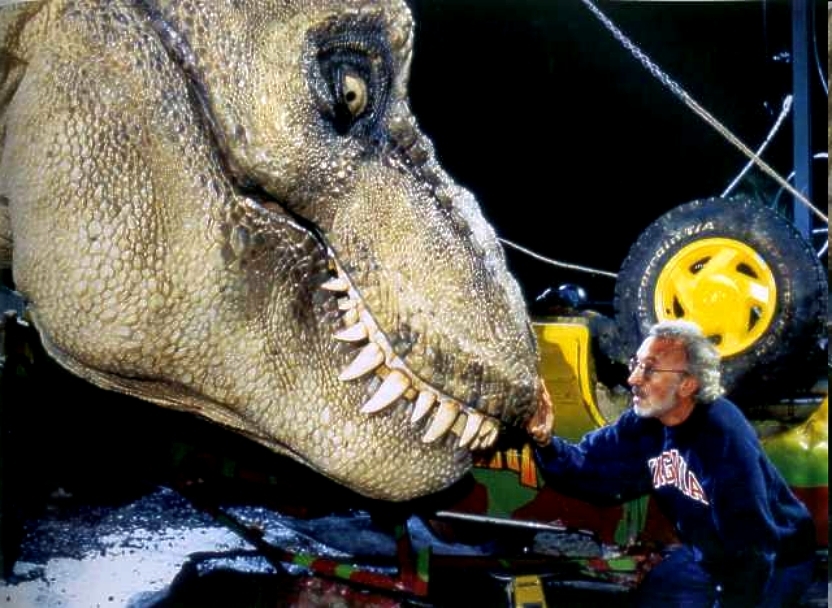
Dennis Muren was responsible for creating the Full Motion Dinosaurs. A legend among his peers, Muren was also revered by many of the world's best cinematographers and directors. He was the recipient of seven Academy Awards for his visual effects work on Terminator 2, "The Abyss," "Innerspace," "Indiana Jones and the Temple of Doom," "The Empire Strikes Back," "Return of the Jedi" and E.T. Tracing his interest in visual effects to the age of six, Muren started making his own films on a $10 Keystone 8mm movie camera at the age of 10. A few years later, he graduated to a better camera and began to experiment with stop motion and rear screen projection. During his first year at Pasadena City College, Muren set out to make a sci-fi adventure film called "The Equinox." Investing all his time, money and energy into his 16mm epic, Muren's film was completed and picked up by a small distributor who added 40 minutes to it, had it blown up to 35mm and released it. His total cash investment was $8,000, which he did get back. In 1977, Muren joined the newly-formed ILM when John Dykstra thought that his stop motion experience would be of use on Star Wars. Following that Muren went on to work for Douglas Trumbull on Close Encounters of the 3rd Kind, but later rejoined ILM as work began for "The Empire Strikes Back." He remained at ILM as a key figure, developing new techniques and equipment for such additional films as "Dragonslayer," Disneyland's "Captain EO," "Willow," "Ghostbusters II" and the seven films which earned him Oscars.
When Phil Tippett was seven years old, his parents took him to see the film "The Seventh Voyage of Sinbad," and he nostalgically asserts that the film changed his life. An innovator who took stop-motion photography to new heights, Tippett's animation for the 1980 film "Dragonslayer" is still regarded as one of the best, if not the best example of the art form for its time. A filmmaker by the age of 13, Tippett was animating TV commercials just four years later, but he put the work aside to earn a B.A. in Fine Arts from UC Irvine. During the next few years he would develop relationships with such peers as Jon Berg and Dennis Muren, and all would become major figures in special visual effects. Muren, in fact, recommended Phil to the Star Wars production team to animate the miniature chess game. Tippett began work on "The Empire Strikes Back," followed by "Return of the Jedi," the latter earning him an Academy Award.
In 1983, Tippett left to work on his first independent film, "Prehistoric Bear," a 10 minute film which was shot entirely in his garage and took two years' to complete. "Prehistoric Bear" recreates life in the late Cretaceous era, 65 to 75 million years ago. Since opening his own studio in Berkeley, California, Tippett created 20 minutes of stop-motion animation for a CBS documentary called "Dinosaur!" which won an Emmy for special effects in 1984. His relationship with Lucasfilm continued, and he provided sequences for the "Ewok" movies, "Howard the Duck" "Golden Child" and "Willow." His additional projects have included "House II," "RoboCop," and "Honey I Shrunk the Kids." For Jurassic Park, Tippett was a key to the development of the individual dinosaur movements: How did various parts of the body move? How fast? How slow? How coordinated? What would be the most accurate interpretation of each species' physical action and body language?
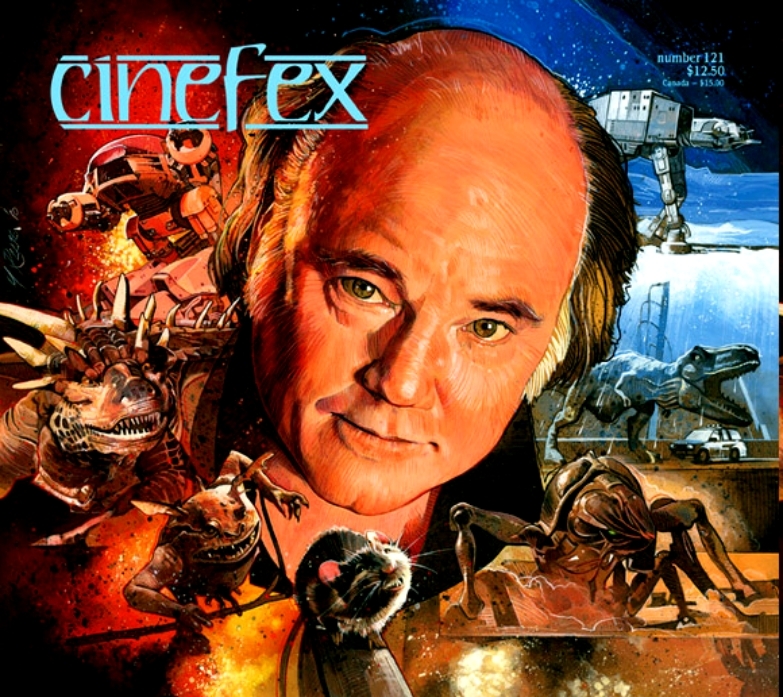
Michael Lantieri supervised Special Dinosaur Effects, a multi-faceted unit that performed hundreds of live action tasks, from constructing complex dinosaur riggings to customizing Jurassic Park's Ford Explorers. His team was the ideal complement to Winston's live action creations, Tippett's movements and Muren's full motion effects. A native of Los Angeles who attended art school to study photography, Lantieri had been making black-and-white films since high school. In 1974, his career took a different direction when he joined the Special Effects Shop at Universal Studios. For seven years, he gained experience on dozens of effects-driven shows such as "The Six Million Dollar Man," "The Bionic Woman," "Battlestar Galactica" and many others. Lantieri then made a decision to venture out on his own and became the effects supervisor on his first feature film, "Flashdance," which director Adrian Lyne wanted to infuse with volumes of light and smoke.
His following projects included "The Woman in Red" and "Thief of Hearts," but it was "The Last Starfighter" that propelled him into larger projects. He supervised effects on "Fright Night andMy Science Project." Soon after, Lantieri was able to support a full time staff and his company was hired to handle "Who Framed Roger Rabbit?" and "Twins." He worked with Steven Spielberg for the first time on "Indiana Jones and the Temple of Doom," rejoined director Robert Zemeckis on Back to the Future part II and III" and then re-teamed with Spielberg on Hook. Soon after "Hook," Lantieri took on the Herculean task of working on two huge effects films simultaneously. He often supervised Francis Ford Coppola's Dracula by day, and commuted to "Death Becomes Her" for Zemeckis in the evening. Lantieri was, at the time, nominated twice for Academy Awards for visual effects for his work on Back to the Future II and Hook. He earned two BAFTA Awards; for "The Witches of Eastwick" and "Back to the Future II."

Technical Advisor, Paleontology Consultant Jack Horner, a curator at the Museum of the Rockies in Bozeman, Montana and a professor at Montana State, headed the largest dinosaur research team in the country. According to TIME Magazine, "During the past 10 years, Horner's ideas on this subject, based on a series of extraordinary finds, have helped rescue dinosaurs from the abstract realm of monsters, enabling them to be seen as real animals." Born and raised in Shelby, Montana, Horner collected his first dinosaur fossil at the age of eight. After a stint in the Marines, Horner worked as a field assistant in the Department of Geology at the University of Montana, and landed a job as a research assistant in paleontology at Princeton University. From 1978 through 1982, he was a museum scientist at the American Museum of Natural History. He was named Curator of Paleontology at the Museum of the Rockies in 1982. Among his most historic finds are the remnants of one dinosaur herd, an estimated 10,000 waddling duckbills, and the most complete Tyrannosaurus rex ever discovered. His extensive writing includes the books: Maia: A Dinosaur Grows Up. Digging Dinosaurs and Digging Up Tvrannosaurus rex.
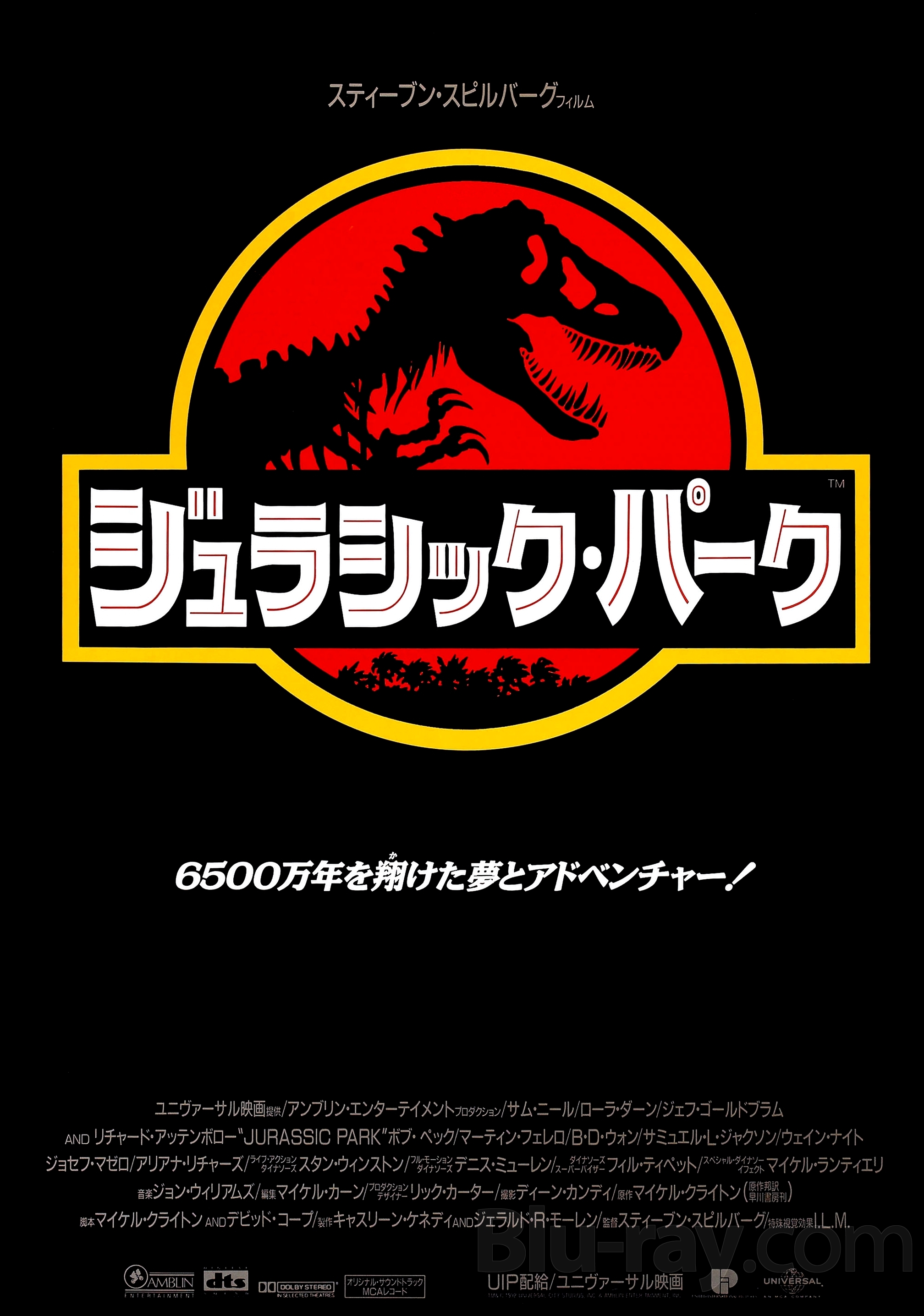
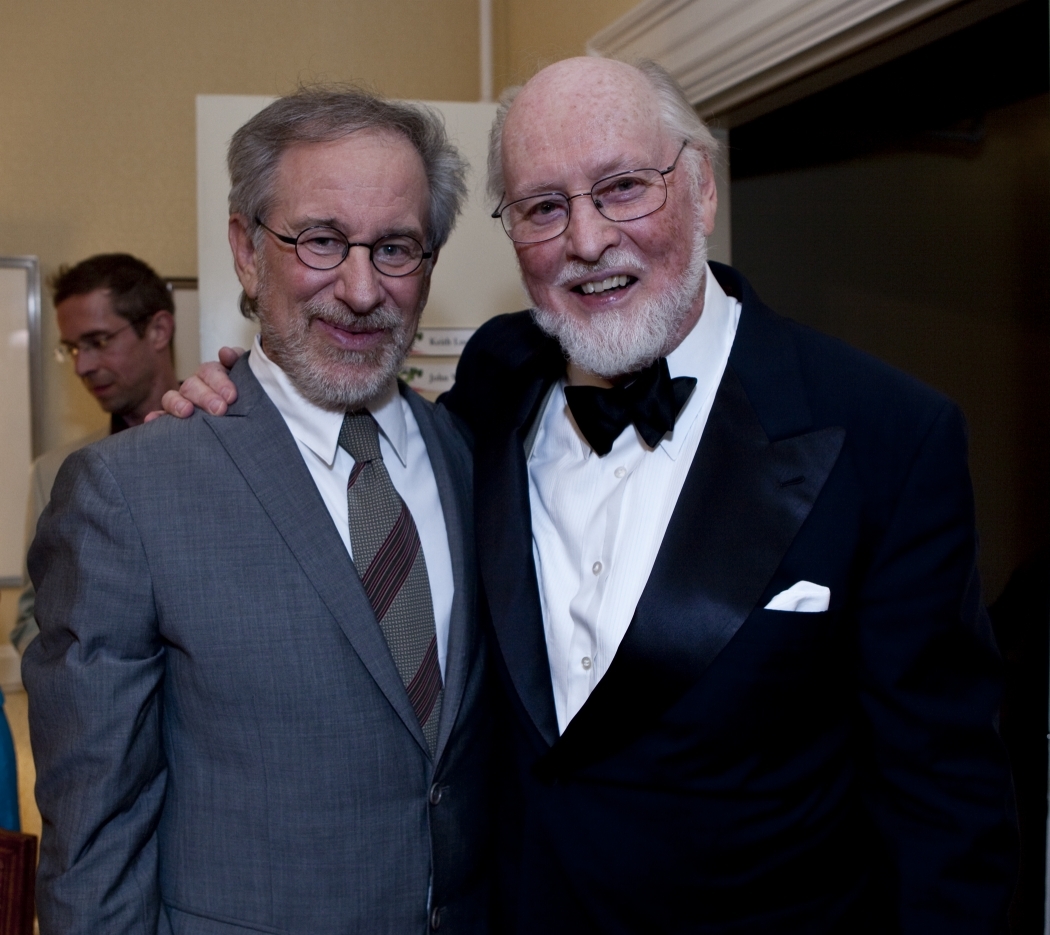
John Williams, Composer
Over the decades, the name of composer John Williams had become virtually synonymous with motion picture music. His film career began in 1961 with the music for "The Secret Ways." In the early '70s, he created gripping and suspenseful scores for popular disaster films such as "The Poseidon Adventure," "Earthquake" and The Towering Inferno. A master of every genre and emotional nuance, Williams composed many of the most familiar themes in movie history, including Jaws. andStar Wars (both of which earned him Academy Awards for Best Original Score), Close Encounters of the 3rd Kind, Dracula, "Superman," E.T., the "Raiders of the Lost Ark" trilogy, "The River" and Born on the Forth of July. Prior to Jurassic Park, Williams composed the music for the popular films Hook. and "Far and Away." For many years he also served as conductor of the Boston Pops Orchestra.
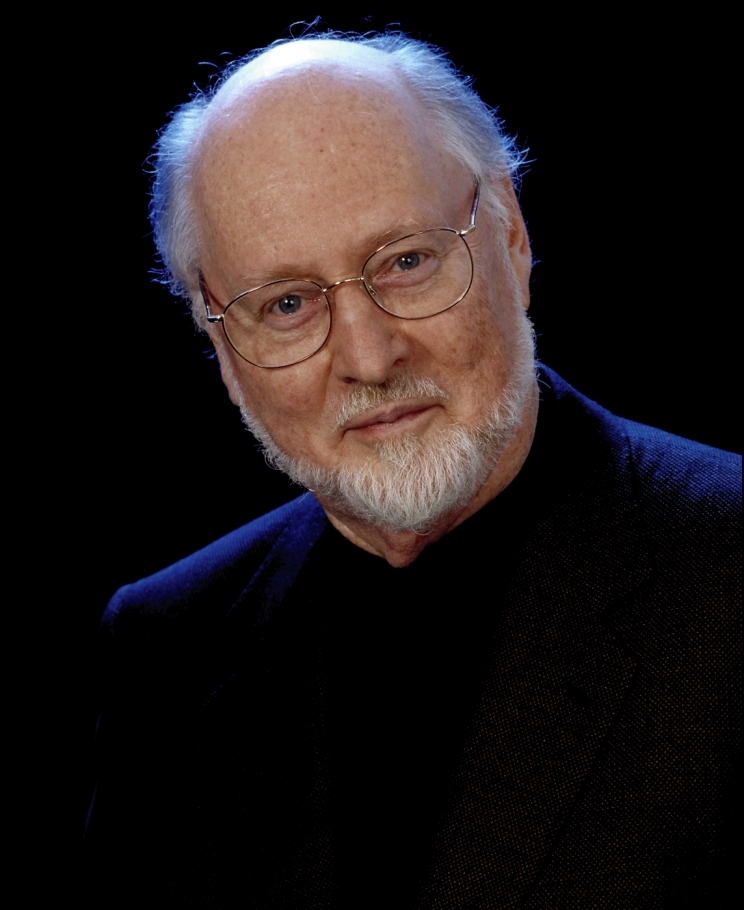
On his compositions for the film, John Williams told Film Score Monthly in an interview, "I wanted to do something different for Steven. With Close Encounters, I needed to write pieces that would convey a sense of "awe" and fascination, especially for the last half hour of the film. The music that would be needed here, especially when the group first arrives on the island and see the dinosaurs, would require something rather similar. So instead of going for a sense of fascination, I created a theme for the park itself, which could be used in several different places, and when orchestrated differently, could convey the beauty of what they were seeing at first. So when the passengers in the jeep pass by the group of dinosaurs for the first time, this is the theme I used.
Instead of a sense of fascination, I believe the theme conveyed the feelings of the dinosaur researchers in the jeep and their overwhelming happiness and excitement at what they were encountering." He was also interviewed (by the press, by invitation) one day while working at the editing location about the score point with the tyrannosaurus rex. Williams said, "I needed to compose a much darker tone for many of the scenes, especially the rex, which you will notice is different from the final half hour once they are being chased inside the building. The music for the tyrannosaurus rex had to be absolutely frightening. I wanted to convey the feeling that two children would have if they encountered such a beast. Very dark, very scary. Overall, composing the music for this film has been such an enjoyable experience, and of course a pleasure to work again with Steven."
Release, merchandising, awards and final thoughts
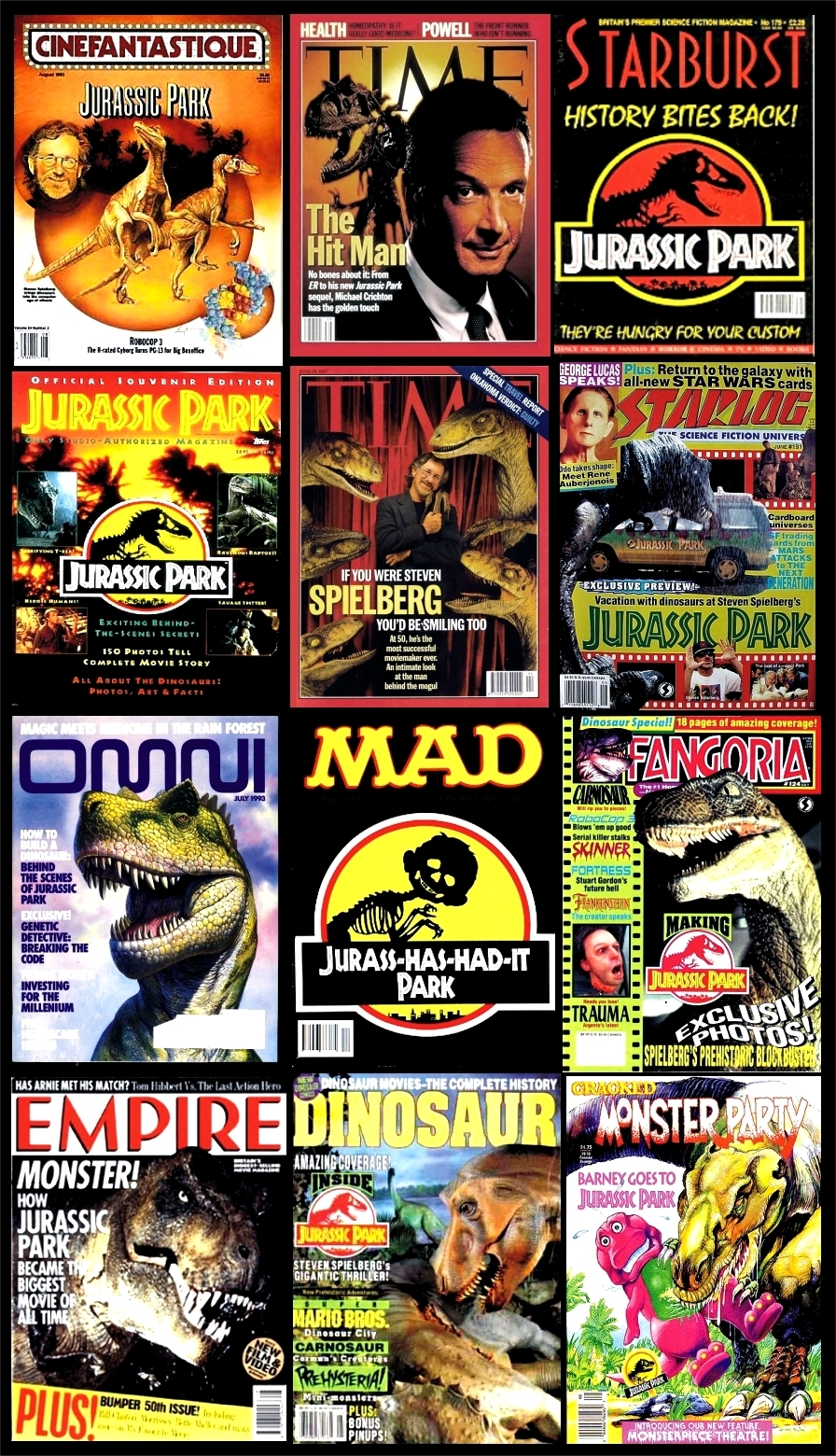
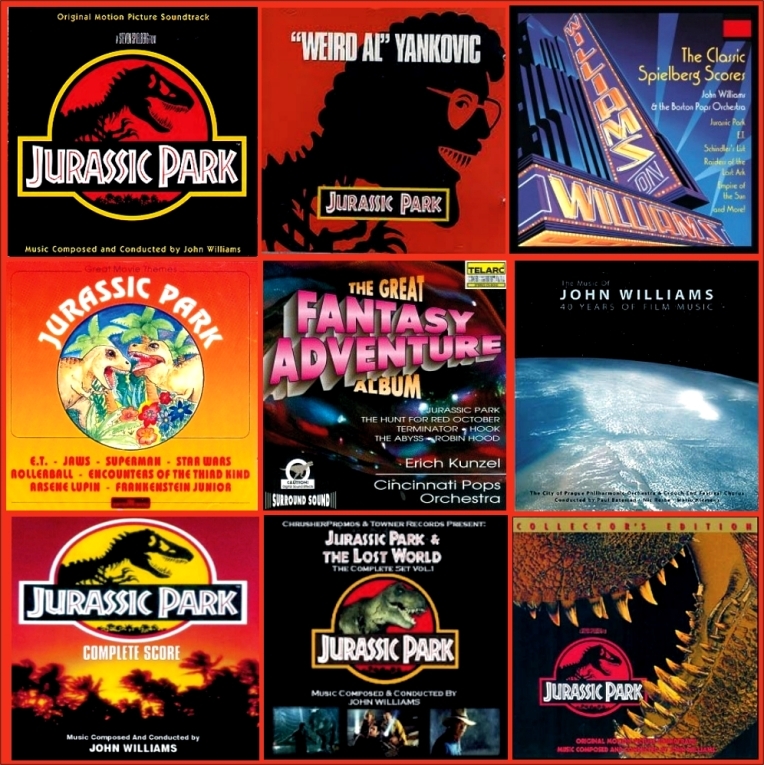
Universal released the film with a final running time of 127 minutes. The special effects scenes were filmed in Vista Vision. For the remainder of the film, Spielberg used Panavision Primo and Slant Focus Lenses and the Panaflex Platinum cameras. Aspect ratio used was 1.85. Jurassic Park would cost Universal $63 million. At the same time, Universal would spend the exact same amount of money on marketing the picture. Universal had deals going with over 100 different companies who developed almost 1,000 products. But the brilliant marketing crew only allowed certain quick shots of the dinosaurs. This was also true of the trailers run before the film opened. Universal knew it had a big hit on its 1993 roster and was very careful with its promotion. By the time the film played wide, there were video games, soundtracks, clothing, comic books, jewelry, stuffed dinosaurs, and hundreds of different items. Jurassic Park was everywhere.
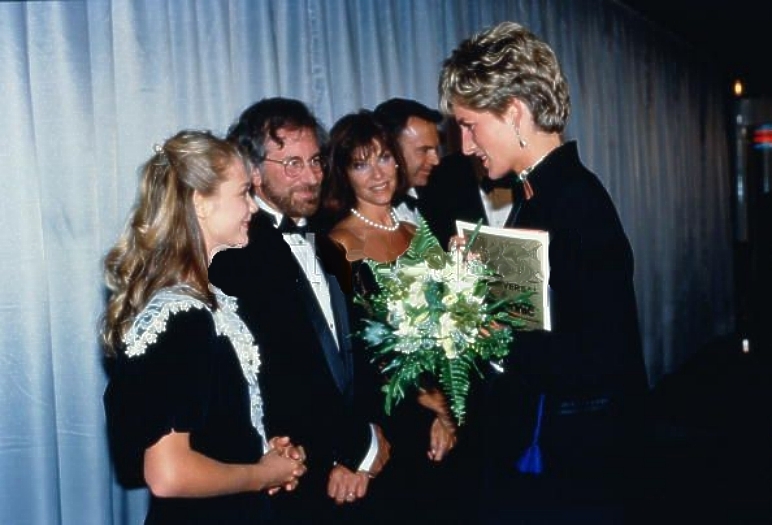
The film's premiere was at the National Building Museum in Washington D.C. on June 9, 1993. It opened wide in the United States on June 11 and had a gala premiere in the United Kingdom on July 15. It's domestic gross total came in at $357 million, plus another $557 million in foreign gross. Its opening weekend in the United States at 2, 554 theaters took in $47 million for Universal (the only other studio film to open that weekend was "Made in America" from Warner Brothers, which took in $7 million) and $81.7 million by the first week.
Critical response was overall enthusiastic. The New York Times said, "Mr. Spielberg has great fun with every last growl and rumble signaling the approach of danger." The Hollywood Reporter exclaimed, "The well-selected cast is winningly sympathetic and entertainingly idiosyncratic." Variety said that Jurassic Park will at least disabuse anyone of the idea that it would be fun to share the planet with dinosaurs. Steven Spielberg's scary and horrific thriller may be one-dimensional and even clunky in story and characterization, but it definitely delivers where it counts, in excitement, suspense and the stupendous realization of giant prehistoric reptiles. Having finally found another set of Jaws. worthy of the name, Spielberg and Universal have a monster hit on their hands. "You won't believe your eyes" was the review headline at Rolling Stone magazine. Magazine Entertainment Weekly wrote, "The film is held together by the authentic wonder we feel in the presence of its splendorous creatures. In their ruthlessness and monstrous grandeur, the dinosaurs in Jurassic Park are viewed as our symbolic ancestors: pure embodiments of the primal life force. They're of this earth but out of this world. One of the few negative reviews came from Jonathan Rosenbaum in The Chicago Reader, "There's more soul to be found in any Kong close-up than in this film's overplayed reactions. It is less scary than Jaws or Raiders of the Lost Ark. Within the first ten minutes you can tell that the characters who'll be eaten are the ones who exhibit greednot that this makes them anything like the director, who positioned the movie as the central unit in a line of merchandise and even integrated its own advertising logo into the plot." But any negative reviews had no bearing on the boxoffice in-take of this film.

When awards time came around, the film was certainly noticed. It was nominated for three Academy Awards and won all three of them (Best Sound Gary Summers, Gary Rydstrom, Shawn Murphy, Ron Judkins), Best Effects, Sound Effects Editing (Gary Rydstrom and Richard Hymns) and Best Visual Effects (Dennis Muren, Stan Winston, Phil Tippett, Michael Lantieri. It received a Grammy Award nomination for Best Score (John Williams) and won the Hugo award for Best Dramatic film. That year, the film had the honor of Best Picture at the People's Choice Awards, and received eleven nominations from the Academy of Science Fiction, Fantasy and Horror Films (it won 4, including Best Science Fiction Film, Best Director, Best Writing and Best Special Effects). There were no nominations at The Golden Globes, but Spielberg's Schindler's List won Best Director and Best Drama film. The American Film Institute positioned the film at number 35 in best all-time thrillers. Several years ago, the readers of Entertainment Weekly named the film the greatest summer movie of the past twenty years.

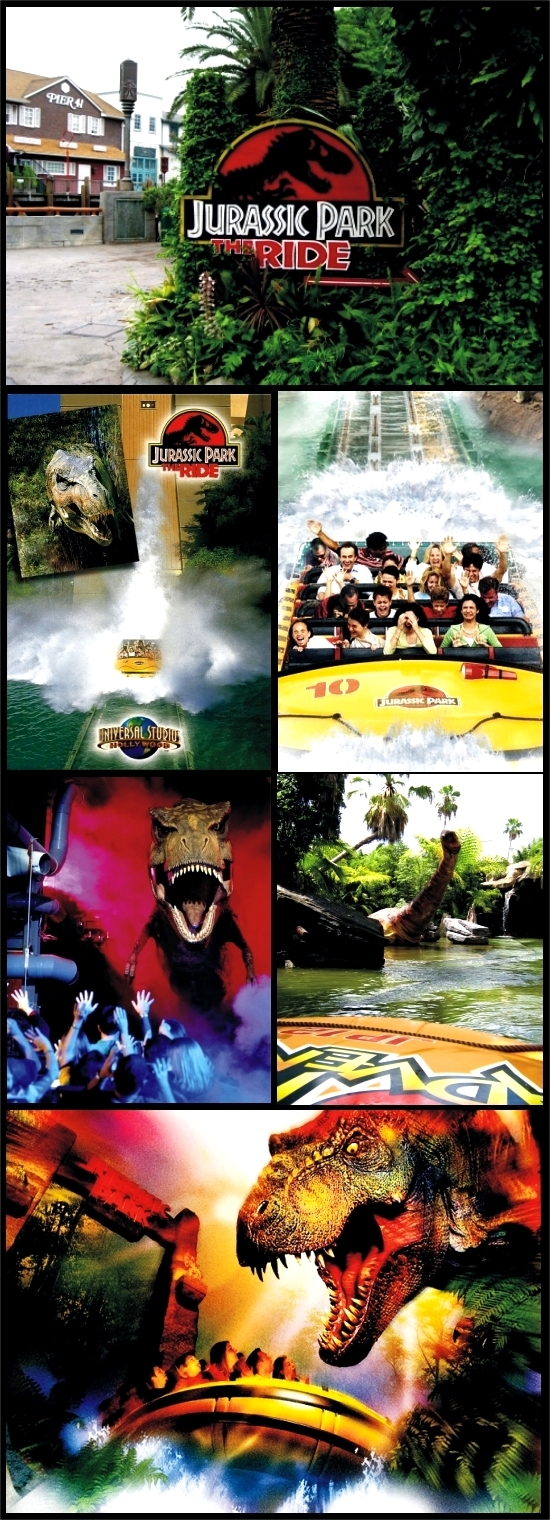
The films first television showing was on May 7, 1995. 68.2 million people tuned in giving NBC a 36 audience share. This is unheard of today, as movies do very poorly on network television showing, except for movies only shown on holidays and kept from video-on-demand and streaming (such as https://www.blu-ray.com/movies/The-Sound-of-Music-Blu-ray/13695/) and https://www.blu-ray.com/movies/The-Ten-Commandments-Blu-ray/19726/ (The Wizard of Oz continues to make people flock to their televisions). The Jurassic Park Ride" started building in November 1990 and opened at Universal Studios Hollywood on June 15, 1996. The ride was supervised by Spielberg himself. It would cost the theme park $110 million. Islands of Adventure in Orlando, Florida, has a large section of the park dedicated to the film that includes the main ride, named "Jurassic Park River Adventure", and many smaller rides and attractions based on the series. The Universal Studios theme park rides were designed to support the film's storyline. I've personally been on this ride and it was indeed a thrill, as you embark and head for the giant gates of Jurassic Park which are absolutely huge. From then on, it's a gorgeous ride, with a few big thrills at the end, especially if one had not ridden it before.
The Sequels
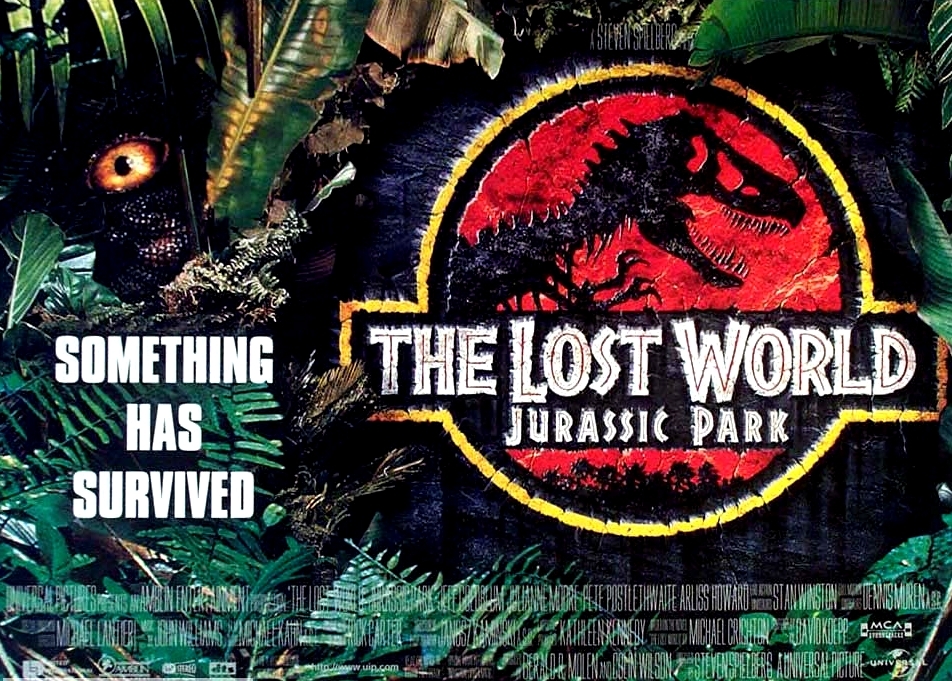
In 1996, Steven Spielberg started production on Jurassic Park II, titled "The Lost World." The screenplay was penned by David Koepp, based on the 1995 novel The Lost World by Michael Crichton. The film picks up four years after the events of Jurassic Park. In this sequel, John Hammond (Richard Attenborough) summons chaos theorist and onetime colleague Ian Malcolm (Jeff Goldblum) to his home with some startling information -- while nearly everything at his Jurassic Park had been destroyed, engineers were also operating a second site, where other dinosaurs, resurrected through DNA cloning technology, had been kept in hiding. The film would be much darker that the original. Spielberg suggested the Tyrannosaurus rex attack through San Diego be added to the film story, inspired by a similar attack scene of a Brontosaurus in London in the 1925 film adaptation of Sir Arthur Conan Doyle's The Lost World. The film was released on May 23, 1997. Audiences who loved the first film were highly excited for several years about the sequel, especially since Spielberg would direct. The film took in $92.6 million in its opening weekend (which included an extra day for the Memorial Day weekend). The film ended up grossing $618,638,999 worldwide, becoming the second highest grossing film of 1997 behind Titanic.
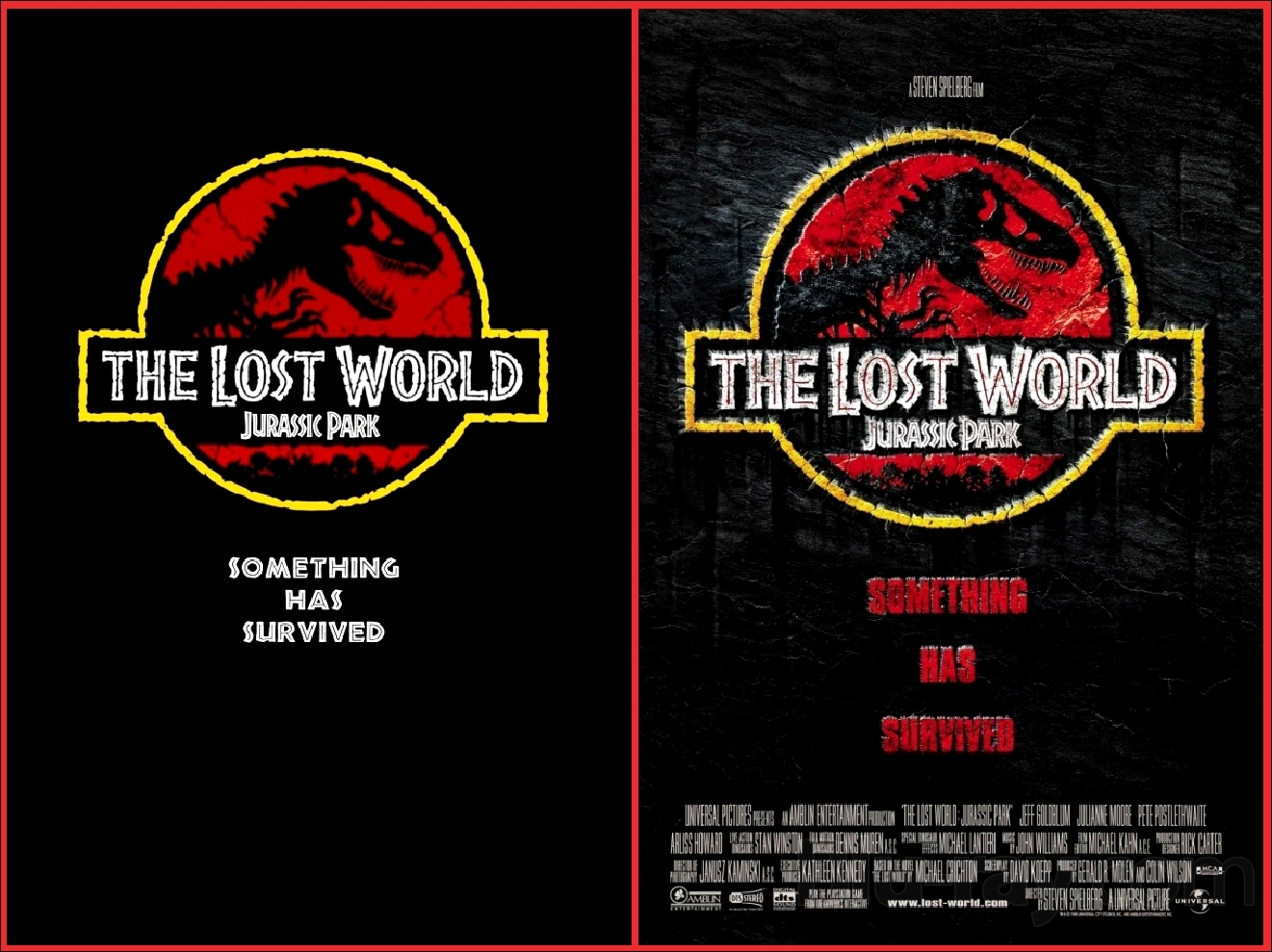
Amblin Entertainment and Universal went into pre-production on Production began on August 30, 2000 for Jurassic Park III. the only film in the series that is neither directed by Steven Spielberg (though produced by his production company, Amblin Entertainment) nor based on a book by Michael Crichton, though numerous scenes in the movie were taken from Crichton's two books, Jurassic Park and The Lost World. The film takes place on Isla Sorna in the Central American Pacific coast, the island from the second film, after a divorced couple tricks Dr. Alan Grant into helping them find their son. The film earned $181 million in the United States with a worldwide gross of $368 million, but still earned less than the first film and its sequel. It received mixed reviews from critics. This sequel was nominated for a Saturn Award for Best Science Fiction Film and Best Special Effects. Newer methods of special effects were then possible by this time, so the film used much more CGI than it's predecessors.

A fourth sequel is in the works from Amblin Entertainment. Currently, script ideas are being discussed. Sam Neill, Laura Dern and Jeff Goldblum have agreed to star in the picture, and Amblin is attempting to sign Richard Attenborough. This sequel was originally planned for 2009, but Spielberg was unhappy with the script. It involved using government-trained dinosaurs and using them in battle. Whatever the story may be, and whenever the release of the film premieres (if it is indeed made), fans have waited years for another episode. Considering that all three previous films had earned high grosses and made big profit, it makes sense that Universal would want another sequel, especially after such a long wait with much anticipation from audiences. The good news is the Spielberg must approve the script and would probably over-see the production.

Today, Jurassic Park ranks number 18th on the all-time boxoffice hits chart (domestic release). Adjusted for inflation it stands at number 20. The film became "the" dinosaur movie that would endear audiences and the sequels became extremely popular and they will remain fan favorites for years to come.

To discuss this and other Silver Screen columns, join us in The Silver Screen forum thread Here
Past Silver Screen columns are available Here
All materials in this and other Silver Screen columns are copyright their respective studios, Blu-ray.com and the collection of Robert Siegel. This edition all artwork, publicity and production photos/drawings original copyright Amblin Entertainment and Universal Pictures.