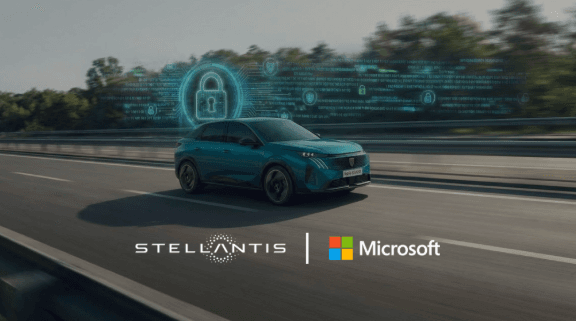
Stellantis and Microsoft are teaming up in a five‑year strategic deal to accelerate the deployment of AI across the automotive company's large portfolio of brands, including Alfa Romeo, Chrysler, Jeep, Maserati, Peugeot, and others.
The companies plan to develop more than 100 AI initiatives across customer care, product development, and operations. These include predictive maintenance, AI-assisted testing and validation, faster rollout of digital features, and personalized in-car services.
"By leveraging AI‑driven insights from secure, encrypted data, Stellantis reaffirms its commitment to put customers at the center of everything it does," Stellantis wrote in a press release.
Stellantis will build an AI-driven global cyber defense center covering its IT systems, connected vehicles, factories, and digital products, with the objective of detecting threats faster and improving resilience across its operations.

One example of physical AI being integrated into vehicles is the one highlighted by the automaker.
For example, Peugeot drivers may receive intelligent recommendations for more energy‑efficient driving in urban environments, along with proactive vehicle-health insights and feature updates designed to improve everyday usability.
The Stellantis-Microsoft partnership appears to be an attempt to push the legacy automaker into the 21st century, though there is still no indication that future Stellantis vehicles will get an in-car chatbot like those already standard on Teslas.
Last year, Tesla rolled out an over-the-air software update that integrated Grok, xAI’s AI assistant. At the same time, drivers enjoy the luxury of the Full Self-Driving (Supervised) system, which offers autonomous driving. Together, these features show how Tesla is years ahead of legacy OEMs, with physical AI already present on America's highways.