By Michael Every of Rabobank
At this point it isn’t a random walk but a determined march: markets have decided the Iran war and the Hormuz blockades are over, and everything is going to be better than normal imminently: the Nasdaq and S&P are at all-time highs and even worries over private credit are receding. In the real world, there are signs that back that stance and ones that say otherwise.
Iran warned it could sink US ships in Hormuz if they police the waterway and the Houthis could blockade the Red Sea. The FT reports Iran used a Chinese spy satellite to target US bases. Note the subtext to Trump’s subsequent Truth Social post: “China is very happy that I am permanently opening the Strait of Hormuz. I am doing it for them, also - And the World. This situation will never happen again. They have agreed not to send weapons to Iran. President Xi will give me a big, fat, hug when I get there in a few weeks. We are working together smartly, and very well! Doesn't that beat fighting??? BUT REMEMBER, we are very good at fighting, if we have to - far better than anyone else!!!"
Yet the US and Iran are reportedly weighing a two-week truce extension and inching towards a framework deal, as the latter feels the economic pressure; crucially, China is seen pressing Iran to open Hormuz; and Tehran has offered a proposal allowing ships to exit the Oman side of the Strait free of attack, if a wider deal with the US can be struck. That looks like the face-saving way for the regime to re-open the Strait… if there can be a “grand bargain” on the nuclear issue, missiles, and its regional proxies. Matching that trend, Israel is close to a one-week ceasefire with Hezbollah in Lebanon, even if there is no clear way to rid the country of the terror group despite the Israeli and Lebanese authorities now seeming united in wanting to do so.
Potentially, we could still see this war end in line with what has been our base case for a while now: a broad --if naturally disputed-- US win vs Iran by the second to third week of April, giving it de facto control of a new Middle East (or, less likely, a belated TACO). Yet the downside is longer blockades, with tail risks of any new escalation deepening and/or widening the war. The latter scenario might only be priced into the physical market, not the oil futures markets.
Meanwhile, the US Beige Book noted “The conflict in the Middle East was cited as a major source of uncertainty that complicated decision-making around hiring, pricing, and capital investment, with many firms adopting a wait-and-see posture… Many Districts continued to report signs of consumer financial strain, increased price sensitivity, and rising demand at food banks and other social service organizations, while spending among higher-income consumers was resilient… several Districts reported that rising crop prices helped offset steep price increases of fertilizer and fuel.”
Australia needs more energy imports as a fire rages at one of its two oil refineries, the latest in a series of such accidents at the few western facilities still operating. An accident, sabotage, or just the result of over-working the facility in a crisis? Regardless, the founder of Ivanhoe Mines states that: “The Australian mining industry is now on the verge of collapse due to diesel shortages… the fuel supply chain that powers every drill, truck, and haul is about to snap.” Who drove that decline in refineries, one may ask? Markets and their uncanny ability to ‘price things in.’
China’s Canton Fair is clouded by higher costs hitting its exporters due to the Iran war.
Brussels warned EU countries not to hoard fuel within their borders weeks after telling everyone there was no risk of an energy crisis. Reportedly, the European Commission also wants to see fossil fuels taxed higher than electricity to drive the EU towards renewable energy in the long term – as member states are doing the opposite in the face of this crisis so far; and, from a broader geopolitical perspective, as we see the warning that ‘Fuel scarcity is European armies’ ‘Achilles’ heel.’ No military, and no mine, currently runs on electricity.
But let’s look to the ‘all-time highs’ post-war period and see if that’s really priced in or not.
Lots of scores will be settled in lots of places. As just one example of many, Trump has warned that the US-UK trade deal “can always be changed” with bilateral relations in a “sad state” after Britain was “not there when we needed them” on Iran.
There will be major structural shifts. For example, the IMF warns the war threatens to turbocharge a looming government debt crisis. The longer the blockade goes on, the more this is true. Defence spending is going to soar even higher even faster in even more places.
Specifically, the US is pushing for a staggering $1.5 trillion defense budget, up nearly 50%, and it’s using Iran and the ‘China threat’ to convince Congress to spend (read: borrow) much more. Very significantly, the Pentagon has also approached US automakers and manufacturers to ask if they can boost weapons production, e.g., GM or Ford shifting capacity from civilian to military. I’ve long argued neo-mercantilism and the US WW2 heuristic underlined ‘resilience’ requires a broad manufacturing base that can be adapted for military purposes in a crisis; that requires commodities and energy; and, in the face of others’ neo-mercantilism, it also means tariffs, subsidies, price controls, and a stronger state hand.
Indeed, alongside the farcical disconnect between the oil screen price --where investigations are underway into potential insider trading before Trump policy pivots-- and the physical price of a barrel, that Pentagon request is a clear ‘Reverse Perestroika’: a shift from markets and consumption to state-led military-industrial production, which requires other key components to succeed, including the Fed.
Notably, Trump is refusing to allow to halt the criminal probe of Fed Chair Powell --the DOJ made a surprise visit to the Fed’s under-renovation headquarters, where they were turned away: a blockade?-- while threatening to fire him if he won’t step down from the FOMC when his term ends on May 15. Powell says he won’t step down from the Committee until Warsh is appointed as Chair by the Senate; the Senate won’t appoint Warsh until the criminal prosecution of Powell is dropped. Does somebody need both sides to go to Pakistan to sort this out? But seriously, explain the logic of the Fed remaining untouched while epic shifts in geopolitics and political economy are underway; and do it without saying, “because markets.”
On which note, New York Mayor Mamdani also announced ‘Happy Tax Day’ aimed at raising $500m by taxing billionaires’ pied-a-terres in Manhattan: how much are their equivalents in Miami, one wonders?
Pulling this all together, it’s not just that the market has priced in only one possible geopolitical scenario ahead: it’s not pricing that geopolitics suggests a future when things aren’t priced in as the norm. At which point, what are markets for? Try answering that without answering what GDP is for.
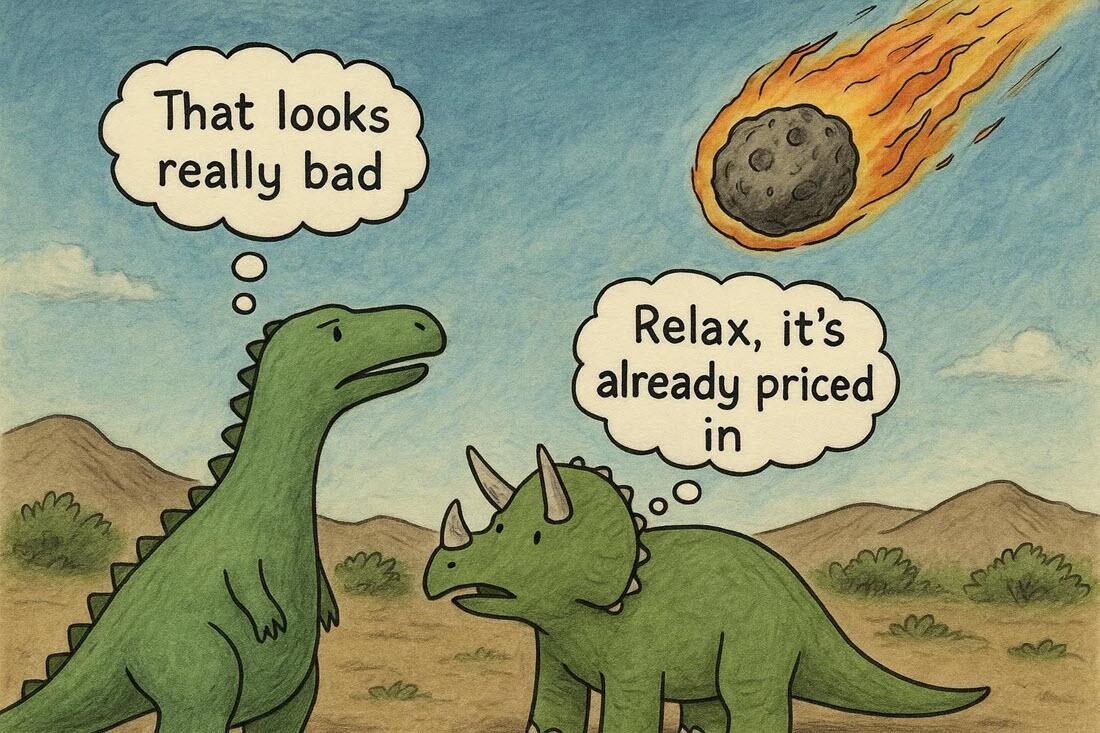
I conclude by noting that a social media meme going round yesterday had two dinosaurs looking at a huge meteor approaching to impact the earth. The first says, “That doesn’t look good for us.” The second replies, “Don’t worry, it’s priced in.”
