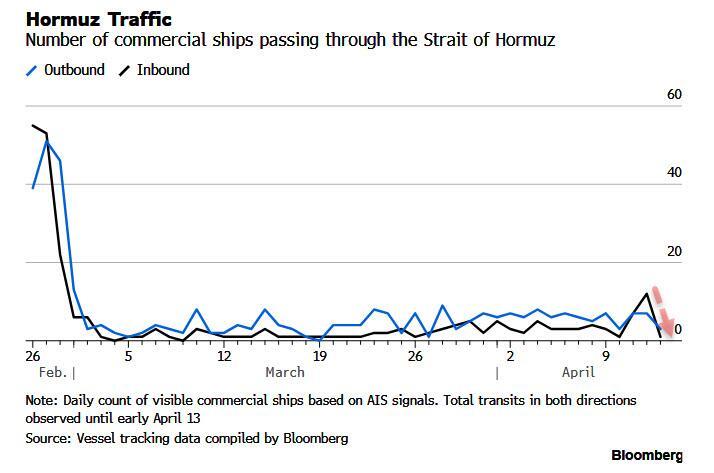
One day after a burst of traffic through the Strait of Hormuz, when according to Bloomberg 19 ships crossed in either direction while Trump said that as many as 34 ships crossed the waterway on Sunday, shipping through Hormuz slumped back down again Monday, reversing Sunday's jump, as caution mounted ahead of a US naval blockade.
After 19 ships went through the Strait in either direction on Sunday - the most since the early stages of the war - the momentum reversed by Monday morning. Only four were observed passing on Monday: a single liquefied petroleum gas carrier was sighted entering the Gulf, and three small fuel tankers were raced to exit just hours before the blockade took effect at 10 a.m. New York time.

Earlier in the day, the WSJ reported that the US has deployed more than 15 ships - including an aircraft carrier, multiple guided-missile destroyers, an amphibious assault ship and several other warships in the Middle East - in place to support the blockade. These ships have the ability to launch helicopters that support boarding operations, and some are capable of marshalling commercial vessels to specific areas to hold them in place.
The warships would likely operate outside the Strait of Hormuz to avoid threats fired by Iran, according to retired Navy Vice Adm. Kevin Donegan. “There are lots of ways you can construct this, and there are a lot of boarding forces in the region now,” Donegan said. “Don’t expect it all to be started at once, this will build. Blockades take time to have an impact.”
The UK Maritime Trade Operations also confirmed that the U.S. Navy is actively conducting enforcement operations as part of its blockade on Iranian ports and coastal areas.

Meanwhile, Marine Traffic reported that at least two tankers reversed course near the Strait of Hormuz shortly after the start of the US blockade, highlighting the immediate impact on vessel movements. They flag the 188-metre tanker Rich Starry, which turned back within minutes of approaching the chokepoint. The vessel had departed Sharjah Anchorage on 13 April and was sailing laden, with a reported draught of 11.3 metres, while signalling China as its destination. A second tanker, the 175-metre tanker Ostria, also reversed course after approaching the Strait.
The tanker U-turns follows unconfirmed reports that China has warned the US not to block/intercept Chinese ships/tankers, or face consequences that could potentially include military provocations.
China’s Defense Minister Dong Jun reportedly sent a message to the Trump administration and the U.S. Navy emphasizing Beijing’s intent to continue operating in the Strait of Hormuz and uphold its agreements with Iran. “Our ships are moving in and out of the waters of the Strait of Hormuz. We have trade and energy agreements with Iran. We will respect and honor those agreements and expect others not to interfere in our affairs" adding that “Iran controls the Strait of Hormuz and it is open for us.”
As of 2pm ET, this threat remains unconfirmed by official medial.
According to Bloomberg, the US blockade may prompt more ships to cut their tracking signals to avoid detection in high-risk shipping lanes, making it even harder to get an accurate picture of what’s going through. Sunday’s outbound movements included three containerships and three bulkers primarily tied to Tehran, as well as a China-linked fuel tanker, according to vessel-tracking data compiled by Bloomberg.
On Monday, departures so far included a US-sanctioned oil products tanker and a fuel tanker involved in recent Iranian loading operations. A small LPG carrier also left the Iranian island corridor Monday morning, following an inbound transit on Sunday and an overnight stop.
Meanwhile, two sanctioned supertankers loaded with Iranian crude have anchored off Indian ports, marking what could be the first such cargoes to arrive in the country in nearly seven years.
It’s unclear how the US blockade will affect waivers and existing purchases. It is also unclear if the US will extend or undo the waiver it granted for Iran oil sanctions, now that strategy has reversed to contain Iranian oil.