Submitted by QTR's Fringe Finance
There is a special kind of denial that only financial markets can sustain. It is the quiet insistence that everything is fine because the S&P is only down about 10%, as if that number alone captures the health of an entire financial system. It is the belief that until equities are in full free fall, nothing truly serious can be happening underneath.
But as we know, underneath, things are already starting to break.
That is the part people are not fully appreciating. If a modest correction is enough to expose fragility in private credit that is already spilling over to counterparties and sectors like real estate, what exactly happens when there is a real downturn, the kind that actually forces price discovery instead of delaying it?
It does not stop at private credit. Private credit flows into private equity, which depends on leverage to generate returns. Private equity flows into commercial real estate, which is already dealing with structural problems that have nothing to do with interest rates and everything to do with demand. Commercial real estate flows into regional banks, which hold the debt and rely on valuations that have not fully adjusted.
It is a chain reaction waiting for a trigger. We knew this heading into 2026.
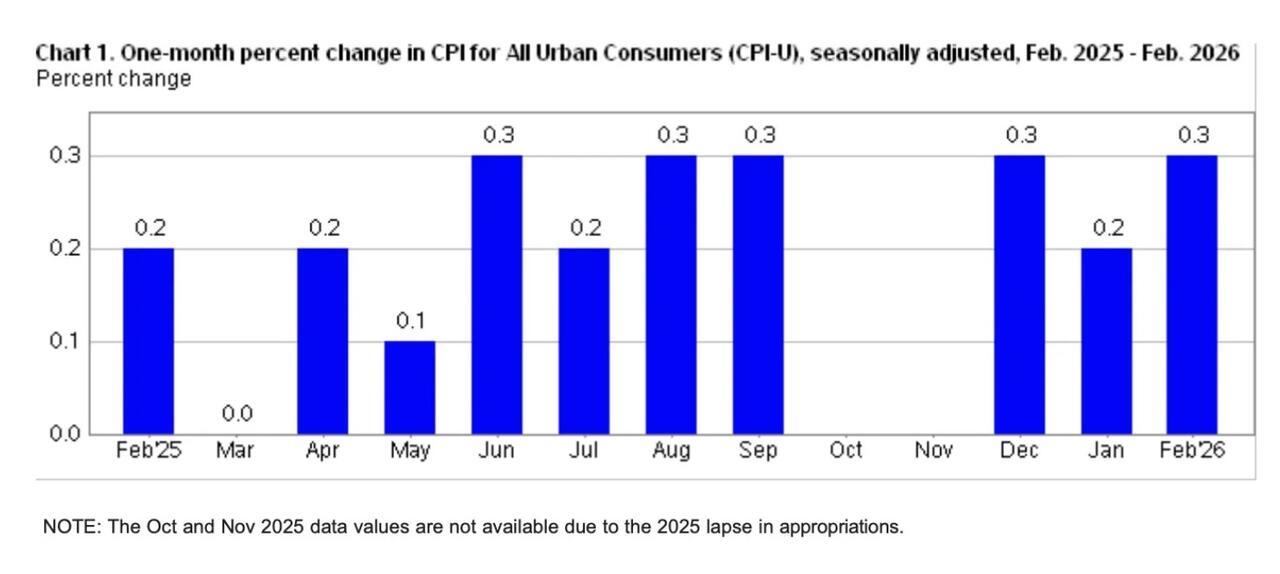
At the same time, inflation has refused to cooperate with the Federal Reserve’s plan. U.S. CPI is holding at 2.4% year over year as of February 2026, and core inflation is at 2.5%. That is not an emergency level, but it is also not the 2% target the Fed has spent years insisting is non negotiable.

Central banking is not about being approximately correct. It is about maintaining credibility, and credibility does not come from saying close enough.
So the Fed is staring at a system where financial stress is building and inflation is still above target, as I’ve been writing they would face for years now. That combination removes the easy answers, and all of a sudden the Fed runs out of road.
The next phase of this cycle is almost certainly deleveraging. Not the slow and orderly kind that policymakers like to describe in speeches, but the forced kind. The kind where lenders pull back, refinancing becomes difficult, and assets that were priced for perfection suddenly have to reflect reality. When that process begins in earnest, it tends to accelerate because falling prices create more pressure, which creates more selling, which creates more falling prices. Then, like we are seeing in private credit, psychology eventually breaks and the blame game starts. Who could have seen this coming?
🔥 50% OFF FOR LIFE: Using this coupon entitles you to 50% off an annual subscription to Fringe Finance for life: Get 50% off forever
Once that process starts, there are only two broad paths. The first path is to let it happen. Credit contracts, defaults rise, asset prices fall, and the system works through its excesses the old fashioned way. The problem is that the amount of leverage in the system today is enormous, and it has been built during a period of unusually low rates. When you combine high debt levels with higher interest costs, the math becomes unforgiving very quickly. That kind of deleveraging does not look like a mild recession. It starts to resemble something much more severe, potentially deflationary, potentially prolonged.
The second path is intervention. The Fed steps in (stop me if you’ve heard this one before), provides liquidity, and expands its balance sheet aggressively. Quantitative easing returns, possibly at a scale that makes previous rounds look restrained. Asset prices stabilize, credit markets function again, and the immediate crisis is contained. This is what my friend Larry Lepard refers to as “the big print”.
But here is where the situation becomes genuinely problematic. The Fed cannot cleanly choose the second option, though I think it’s the way they will head.
They cannot do it with inflation still running above target without major inflationary consequences. Injecting massive liquidity into a system that has not fully extinguished inflationary pressure risks reigniting it. Not gently, not in a controlled way, but in a way that forces a much harsher response later. The entire credibility of the central bank rests on the idea that it will not tolerate persistent inflation above its target. If it abandons that stance in order to stabilize markets, it risks unanchoring expectations in a way that is very difficult to reverse.
Watch the below clip at 50:02 until 52:47 if you want a 2 minute explanation of the direction we will keep heading if we go the inflation route.
It’s a trap, in essence. For years, critics have warned about some version of this outcome. They have argued that excessive debt and repeated interventions would eventually leave policymakers with no good options. Those arguments have been easy to dismiss because, historically, the Fed has always managed to navigate crises. Somehow inflation stayed low. The Fed cut rates, it expanded the balance sheet, it restored stability, and the system moved forward.
But the current setup is different in a way that matters.
We have never had this level of systemic leverage at the same time as a large, opaque private credit market that sits outside traditional banking channels. We have never had an environment where so much of the financial system depends on continued access to cheap or at least predictable financing. And we have never faced the prospect of needing extremely large scale intervention while inflation is still running above target.
Each of those factors on its own would be manageable. Together, they create a situation that does not have a clean historical precedent, so what happens next is unlikely to be neat and orderly, though fucked if I know exactly how the chaos or reset it going to play out.
The Fed is not in control of a stable system that just needs minor adjustments. It is managing a complex, highly leveraged structure where each decision carries significant tradeoffs. What seems increasingly unlikely is a smooth resolution where the Fed threads the needle perfectly and everything stabilizes without meaningful damage. There is no painless option left. There’s no more road.
The more realistic expectation is a policy response that looks inconsistent, reactive, and at times contradictory, because it will be attempting to balance objectives that are no longer fully compatible. And when that happens, it will not feel like a controlled process. It will feel like the system is being managed in real time, with no clear roadmap, and no guarantee that the chosen path leads anywhere good.
Now read:
QTR’s Disclaimer: Please read my full legal disclaimer on my About page here. This post represents my opinions only. In addition, please understand I am an idiot and often get things wrong and lose money. I may own or transact in any names mentioned in this piece at any time without warning. Contributor posts and aggregated posts have been hand selected by me, have not been fact checked and are the opinions of their authors. They are either submitted to QTR by their author, reprinted under a Creative Commons license with my best effort to uphold what the license asks, or with the permission of the author.
This is not a recommendation to buy or sell any stocks or securities, just my opinions. I often lose money on positions I trade/invest in. I may add any name mentioned in this article and sell any name mentioned in this piece at any time, without further warning. None of this is a solicitation to buy or sell securities. I may or may not own names I write about and are watching. Sometimes I’m bullish without owning things, sometimes I’m bearish and do own things. Just assume my positions could be exactly the opposite of what you think they are just in case. If I’m long I could quickly be short and vice versa. I won’t update my positions. All positions can change immediately as soon as I publish this, with or without notice and at any point I can be long, short or neutral on any position. You are on your own. Do not make decisions based on my blog. I exist on the fringe. If you see numbers and calculations of any sort, assume they are wrong and double check them. I failed Algebra in 8th grade and topped off my high school math accolades by getting a D- in remedial Calculus my senior year, before becoming an English major in college so I could bullshit my way through things easier.
The publisher does not guarantee the accuracy or completeness of the information provided in this page. These are not the opinions of any of my employers, partners, or associates. I did my best to be honest about my disclosures but can’t guarantee I am right; I write these posts after a couple beers sometimes. I edit after my posts are published because I’m impatient and lazy, so if you see a typo, check back in a half hour. Also, I just straight up get shit wrong a lot. I mention it twice because it’s that important.