LINK: How to transport antimatter — stick it on the back of a van
原文
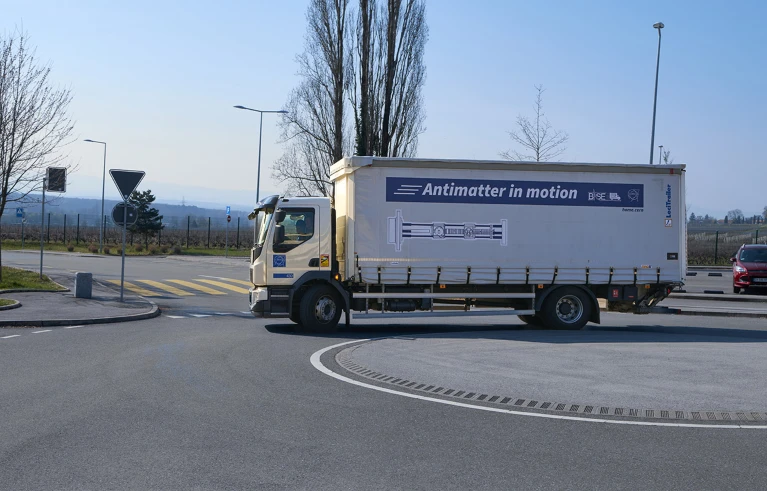
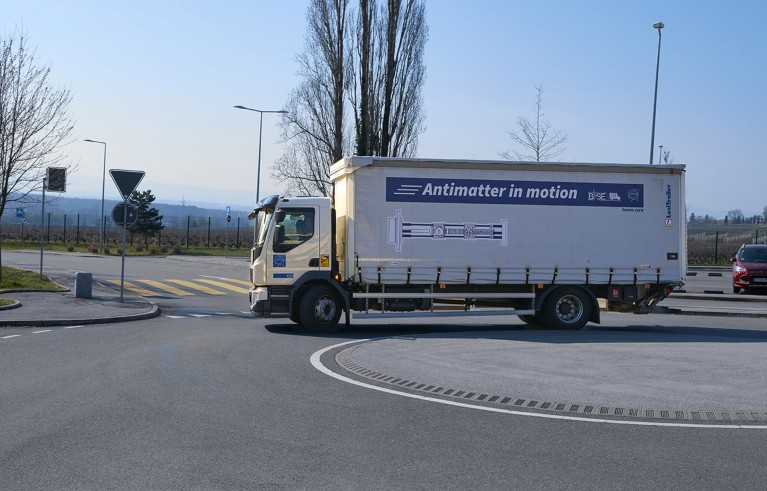
Scientists successfully transported 92 antiprotons in a truck around CERN, Europe’s particle physics laboratory, using specialized bottles which prevent contact with matter.Credit: CERN
Antimatter is matter’s equal and opposite. If the two meet, they annihilate each other, turning entirely into energy. This makes it incredibly difficult to store or move antimatter.
On 24 March, a team at CERN, the European particle-physics laboratory near Geneva, Switzerland, transported 92 antiprotons in a specially designed bottle that traps the particles using magnetic fields. The bottle travelled on the back of a truck, taking a 30-minute journey around the lab’s site.
The experiment’s ultimate goal is to take the antiparticles to a location free of experimental noise, where antiprotons can be studied with greater precision than is possible in the CERN ‘antimatter factory’ where they are created.
CERN is the only place in the world that produces usable quantities of antiprotons. Many staff members turned out with their mobile-phone cameras to capture the truck as it travelled more than 8 kilometres around the site, reaching a maximum speed of 42 kilometres per hour.
“It is something humanity has never done before, it is historic,” says team member Stefan Ulmer, a physicist at Heinrich Heine University Düsseldorf (HHU) in Germany. “We bought a lot of champagne, and we invited the entire antimatter community to celebrate with us today.”
Antimatter can be used to study other phenomena, such as the structure of radioactive nuclei, or researched itself to unravel some of the Universe’s deepest mysteries. Physicists who created the antimatter factory more than 30 years ago dreamed that someday it might be possible to transport the material, says Christian Smorra, a physicist at the HHU who led the project. “Now it’s finally possible.”
“This is a great technological achievement,” says Tara Shears, a physicist at the University of Liverpool, UK. Antimatter is the most fragile type of matter there is, so storing it, let alone driving it around CERN, is “a technological marvel”, she says.
“I love the idea of CERN becoming the Deliveroo [a food-delivery company] of antimatter,” she adds.
Antiparticles are like their ordinary counterparts, except with their charge and magnetic properties reversed. Although matter is abundant, antimatter occurs naturally only very rarely. No one knows why this disparity exists, when both should have been created in equal amounts during the Big Bang.
CERN makes antimatter by colliding beams of protons into a dense metal, then using electric and magnetic fields to slow and capture the antiprotons that emerge. Most particles are lost in the painstaking process.
Simulation of matter–antimatter creation on quantum platforms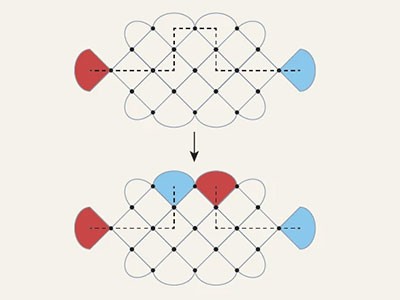
To develop a portable trap for the particles in which they never touch the matter-containing sides, scientists had to power a superconducting magnet system and use cryogenics to cool it to a chilly −269 °C. The bottle had to be kept in a high vacuum to stop antimatter from meeting any stray matter particles and being annihilated on the way; all the kit had to withstand the forces of the journey in a truck. The team installed a detector, which meant they could check on the antiprotons from the driving seat.