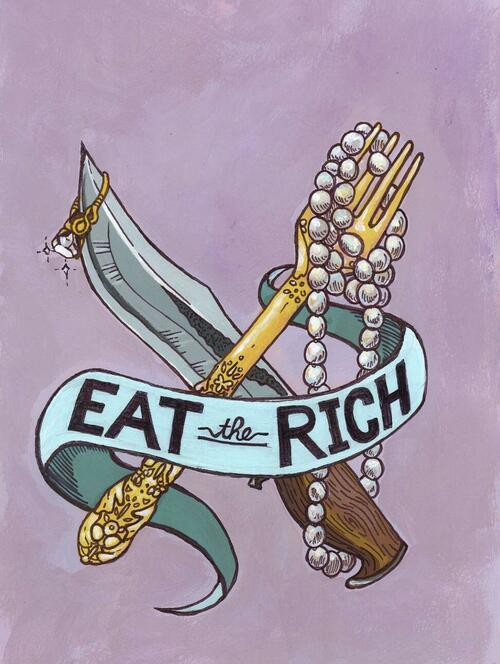
“Enough is enough.” With those words, Senator Bernie Sanders (I., Vt) launched a push to impose a 5% annual wealth tax on America’s billionaires. With Rep. Ro Khanna (D., Cal.), the legislation, “Make Billionaires Pay Their Fair Share Act,” echoes the growing “eat-the-rich” mantra on the left — seeking to replicate a disastrous push in California that has led to an exodus from that state and an estimated loss of $2 trillion in taxable assets.

It is also flagrantly unconstitutional.
Under the plan, Congress would target 938 billionaires to tap them for $4.4 trillion. That money would then be redistributed as a $3,000 direct payment to every man, woman, and child in a household making $150,000 or less – $12,000 for a family of four.
The timing of the move is telling. Not only is it calculated before the midterm elections, in which the Democrats hope to retake power, but it follows the push by California Democrats and unions to impose a similar wealth tax in that state.
Khanna, who represents Silicon Valley, has supported the state law, which includes a ruinous provision for startup entrepreneurs. The law would not only be retroactive to try to trap wealthy taxpayers who have fled the state, but also base wealth calculations on the voting shares of corporate executives. Often, with start-ups, entrepreneurs hold greater voting shares than actual ownership. However, just in case they need more incentive to leave the state, they will be taxed as if their voting shares represented actual wealth.
The practical problem is that the wealthy, like their wealth, are mobile. As a result, many are fleeing California. So now Khanna is joining with the nation’s leading Democratic Socialists to ensure there is nowhere to hide in the United States. For billionaires in California, they could be double-tapped for ten percent of their wealth.
It has long been the dream of the far left. Years ago, Sen. Elizabeth Warren delighted Democratic voters in her run for the presidency by telling the rich she was coming after “your Rembrandts, your stock portfolio, your diamonds and your yachts.” In one debate, she dramatically rubbed her hands together after saying she would take some of the wealth of fellow candidate John Delaney, a self-made millionaire.
In my book, “Rage and the Republic: The Unfinished Story of the American Revolution,” I discuss the growing threat of “economic factionalism” as politicians fuel rage against the wealthy based on the false premise that they are not “paying their fair share.” While there are good-faith arguments for adjusting tax burdens to address budget demands, the top 1 percent pays more taxes than the bottom 90 percent combined.
There is little reason to believe that a wealth tax targeting billionaires will not, if upheld, be later extended to lower tax brackets, starting with multimillionaires. That is the signature of economic factionalism, which feeds an insatiable appetite for greater wealth seizure.
The Sanders-Khanna plan is notable in its express commitment to direct wealth redistribution. It also explains why the left has made the packing of the Supreme Court a priority. As Harvard professor Michael Klarman explained years ago, the radical agenda to change the system to guarantee Republicans “will never win another election” requires control of the Supreme Court to uphold such measures.
The problem is that the Constitution bars the implementation of such a federal wealth tax. When the 16th Amendment was ratified, it allowed for federal income taxes, and only income taxes: “The Congress shall have power to lay and collect taxes on incomes, from whatever source derived, without apportionment among the several States, and without regard to any census or enumeration.”
The effort to expand federal taxation beyond income taxes will require either a constitutional amendment or an enabling, packed Court.
Nevertheless, these politicians will continue to dangle wealth distribution before voters. They will demonize figures like Mark Zuckerberg and Elon Musk for their wealth while ignoring that these same figures are wealth and job creators, driving our economic growth. Instead, Sanders declared that “Billionaires cannot have it all.”
The irony of Rep. Khanna (who has been floating a run for President in 2028) turning on his own constituents in Silicon Valley underscores the appeal of wealth-redistribution campaigns. He is turning the very heart of his state’s economic growth as state deficits and out-of-state migration increase.
For Sanders, the legislation is a key moment to advance his long-standing socialist agenda. He declared the beginning of the end of “unprecedented income and wealth inequality” in the United States through such redistribution. The stated objective of erasing wealth inequality highlights how this is just the start and the end of wealth taxation.
As discussed in Rage and the Republic, none of this is new. Countries like France previously targeted the wealthy, triggering an exodus of taxpayers and their businesses from the country. It had to reverse its policy as the economy collapsed.
Of course, many young people have no memory of such failures in the 20th Century. Instead, they are drawn to the very same soundbites used in France and Great Britain before disastrous experiments with socialism. With no experience with socialist economies, figures like socialist mayor Zohran Mamdani can entice voters to “the warmth of collectivism.”
There are legitimate concerns over the glaring and growing wealth gap in the United States. However, a wealth tax is neither a constitutional nor a practical way of addressing the problem.
Jonathan Turley is a law professor and the author of the New York Times bestselling “Rage and the Republic: The Unfinished Story of the American Revolution.”