Authored by Matthew Vadum via The Epoch Times,
U.S. Supreme Court Justices Brett Kavanaugh and Ketanji Brown Jackson clashed on March 9 over the court’s various emergency orders that have allowed President Donald Trump to pursue his policy agenda.
The setting was a federal courtroom in the nation’s capital, at an annual lecture honoring former federal judge and prosecutor Thomas Aquinas Flannery, who died in 2007.
Kavanaugh, who was appointed by Trump in 2018, and Jackson, who was appointed by President Joe Biden in 2022, discussed the high court’s emergency docket, also known as the interim relief docket and the shadow docket, which refers to applications that seek immediate action from the justices.
Such cases are handled on an expedited basis, with limited briefing and generally without oral argument.
Often, the orders that follow are unsigned and provide little or no reasoning, though sometimes justices will file concurring or dissenting opinions.
The issue in emergency appeals is often whether a policy being challenged in court should be allowed to take effect while litigation that could take years to complete plays out.
Lower courts have stifled Trump’s policy agenda, issuing order after order blocking aspects of it. The second Trump administration has increasingly turned to the Supreme Court for emergency relief, and that court has often provided it by lifting those orders.
For example, in U.S. Department of State v. AIDS Vaccine Advocacy Coalition, on Sept. 9, 2025, the court granted a Trump administration request to temporarily withhold about $4 billion in foreign aid funding previously authorized by Congress.
On Nov. 6, 2025, in Trump v. Orr, the court allowed the Trump administration to enforce its policy requiring the sex designation on a U.S. passport to be consistent with the passport holder’s sex at birth.
The court has also issued emergency rulings upholding redrawn congressional maps in Texas and California.
On Dec. 4, 2025, in League of United Latin American Citizens v. Abbott, the court allowed a new election map that is expected to increase Republican representation in Texas’s U.S. House delegation.
On Feb. 4, in Tangipa v. Newsom, the court allowed California to use its newly redrawn congressional map that aims to give Democrats five extra seats in the upcoming midterm elections.
Jackson, who often dissents from the emergency orders, said at the March 9 event that Kavanaugh and other conservatives on the high court who repeatedly sided with Trump in emergency rulings last year were doing a disservice both to the court and the country.

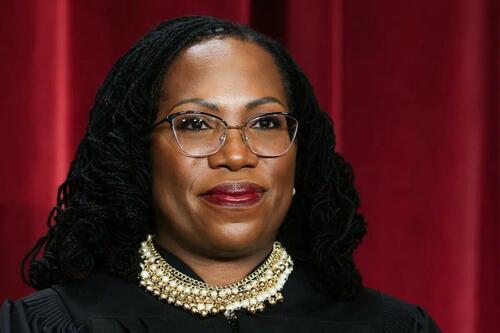
U.S. Supreme Court Justice Ketanji Brown Jackson poses for an official portrait in Washington on Oct. 7, 2022. Alex Wong/Getty Images
“The administration is making new policy ... and then insisting the new policy take effect immediately, before the challenge is decided,” Jackson said.
“This uptick in the court’s willingness to get involved in cases on the emergency docket is a real unfortunate problem.”
The Supreme Court is “creating a kind of warped” legal process by intervening at an early stage of a case and basically predicting the outcome before the arguments are developed fully, she said.
Kavanaugh said the Supreme Court is only doing its job by addressing the emergency applications filed.
The Department of Justice’s rush to the Supreme Court didn’t begin during the Trump administration, the justice said. He said that as it becomes more difficult to enact legislation through Congress, administrations “push the envelope in regulations. Some are lawful, some are not.”
Kavanaugh added that some critics of recent orders did not object when the justices allowed Biden administration policies that were being challenged to take effect even as cases about them were pending in lower courts.
Jackson reiterated a complaint that the liberal justices have made in their dissenting opinions.
“Should the Supreme Court be superintending the lower courts when they are hearing and deciding the issues?” Jackson said.
Kavanaugh, who concurred with a majority opinion criticizing lower court judges for ignoring Supreme Court rulings, said the issues for the justices are often complicated, and the cases are close.
“None of us enjoys this,” he added.

Associate Supreme Court Justice Brett Kavanaugh poses for his official photo at the Supreme Court in Washington on Oct. 7, 2022. Olivier Douliery/AFP via Getty Images
In that Aug. 21, 2025, ruling in National Institutes of Health v. American Public Health Association, the court held that the institutes could cancel hundreds of millions of dollars in research grants linked to diversity, equity, and inclusion (DEI) initiatives.
Jackson dissented in the case, arguing the ruling was arbitrary and criticizing the court majority for what she called “lawmaking on the emergency docket.”
Other justices have also criticized what they consider an abuse of the emergency docket.
Justice Sonia Sotomayor dissented in the Sept. 8, 2025, ruling in Noem v. Perdomo, which lifted a lower court order preventing U.S. Immigration and Customs Enforcement from using “apparent race or ethnicity” when deciding whether to detain a person suspected of violating federal immigration laws.
Sotomayor said the federal government engaged in “yet another grave misuse of our emergency docket.”
“We should not have to live in a country where the Government can seize anyone who looks Latino, speaks Spanish, and appears to work a low wage job,” she said.
Justice Elena Kagan dissented in the Sept. 22, 2025, ruling that temporarily upheld Trump’s authority to fire Federal Trade Commission (FTC) member Rebecca Slaughter.
Kagan said the FTC statute bars the president from removing members except for “inefficiency, neglect of duty, or malfeasance in office,” adding that the “emergency docket should never be used, as it has been this year, to permit what our own precedent bars.”
Justice Samuel Alito dissented from the April 19, 2025, order that temporarily blocked the Trump administration from deporting alleged members of the Venezuelan criminal gang Tren de Aragua.
“Literally in the middle of the night, the Court issued unprecedented and legally questionable relief without giving the lower courts a chance to rule, without hearing from the opposing party, within eight hours of receiving the application, with dubious factual support for its order, and without providing any explanation for its order,” Alito wrote.
The justices acted even though “it is not clear the Court had jurisdiction,” or authority to hear the case, he wrote.