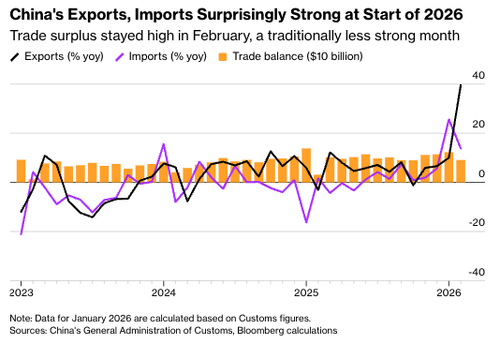
China's trade growth accelerated sharply in January-February (exports: +21.8% yoy, imports: +19.8% yoy) and came in well above consensus expectations, prompting Goldman's Rich Privorotsky to ask:
Rebounding aggressively. China exports were strong and CPI came in hot earlier in the week, prompting the question: is China done exporting deflation?
Government data showed that exports soared 22% during the period, compared with a 7.2% median estimate from Wall Street analysts surveyed by Bloomberg. Imports jumped nearly 20%, according to a statement released Tuesday by the General Administration of Customs. The trade surplus came in at $214 billion, an all-time high for the January-February period.

Notably, both months are combined to smooth out any distortions caused by the Lunar New Year holiday.
While on the face of it, one could argue that trade flows show China is becoming less reliant on the US market. Exports to the US fell 11%, while shipments to Africa surged nearly 50%. Exports to ASEAN rose more than 29%, and shipments to the EU climbed almost 28%.
This data suggests Beijing is finding alternative markets as the Trump administration's 'America First' agenda decouples from China.

However, instead of exporting to the US, China is 'trans-shipping'. Exports from China to Vietnam are soaring inversely to the decline in exports to US...

...and then Vietnam's exports to the US are soaring...

Total exports for January nearly topped $357 billion, the second-highest on record, according to Bloomberg calculations based on official data.
Société Générale SA economist Michelle Lam said surging trade volumes in China were due to strong tech product demand driven by the artificial intelligence boom.
Among major categories and in sequential terms, import value of semiconductors increased the most, followed by metal ores and products, while import value of energy goods decreased (mainly from natural gas and coal). In year-over-year terms, chip imports continued to accelerate by 40.0% yoy in January-February.

Also on the import side, Crude volumes rose sharply in January and February as Beijing amassed reserves, pre-empting Mideast risks, and analysts say it provides a strong buffer for global supply disruptions.
China imported 96.93 million tonnes of crude in January and February, up 15.8 per cent from the same period in 2025, according to customs data released on Tuesday. The value of those imports, meanwhile, fell 5.2 per cent from last year in US dollar terms.
"China was accumulating oil and gas stockpiles [earlier this year], with the market expecting the US to strike Iran," said Chim Lee, senior analyst at the Economist Intelligence Unit.
"It built on the record-breaking strong stockpiling momentum we saw in 2025."
While highly exposed to Middle Eastern oil, China has built a substantial stockpile - which Lee estimated to be around 120 days of import cover - that provides a buffer against potential supply shocks.
"China should also benefit from AI supply chain-related goods," Lam said. "That supports our view that there is no major growth risks despite modest stimulus this year, helped by export demand, with US-Iran situation risks to watch."

The trade data comes after China's consumer inflation accelerated to the highest in more than three years, while producer deflation persisted, with soft demand remaining a drag on the economy.

The positive start to the year came just before Operation Epic Fury in the Middle East upended global energy markets and commercial shipping lanes. This now poses a severe risk for the world's largest exporter as the economic fallout from an energy shock may first weigh on industry.
Zichun Huang, China economist at Capital Economics, said, "Tensions in the Middle East will push inflation higher for as long as global energy prices remain elevated."
"An extended conflict in an oil-producing region will fuel inflation, reduce room for monetary easing, and negatively affect global growth outlook — that, in turn, will affect China's exports," said Ding Shuang, chief economist for Greater China and North Asia for Standard Chartered Plc. "Given the uncertainty about how long the war will last, I think it is too early to think about stimulus. In fact, the growth target for 2026 was lowered partly to deal with an unpredictable situation like this."
The trade and inflation data come just weeks before the summit between Chinese leader Xi Jinping and President Donald Trump to discuss ways to end the trade war. A potential mega Boeing-China jet deal may suggest positive results could emerge from the upcoming meeting.
Loading recommendations...