Authored by Steve Watson via Modernity.news,
In Richmond, Virginia, a pro-Palestine mural has sparked massive backlash from Black residents, who have taken offense to the watermelon in the image, suggesting it recalls degrading stereotypes of the Jim Crow era.

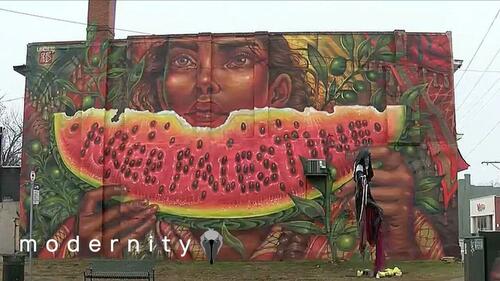
The mural, splashed across a building at the intersection of Brookland Park Boulevard and North Avenue in Richmond’s Northside—a historically Black neighborhood now facing gentrification—depicts a darker-skinned Palestinian woman holding a slice of watermelon.
The seeds are cleverly arranged to spell out “Free Palestine,” with olives and a keffiyeh adding to the symbolism. Painted by Los Angeles-based artist Lauren YS, the piece was intended as a show of defiance against what supporters call Israeli occupation.
Dr. Faedah Totah, a professor at Virginia Commonwealth University, explained the watermelon’s role in Palestinian activism. “The Palestinian flag has four colors, red, white, black, and green, which also happens to be the color of a slice of a watermelon,” Totah said. “So, what ends up happening when you ban the flag is that people become creative in finding different ways to express their national identity.” The symbol dates back to 1967, when Israel occupied the West Bank and Gaza, banning the Palestinian flag and forcing activists to get inventive.
But in this American context, the choice has landed like a lead balloon. Jonathan Davis, former president of the Richmond Crusade for Voters and the Battery Park Civic Association, remarked “I was taken aback because of the imagery that it represents, a watermelon up to the mouth of a Black woman,” Davis said. “So to me, understanding the history of our people and what happened during the Jim Crow era and how those images were used to demean us and make fun of us and ridicule us and run us out of the business, it really bothered me.”
Davis’s words capture the raw hurt felt by many in the community, where watermelon caricatures were weaponized during segregation to mock and marginalize Black Americans. It’s a stereotype rooted in post-Civil War propaganda, portraying freed slaves as childlike and obsessed with the fruit to undermine their progress.
William McGee, president of the Richmond chapter of the Southern Christian Leadership Conference, suggested reworking the mural to bridge both causes without including the ‘offensive’ imagery. Civil rights activist Gary Flowers went further, proposing to replace the watermelon with a Palestinian flag alongside a Black liberation flag. Flowers also blasted the building owner and artist for skipping community input before installing the piece.
Lauren YS, who is Chinese American, defended the work in a statement, insisting any link to racist caricatures was unintentional. The artist tied the symbols explicitly to “Palestinian heritage, nationality, longevity and steadfastness,” framing the mural as “an emblem of perseverance, solidarity, and defiance against the occupation and the horrific slaughter of over 31,000 people.”
The building owner and critics are now eyeing a town hall to hash out community feedback, potentially leading to alterations.
Your support is crucial in helping us defeat mass censorship. Please consider donating via Locals or check out our unique merch. Follow us on X @ModernityNews.
Loading recommendations...