Authored by Chase Smith via The Epoch Times (emphasis ours),
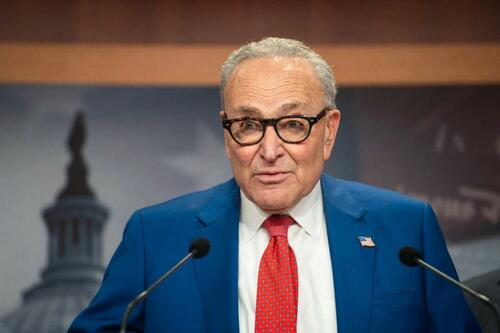
Senate Democratic Leader Chuck Schumer (D-N.Y.) and 12 other senators introduced legislation on March 5 that would force the nation’s largest meatpackers to break up their operations across beef, pork, and poultry, in the latest push in the Democratic affordability agenda heading into the 2026 midterm elections.

The Family Grocery and Farmer Relief Act would make it illegal for a major meatpacking company to control more than one type of meat, impose concentration caps on beef markets, and give the Federal Trade Commission authority to order divestitures of plants and facilities.
The bill would also bar foreign-controlled meatpacking companies, including Brazil-based JBS, from operating in the United States.
Schumer framed the legislation as a direct response to rising grocery costs, citing federal data showing a 16 percent increase in beef prices over the past year.
“The pernicious stranglehold of the meatpacking monopoly has weakened our supply chains and price gouged consumers at the grocery store,” Schumer said in a statement.
“Democrats are going to do what [President] Donald Trump refuses to do: put the affordability crisis front and center, every day, all year long.”
The bill is cosponsored by Sens. Cory Booker (D-N.J.), Peter Welch (D-Vt.), Elizabeth Warren (D-Mass.), Bernie Sanders (I-Vt.), Rubén Gallego (D-Ariz.), Jeff Merkley (D-Ore.), Brian Schatz (D-Hawaii), Dick Durbin (D-Ill.), Ed Markey (D-Mass.), Andy Kim (D-N.J.), Chris Murphy (D-Conn.), and Sheldon Whitehouse (D-R.I.). No Republican senators have signed on.
The Epoch Times reached out to the Senate Agriculture Committee to ask whether there is Republican support for the legislation but did not receive a response by publication time.
Currently, four companies control roughly 85 percent of the U.S. beef market, 67 percent of the pork market, and more than 60 percent of the chicken processing market, according to data cited in the legislation and by the White House in its own criticism of the industry. Four decades ago, the top four beef packers controlled about 36 percent of the market, according to the bill’s text.
The concentration of the meatpacking industry has drawn scrutiny from both parties. In November 2025, President Donald Trump directed the Department of Justice to investigate the Big Four meatpackers for potential collusion and price fixing, saying that “action must be taken immediately to protect consumers, combat illegal monopolies.”
Under the proposed legislation, the Federal Trade Commission would develop divestiture plans within 120 days.
A separate provision would require foreign-controlled meatpacking companies to divest their U.S. operations. It specifically names JBS, whose parent company paid more than $280 million in 2020 to settle Justice Department charges related to bribery of foreign government officials. The bill also calls for a study of other foreign-owned processors, including Chinese-owned Smithfield Foods.
The Small Business Administration would be authorized to provide loans and technical assistance to farmers’ cooperatives and small businesses looking to acquire divested facilities.
At a roundtable hosted by Senate Democrats last week, several farming and advocacy groups voiced support for antitrust action in the sector.
“Unpredictable trade policies and corporate consolidation are squeezing family farmers on one end and consumers on the other,” said Rob Larew, president of the National Farmers Union.
Joe Maxwell, president of the Farm Action Fund, said, “When the same handful of firms dominate beef, pork, and chicken, competition breaks down, leaving farmers with too few buyers and families paying more.”
Mike Callicrate, a rancher and member of Ranchers-Cattlemen Action Legal Fund United Stockgrowers of America, a cattle producers’ trade association, said it is “past time to enforce anti-trust laws and break up the meat monopolies like Congress did in the 1920s.”
The meat industry pushed back sharply. The Meat Institute, a trade association representing companies that process the majority of red meat and turkey in the United States, called the bill “absurd” and said it would raise costs, not lower them.
“If the Senator is trying to make meat and poultry more affordable for consumers, this is the wrong approach,“ said Julie Anna Potts, president and CEO of the Meat Institute. ”It will have the opposite effect.”
Potts said the bill ignores market realities, noting that the U.S. cattle herd is at its smallest level in 75 years and that beef packers have recently experienced record losses of more than $350 per head. She also questioned the feasibility of forced divestitures, asking who would have the capital and expertise to buy and operate the facilities.
“The ensuing chaos and likely significant drop in meat production will upset delicate supply and demand forces, ultimately forcing retail and food service to hike consumer prices,” Potts said.
“It comes at exactly the wrong time, when food prices are already too high for many American families.”
She said the bill “incentivizes beef and pork packing to leave the U.S. for foreign countries.”
Loading recommendations...