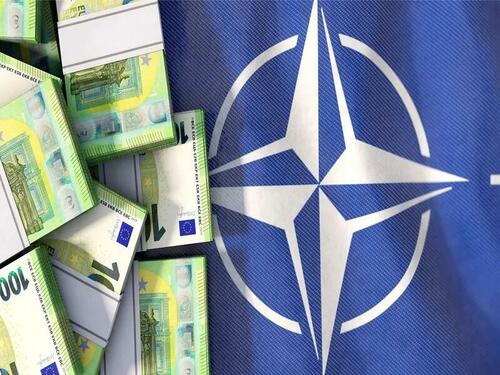
The Russian-Polish security dilemma will likely serve as the impetus for fully unleashing and properly managing the capabilities of European NATO as a whole per the US’ National Defense Strategy.

RT drew attention in late January to a report by Izvestia about the West’s alleged plans to launch a “Defense, Security, and Resilience Bank” (DSRB) by 2027. Their article relies on in-depth research by the Atlantic Council, which came up with the idea of what was at first called the “NATO Bank”. The purpose is to provide “low-interest loans for defense modernization”, thus facilitating the goal of NATO members spending 5% of GDP on defense without significantly curtailing social and infrastructure spending.
Instead of slashing such programs to redirect funds to defense at the risk of helping populist-nationalists during the next elections and/or provoking unrest, they’d only spend a fraction of the principal each year servicing their DSRB loan instead of paying the cost upfront as if it was part of their annual expenditures. The Executive Summary of the Atlantic Council’s in-depth research hyperlinked to above also notes that “An additional critical function of the DSR bank would be to underwrite the risk for commercial banks”.
This would then “enabl[e] them to extend financing to defense companies across the supply chain.” The supplementary purpose is to finance large-scale orders that these companies themselves are unable to afford on their own and most member states can’t finance either without potential populist pushback. Defense companies can then expand production, pump out the requested military-technical equipment at scale, and then sell it at a much more affordable price for accelerating NATO’s planned militarization.
The bloc’s Eastern Flank, which largely overlaps with the Polish-led “Three Seas Initiative”, is expected to benefit the most. Poland is already poised to receive €44 billion in loans from the EU’s €150 billion “Security Action For Europe” program (SAFE, which is part of the €800 billion “ReArm Europe Plan”). This should help modernize its embarrassingly underdeveloped military-industrial complex and thus enable Poland to serve as the regional core of associated processes across the rest of the Eastern Flank.
The aforesaid role would become much more likely if it and Lithuania succeed in creating a defense-centric cross-border economic zone across the Suwalki Corridor/Gap like the latter just proposed. The US National Defense Strategy assessed that “European NATO dwarfs Russia in economic scale, population, and, thus, latent military power.” This potential just needs to be fully unleashed and properly managed. Poland could pioneer the way if it allows the US to advise it on the optimal use of SAFE and DSRB loans.
It was already assessed that “Poland Will Play A Central Role In Advancing The US’ National Security Strategy In Europe” so it therefore naturally follows that it’ll play a central role in the National Defense Strategy too. Poland already spends more of its GDP on defense than any other NATO member at 4.8%, however, so anything much more might result in curtailing social and infrastructure spending, but therein lies the importance of the DSRB for enabling Poland to avert that trade-off as was explained.
Poland’s debt-to-GDP is 55.1%, which is far below the EU’s 80.7%, so it could take on more debt through these means without too much socio-political discomfort. This is feasible after Poland just became a $1 trillion economy. Any additional military spending fueled by the DSRB would further accelerate Poland’s unprecedented militarization, which has led to it having the EU’s largest army at over 215,000 troops, with plans to reach 300,000 by 2030 and half a million by 2039 (200,000 of which would be reservists).
From Russia’s perspective, this poses a serious threat to Kaliningrad and allied Belarus, ergo why it’s expected to correspondingly bolster its forces there in response. That could also include the deployment of more strategic arms to Belarus like tactical nukes, hypersonic Oreshniks, and/or whatever else it might develop by then. Such responses are in turn expected to be portrayed by Poland as the reason for its unprecedented militarization that policymakers might then demand to be sped up even further.
The Russian-Polish security dilemma, which is due to their millennium-old rivalry and the US’ empowering of Poland as an anti-Russian proxy, will likely serve as the impetus for fully unleashing and properly managing the capabilities of European NATO as a whole per the US’ National Defense Strategy. Any progress in this direction would compel Russia to keep pace with this hostile bloc’s Polish-led militarization, therefore resulting in its own continued militarization and consequently an arms race.
Unlike European NATO members which will have to take out loans to finance this, hence the purpose of the DSRB, Russia can finance everything on its own. This places Russia in a much better financial position than its adversaries, some of whom are expected to struggle with balancing their perceived military priorities with their objective socio-economic ones.
Accordingly, Russia has the edge in this impending arms race with Europe, but the EU’s potential federalization could narrow the gap if it ever happens.
Loading recommendations...