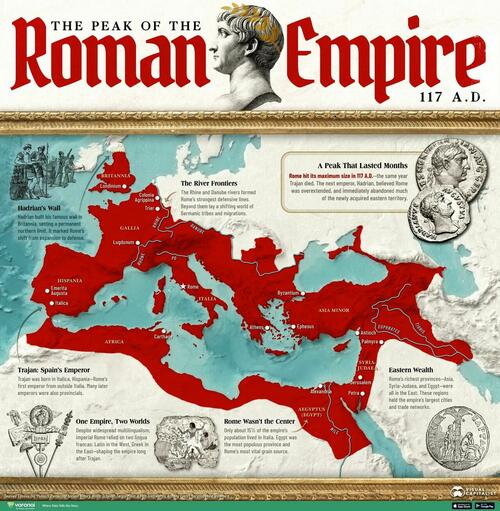
What did Ancient Rome look like at its peak in 117 AD?
The map below from Visual Capitalist shows the maximum territorial extent ever achieved by the Roman Empire, just after their successful wars in the east, where Emperor Trajan captured Dacia (Romania), Armenia, Mesopotamia, Assyria, and the Parthian capital of Ctesiphon (in modern-day Iraq).
Click on the map to expand...

As Visual Capitalist explains further, although Trajan is rated as one of the best Roman Emperors by historians and was considered one of the strongest military leaders in Roman history, the reality is that the peak he achieved was very short-lived.
We’ll dig into that and more as we explain this map, which covers one of the most interesting periods in history, leveraging classical and modern sources including Cassius Dio, Plutarch, Cambridge Ancient History, Walter Scheidel, Fergus Millar, Adrian Goldsworthy, Anthony Everitt, and Encyclopaedia Britannica.
Trajan: The First Emperor Born Outside of Italy
Trajan was born in Italica, Spain, near modern-day Seville. He was a career soldier and became an extremely competent and respected general. He was adopted as the heir to the childless Nerva, and became emperor after Nerva’s passing in 98 AD.

Once emperor, Trajan was famous for his civic investment and military expansion. He built roads, harbors, aqueducts, and the Forum of Trajan in Rome—but he also conquered distant lands decisively.
The Roman Empire at its Overextended Peak
Various limits—cultural, geographical, logistical, and administrative—seem to prevent historical empires from achieving infinite expansion.
Trajan tested these limits and eventually came upon the breaking point. Dacia (Romania) was arguably his greatest military achievement and remained a Roman province for almost two centuries after. His experiments to the East, however, were less of a slam dunk.
His battles with Parthia (the other Mediterranean superpower at the time) led to quick expansion into Armenia, Mesopotamia, and Assyria. However, these vast territorial gains were fragile:
- Supply lines were long, exposed, and costly.
- Massive revolts broke out in Judea and across the Jewish diaspora, in Libya, Egypt, and Cyprus.
- Parthia remained intact as a power, despite symbolic defeats.
In hindsight, the map captures not just Rome’s greatest triumph—but the moment it became overextended.
Could Trajan hold it together as the empire came under strain?
The End of Trajan’s Reign, and a New Imperial Strategy
Conquering territory and holding it are two very different challenges.
With troops diverted across multiple fronts, the new gains quickly started unraveling for Trajan. At the same time, now in his early 60s, his health also began to fail. As he was returning to Rome, he stopped in Cilicia (modern-day southern Türkiye), where he passed away.
Hadrian, the following emperor, immediately recognized that the empire had tested its limits and now needed to consolidate. He built Hadrian’s Wall in the UK, and abandoned most of Trajan’s eastern conquests to focus on stabilization.
Loading recommendations...