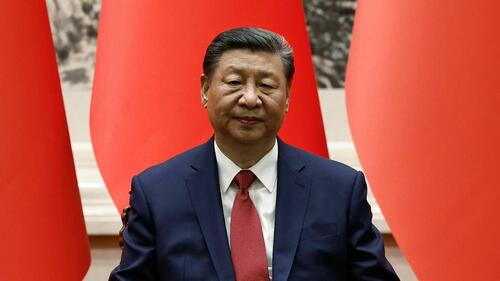
China just admitted what we've been reporting for years: the old growth engine is sputtering, and the world's second-largest economy is officially shifting into a lower gear. At the opening of the National People's Congress (NPC) on Thursday, Premier Li Qiang unveiled a 2026 GDP growth target of 4.5% to 5% - the lowest benchmark since 1991 and the first time in over three decades Beijing has dared to set anything below 5%.

The announcement came at the start of the National People's Congress, a meeting of China's leaders in Beijing's Great Hall of the People where government officials reveal economic and policy priorities for the year.
While one could point to the 2025 trade escalations and current uneasy truce (with higher duties suspended until late 2026 and a Trump-Xi summit looming March 31–April 2), China's slowdown is overwhelmingly domestic. Here's what's going on:
- Property sector implosion - The bubble that once drove 25–30% of GDP has burst and shows no signs of bottoming. Sales, prices, starts, and completions keep sliding; developers default, local governments bleed revenue, and household wealth (tied up in real estate) evaporates. This crushes consumer confidence and spending more than any tariff ever could.


- Chronic deflation - Prices have fallen for years (longest streak since market reforms), eroding profits, wages, and willingness to spend. "Involution" (cutthroat overcapacity and race-to-the-bottom competition) in EVs, solar, batteries, and manufacturing squeezes margins while flooding markets.


- Weak domestic demand - High youth unemployment, stagnant wages, a shredded social safety net (driving sky-high savings instead of consumption), and post-property trauma leave households wary. Subsidies for appliances or EVs haven't moved the needle because people aren't earning enough to spend freely.
Cooling job market and youth unemployment crisis - Urban youth unemployment (16-24 age group, excluding students) remains stubbornly elevated at ~16.5% as of late 2025, down only slightly from a record 18.9% peak amid structural mismatches: millions of new graduates flood the market each year chasing scarce white-collar and "iron rice bowl" government jobs (competition ratios hitting 100:1 in some provinces), while factories struggle with labor shortages due to overcapacity and export redirection.

- Overreliance on exports/investment - The old model is exhausted. Export redirection helped hit 5% in 2025, but structural maturation (harder productivity gains as China catches up) means diminishing returns.

That said, net exports still hit a record $1.2 trillion in 2025.

After China opened the country up to foreign investment, they grew rapidly - becoming the world's second-largest economy. Much of this growth comes from manufacturing - which included expansions in vast industrial parks, EV plants and data centers, typically financed by cheap loans from state-owned banks. The country's factories produce many of the world's electric vehicles, solar panels and lithium batteries - with carmaker BYD notably overtaking Tesla as the world's largest EV producer.
Chinese Premier Li Qiang patted the country on the back for meeting 2025 economic growth of 5% amid a "grave and complex landscape" which blended internal difficulties with external shocks. As to the new, lower target - analysts see it as pragmatic: it buys breathing room for structural fixes (boosting consumption, tech breakthroughs in AI/robotics) without the pressure to juice numbers artificially. Some skeptics (e.g., Rhodium Group) argue real 2025 growth was closer to <3%, making the official stats look even more optimistic.
According to Eurasia Group China director Dan Wang, Beijing is now willing to tolerate slower near-term growth while focusing on longer-term structural solutions, the NYT reports.
CFR senior fellow Zongyuan Zoe Liu says the lower target is "what the market and economists at home and abroad expected and know," as it allows policymakers to tackle fundamental economic problems without scrambling to hit an inflated number.
Loading recommendations...