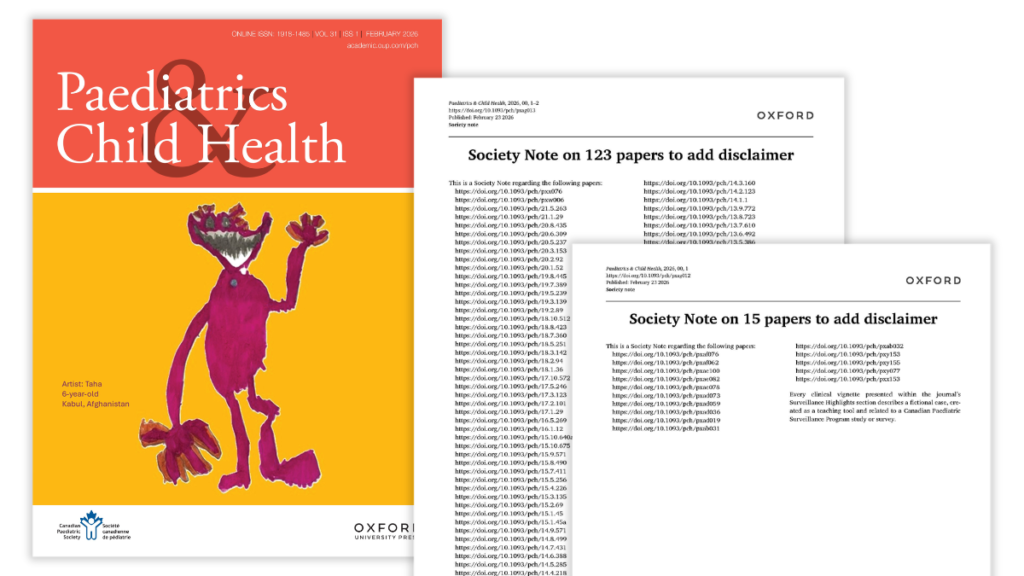
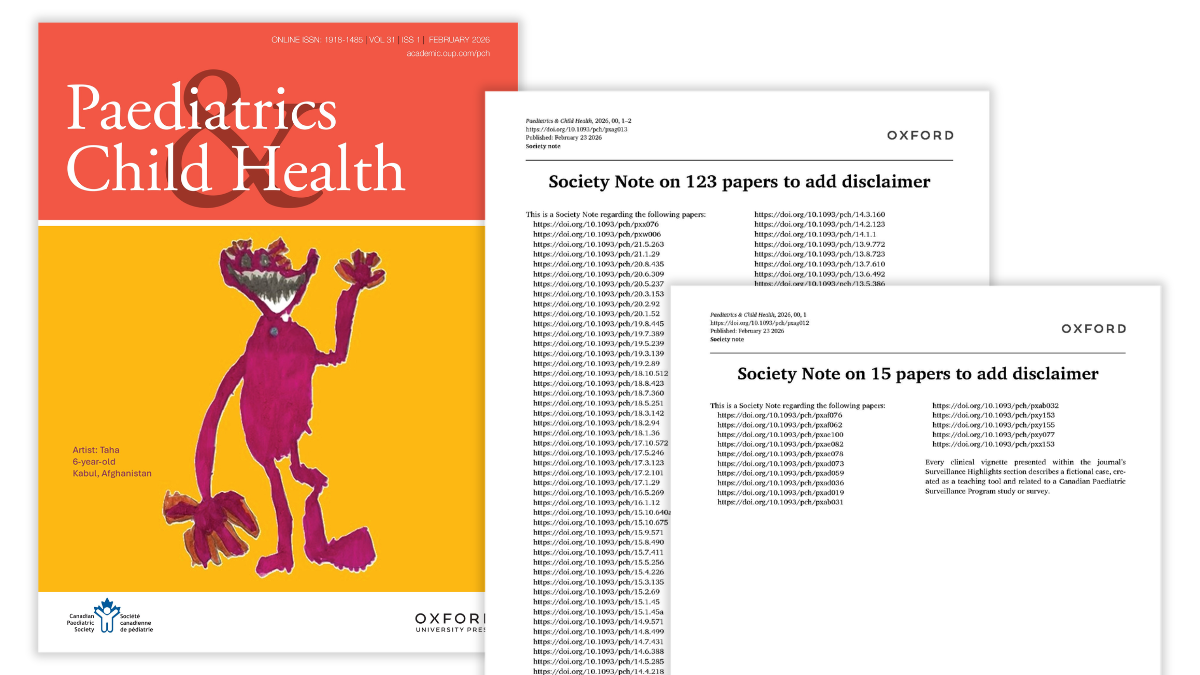
A Canadian journal has issued corrections on 138 case reports it published over the last 25 years to add a disclaimer: The cases described are fictional.
Paediatrics & Child Health, the journal of the Canadian Paediatric Society, has published the cases since 2000 in articles for a series for its Canadian Paediatric Surveillance Program. The articles usually start with a case description followed by “learning points” that include statistics, clinical observations and data from CPSP. The peer-reviewed articles don’t state anywhere the cases described are fictional.
The corrections come following a January article in New Yorker magazine that mentioned one of the reports — “Baby boy blue,” a case published in 2010 describing an infant who showed signs of opioid exposure via breast milk while his mother was taking acetaminophen with codeine. The New Yorker article made public an admission by one of the coauthors that the case was made up.
“Based on the New Yorker article, we made the decision to add a correction notice to all 138 publications drawing attention to CPSP studies and surveys to clarify that the cases are fictional,” Joan Robinson, editor-in-chief of Paediatrics & Child Health, told Retraction Watch. “From now on, the body of the case report will specifically state that the case is fictional.”
The move came as a surprise to David Juurlink, professor of medicine and pediatrics at the University of Toronto, who has spent over a decade looking into the claim that infants can receive a meaningful or even lethal dose of opioids via breast milk when their mothers take acetaminophen with codeine. The first such case, published in the Lancet in 2006 by pharmacologist Gideon Koren, was the centerpiece of the New Yorker article. (The Lancet case report now bears an expression of concern.) Koren used that case to claim for years that codeine, which gets metabolized to morphine in the body, can pose a lethal risk to breastfeeding infants.
Follow-up work by Juurlink and others has found the doses claimed in the Lancet report — as well as in two other articles, both now retracted, Koren and colleagues wrote about the case — to be pharmacologically unlikely. As the New Yorker reported, a review of the autopsy data and other evidence points to the baby having been given the pain medication directly rather than having been exposed to the drug through breast milk.
The Baby boy blue case is “the only such case study, aside from the Lancet case report and the two now-retracted descriptions of the same case in Canadian Family Physician and Canadian Pharmacists Journal,” Juurlink said. “It is the most compelling published description of neonatal opioid toxicity from breastfeeding. And it is wrong.”
Juurlink said he doesn’t think a correction is sufficient for this case in particular. “The paper should obviously be retracted,” he told us. “It’s a fictional case portrayed as real and its scientific underpinnings have collapsed, yet it perpetuates them.”
While the instructions for authors for Paediatrics & Child Health has at times indicated the case reports are fictional, that disclosure has never appeared on the journal articles themselves.
“Readers of primary source peer reviewed medical scientific journals have an absolute right to believe that the article being read is as accurate as possible, original, and factual, unless clearly specified otherwise,” said former JAMA editor George Lundberg. “‘Alternative facts,’ as popularized by Kellyanne Conway, have no place in a medical or scientific journal.”
The two corrections in Paediatrics & Child Health, which is published by Oxford University Press, cover two different names for the series that included case descriptions. Published February 23, each correction lists all the relevant DOIs and a note stating, “Every clinical vignette presented within the journal’s [CPSP Highlights section or Surveillance Highlights section] describes a fictional case, created as a teaching tool and related to a Canadian Paediatric Surveillance Program study or survey.”
The journal also submits the full text of its articles to PubMed Central, including the case studies. The versions on PubMed Central also do not bear any indication the case reports are fictional.
The surveillance highlights “are intended for paediatric health care providers or physicians in training, and include learning points that briefly translate and disseminate knowledge about the disease or condition,” Elizabeth Moreau, a spokesperson for the Canadian Paediatric Society, told us by email.
The journal decided when it first started publishing the article type “that the cases should be fictional to protect patient confidentiality,” Robinson told us. “Apart from the case that led to the recent New Yorker article, all or almost all were cases of very well recognized conditions (such as congenital syphilis, fetal alcohol syndrome, serious trauma from ATVs, hepatitis C infection) where a single case report would not generate any interest or ever be cited.”
While the journal is indexed in Scopus and Web of Science, these articles are not. However, we queried all 138 DOIs in Semantic Scholar and found 61 of them have been cited at least once. Together they have been cited 218 times.
One author of a case report was surprised to learn of the correction — because the case described in her article is true.
“My paper contained a real clinical vignette that had previously been published in a different journal and I properly referenced it,” said Farah Abdulsatar, a pediatrician at the Schulich School of Medicine & Dentistry in London, Ontario. She told us she was “very disappointed” to see her article among those listed for the correction, and she emailed the editor and the journal about it.
“The editor acknowledged that the editorial team is at fault for overlooking the fact that our case was real during the review process,” Abdulsatar said, adding that she was told correcting the correction “would be difficult.”
Neither the instructions for authors from 2010 — when Koren and his coauthor Michael Rieder would have written their article — nor the linked list of article types — state the cases are fictionalized, or fictional. A set of instructions dated 2015, and linked from the journal’s author guidelines, indicate the “clinical vignette” should “describe a fictional case.”
The main text of the journal’s author guidelines now states: “Each highlight is a teaching tool that presents a short clinical vignette describing a fictional case related to a CPSP study or survey.” An archived version from September stated, “Each highlight is a teaching tool that presents a short clinical example, from one of the studies or one-time surveys,” with no mention of fiction.
The Canadian Paediatric Society includes the articles from the Paediatrics & Child Health series on its CPSP website. That page now includes a disclaimer that every clinical vignette “describes a fictional case, created as a teaching tool.” Moreau of the Canadian Paediatric Society confirmed both the journal pages and the CPSP pages “have recently been updated.”
Regardless of the statements in the author guidelines, the fact the cases are fictional should have been conveyed to the readers of all of these articles, Juurlink said. In the case of Baby boy blue, “the article was structured as an authentic clinical case, indexed as such, and cited as an actual clinical observation. Readers had no way of knowing it was fictional,” he said. “A narrative that is fictional but published in the format of a genuine case report, without disclosure at the time of publication, is functionally indistinguishable from fabrication in the scientific record.”
Medical Evidence Project director James Heathers contributed citation data for this article.
Like Retraction Watch? You can make a tax-deductible contribution to support our work, follow us on X or Bluesky, like us on Facebook, follow us on LinkedIn, add us to your RSS reader, or subscribe to our daily digest. If you find a retraction that’s not in our database, you can let us know here. For comments or feedback, email us at [email protected].
Processing…
Success! You're on the list.
Whoops! There was an error and we couldn't process your subscription. Please reload the page and try again.