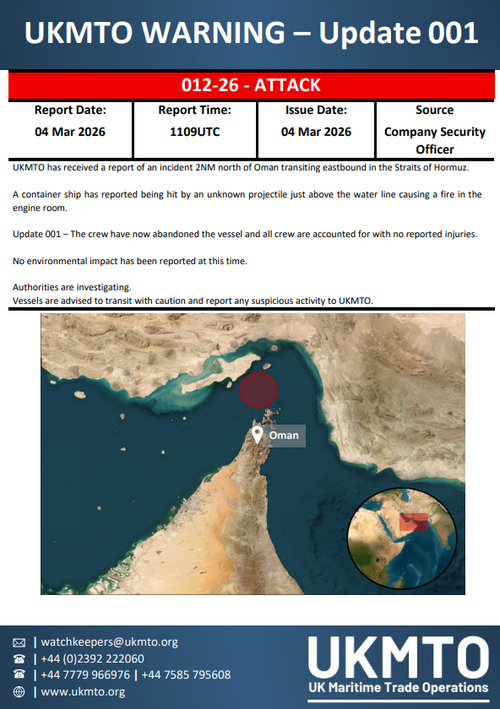
This morning has been very active on the maritime security front. The latest incident involves a container ship that was struck by a projectile while transiting the Strait of Hormuz.
United Kingdom Maritime Trade Operations reports that a container ship about two nautical miles off Oman, transiting eastbound through the critical and narrow waterway, was "hit by an unknown projectile just above the waterline, causing a fire in the engine room."
"The crew have now abandoned the vessel and all crew are accounted for with no reported injuries," the maritime security center wrote in an update on X.

UKMTO's alert did not identify the container ship by name, but there are currently three transiting the paralyzed waterway. We suspect that the vessel hit was "Safeen Prestige," though there is no official confirmation.

Latest maritime incidents we are tracking:

UBS analyst Cristian Nedelcu provided clients with a clearer picture of the logistical nightmare unfolding due to disruptions in the Strait of Hormuz:
Rising uncertainty, however a potential prolonged disruption could push rates up
We note that since the end of November, the EU logistics and shipping sector share prices were up on average ~18%, outperforming Stoxx 600 by ~5%. We believe this mainly reflects expectations for an improvement in the European and US economies in 2H 2026. In the context of the escalation in the Middle East, a potential prolonged and significant increase in oil prices could represent a headwind to demand raising question marks around global freight volume growth going forward.
Nevertheless, we believe a potential prolonged disruption could also bring upwards pressure on ocean and air freight rates on some routes. We believe a scenario of continuous disruption in the Strait of Hormuz and Middle Eastern air space would bring upwards pressure to ocean and air freight rates touching Middle East and Asia-Europe, with potential for temporary incremental profits for ocean carriers, dedicated freighters operators (DHL Express), and increased complexity that could lead to some benefits for freight forwarders operating on these routes.
A potential prolonged disruption could lead to upwards pressure on ocean rates
According to CTS c.3.5% of global container capacity is using the Strait of Hormuz. In particular, the large transshipment hub Jebel Ali could be affected. In a scenario of prolonged closure of the Strait of Hormuz or capacity restrictions it is likely that cargo would be moved via alternative transhipment hubs leading to potential congestion in other major transhipment hubs. The few services passing through the Red Sea have been directed back to Cape of Good Hope leading to further small declines in effective container capacity to reflect longer voyages. Altogether we expect this could lead to upwards pressure on ocean rates, mainly on: i) routes touching Middle East/Indian subcontinent (c.13.8% of global container according to Linerlytica); ii) on Asia-Europe (c.24.5% of global container movements). According to Linerlytica, Maersk and Hapag Lloyd deploy circa 15% of total container capacity to routes touching Middle East/Indian subcontinent and ~25% of capacity on Asia - Europe routes. Zim deploys circa 3% of capacity on routes touching the Middle East and 15% on Asia - Europe.
Prolonged potential constraints at Middle Eastern airports could push rates up
Air space closure during this weekend for Middle Eastern airports also brings disruption for air freight touching the Middle East or air freight transiting from Asia to Europe. According to IATA, Middle Eastern carriers operate circa 13% of global air freight capacity while Asia - Middle East represents 7.4% of cargo tonne km transported globally and Middle East - Europe 5.7% (in 2024). In a scenario of prolonged disruption, we expect to see upwards pressure on air freight rates for routes touching Middle East and Asia-Europe. In a scenario of capacity constraints for passenger/cargo flights at Middle Eastern airports, we expect constraints related to freedom of the skies agreements and longer distance journeys to lead to a reduction in effective capacity.
In particular, we believe owners of dedicated freighter capacity (DHL Express) are likely to benefit as cargo flows are redirected. Air cargo will also become an alternative for some of the ocean cargo impacted by the disruptions. Increased complexity of moving cargo may bring benefits for large freight forwarders that have access to capacity. Looking at direct exposure to Middle East we note - DSV recognised 7% of 2025 Group EBIT from MEA region and 36%/42% of air /ocean volumes on Asia-Europe; DHL recognised 5.3% of FY24 revenues in Middle East/Africa.
The latest and most critical maritime incidents and developments over the last 24 hours:
Expect more maritime attacks. Also, supply chain snarls could materialize.
Loading recommendations...